
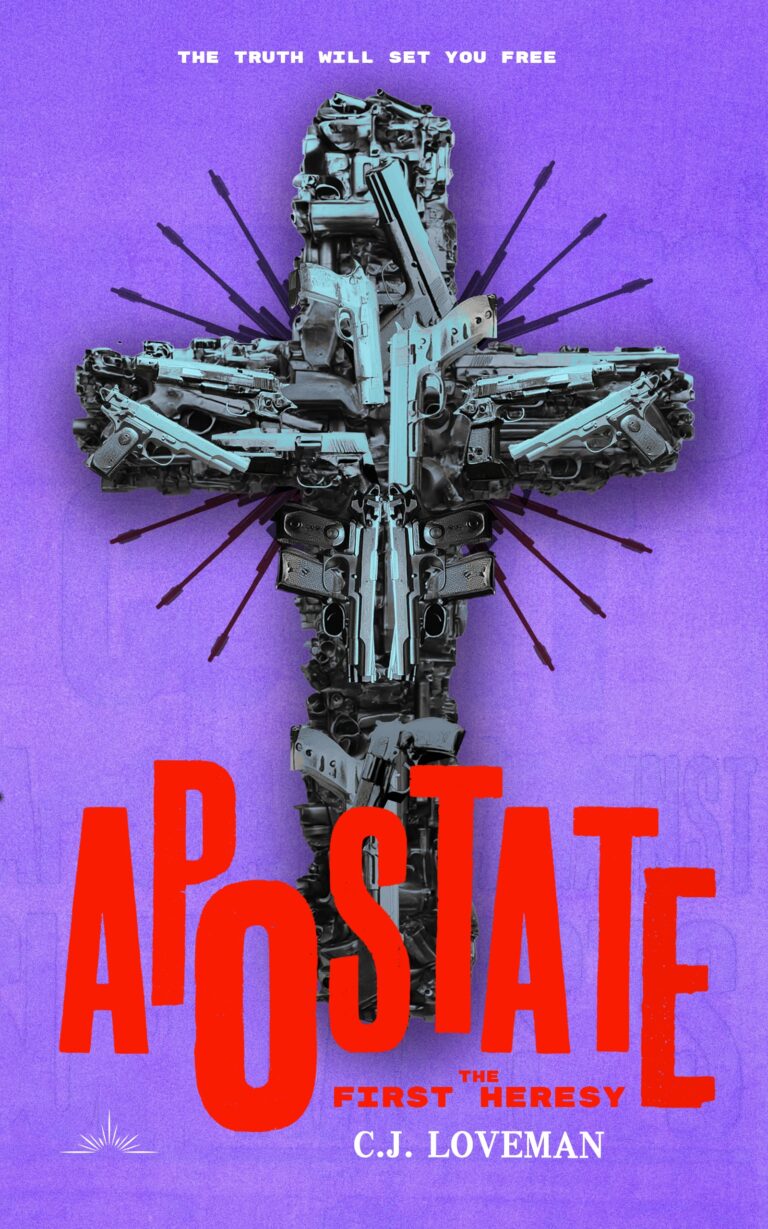

Reminiscent of George Orwell’s 1984, the world of C.J. Loveman’s APOSTATE: The First Heresy feels terrifyingly dystopian and disturbingly plausible. It is a world where state-controlled media and propaganda posters indoctrinate the masses into a system that demands total conformity, where the morality police and the intelligence service will publicly and brutally rebuke anyone who dares to dissent, and where the Church itself has become “the Whore of Babylon” (a biblical symbol of malevolence and corrupted religious authority).
The book’s greatest strength lies in its thematic depth. Through Calvin—a disgraced minister cast out of the Church after admitting he’s gay—Loveman explores the cost of living authentically in a system that equates personal truth with heresy. Based on the author’s bio, one can imagine this almost autobiographical examination to speak on a very personal level to readers who grapple with the same questions.
APOSTATE: The First Heresy is the first introduction to Calvin’s world, launching the protagonist’s resistance against the status quo. Much like his namesake—16th century theologian John Calvin, a key figure in the Protestant Reformation—the protagonist undergoes a reawakening of purpose and a redefining of faith that sets the spark of rebellion into motion. While the theme is multilayered and profound and holds great emotional impact, the execution falters in places and doesn’t always match the weight of its ideas. The scenes can be somewhat disjointed and the timeline of events confusing. The world, although painted in stark dystopia, would have benefited from more tangible demonstrations of its existence—rather than through the filter of Calvin’s internal monologue.
With such an important message to convey, Loveman has perhaps skimped a bit on plot and character building. The protagonist is, unfortunately, fairly one-dimensional; his overpowering need for acceptance is his key characteristic. In the meantime, other characters remain merely on the periphery of the narrative. These limitations flatten the narrative and blunt the impact of its central conflicts.
For readers drawn to dystopian fiction with strong thematic intent, APOSTATE: The First Heresy is a thought-provoking opening to what could become a more compelling series of future installments that deliver richer storytelling.
C.J. Loveman’s APOSTATE: The First Heresy provides a glimpse of the change that can be sparked when someone finds the courage to live authentically and share the message with a world hungry to break free from oppression. Its thematic weight is undeniable.
~ Suneé Jones for IndieReader