
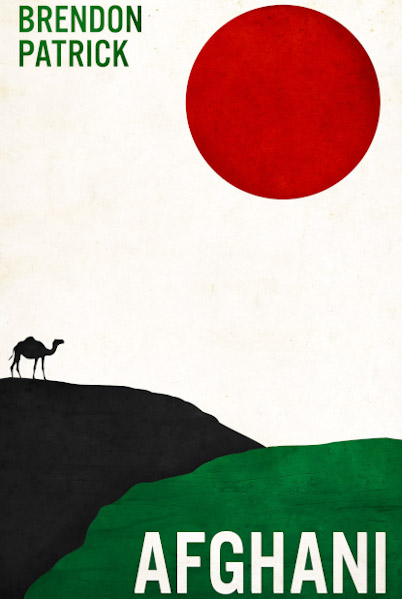

Patterson is seventeen when he enlists in the Australian Army because “it was that, or pushing trolleys.” The nihilistic young man who narrates half of Brendon Patrick’s AFGHANI grows angrier and more resistant to authority as he learns about Australia’s true motives in joining the so-called War on Terror. The book’s second narrator, George Sher Gul, is a Muslim camel shepherd who escapes imprisonment in Afghanistan in the early 20th century and migrates to Australia, where white people’s stereotyping and racism smother his attempts at building a successful, happy life. These alternating stories are both foils and mirrors of each other, exposing the tyranny of capitalism and imperialism and its developing intensity over time. Its poignancy is timely, too.
The book does not shy away from the visceral details of war, including sweat, blood, vomit, and excrement, bolstering emotion and empathy with both main characters. Minor characters, though—friends, villains, and love interests alike—lack distinct personalities as the narrative is laser-focused on George and Patterson’s introspection. Additional sensory details evoke despair and awe in turn, aiding in the expression of George and Patterson’s biases and changing feelings, as when the “brown clouds of dust climbed high, billowed out and blanketed the blue sky” in Afghanistan, which juxtaposes with “the deep turquoise-blue sea … the burnt orange sunsets and red sands shaded by lush green canopies” of Australia.
The chapters are very short, making the whiplash between the alternating perspectives hard to endure as the story’s pace hurtles ever forward. The casual, misanthropic voices of the two first-person narrators are at times hard to discern from one another. After it’s announced that Australia is going to war, the following chapter begins with “God. What a mess, I thought,” a line that belongs to George rather than Patterson, though it could be spoken by either. Also, “I wasn’t fixing to be no whipping boy. And my only shot at escaping with my brains intact would require nothing short of good old-fashioned skulduggery” is not the voice of an early 20th century Afghan. In moments of darkness and brutality, the unrelenting sarcasm and caustic wit are more grating than engaging. Occasional brief chapters that offer an omniscient perspective on the history of the region maintain the book’s sardonic voice. Explanations of little-known treaties and openings of universities and organizations reveal the depth of the author’s research in writing this book, which is laudable and helps make the book worth recommending despite its flaws.
Well-researched and biting in its geopolitical commentary, Brendon Patrick’s AFGHANI is a stirring, breakneck-paced historical novel with a strong voice.
~ Aimee Jodoin for IndieReader