
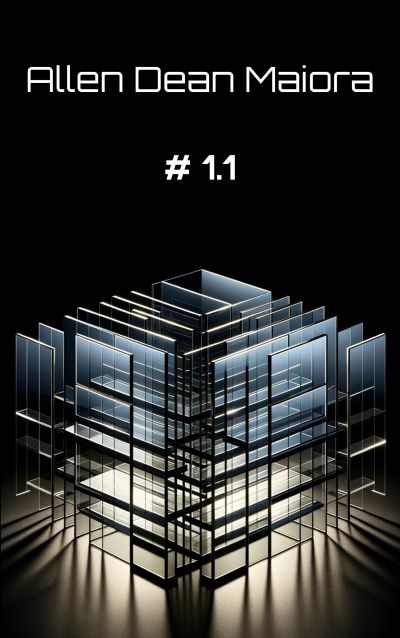

Beginning with the first paragraph of #1.1, Allen Dean Maiora instantly brings the reader into a setting that feels as much like a sensory experience as a story. The main character drifts through a darkness that is physically tangible: a soft but coarse material that feels like it fills all the empty space around his body. This sensation of floating while still being attached to something sets the tone for the remainder of the narrative and foreshadows the ways in which the boundaries of perception and reality will become distorted throughout the novel.
The protagonist eventually leaves this ethereal world behind and returns to what should be a normal life: working in an office, having a family (a wife and son) at home, chatting with colleagues and friends. However, as soon as he settles back into his "normal" life, fissures begin to appear. He finds that he cannot move when waking from sleep, he's unable to explain where large amounts of time have gone missing, and he on occasion sees the world as if everything were drawn using software. While these events create unease within the reader, they are used to explore and study the theoretical concepts surrounding memory, awareness, and whether or not someone may live in a simulated reality. The recurring idea that the character is a "replica" of himself gets explored throughout the entire novel.
Maiora is very interested in examining and studying large themes. In many cases, chapters stop to explore and discuss how technological advancements could either alter or destroy identity, as well as the fragility of our human sense of time. These explorations add an intellectual layer to the narrative, though they do slow down the story's pace. Readers seeking consistent tension and suspense may find themselves waiting for long periods for the next disturbing event to occur. On the other hand, readers who prefer to read contemplative science fiction may appreciate how the author allows each of the events to generate ripples of philosophical territory.
There are some rough edges to the book. The secondary characters (the protagonist's family and co-workers) are portrayed very lightly and serve primarily to further isolate the protagonist from society. Even so, the narrative delivers memorable scenes: objects sinking into a gelatinous black sea, memories jolting away like overcharged circuits. Those images linger and lend weight to the central questions about selfhood and reality. Readers who enjoy speculative fiction that favors thought over action will likely find value here.
In the end, #1.1 is an intriguing blend of psychological drama and science-fiction that offers more than simple thrills—even if it sometimes meanders.
With vivid imagery and the willingness to probe complex ideas, #1.1 by Allen Dean Maiora stands out as a thought-provoking, if imperfect, entry in speculative fiction.
~ Felix Metiagi for IndieReader