
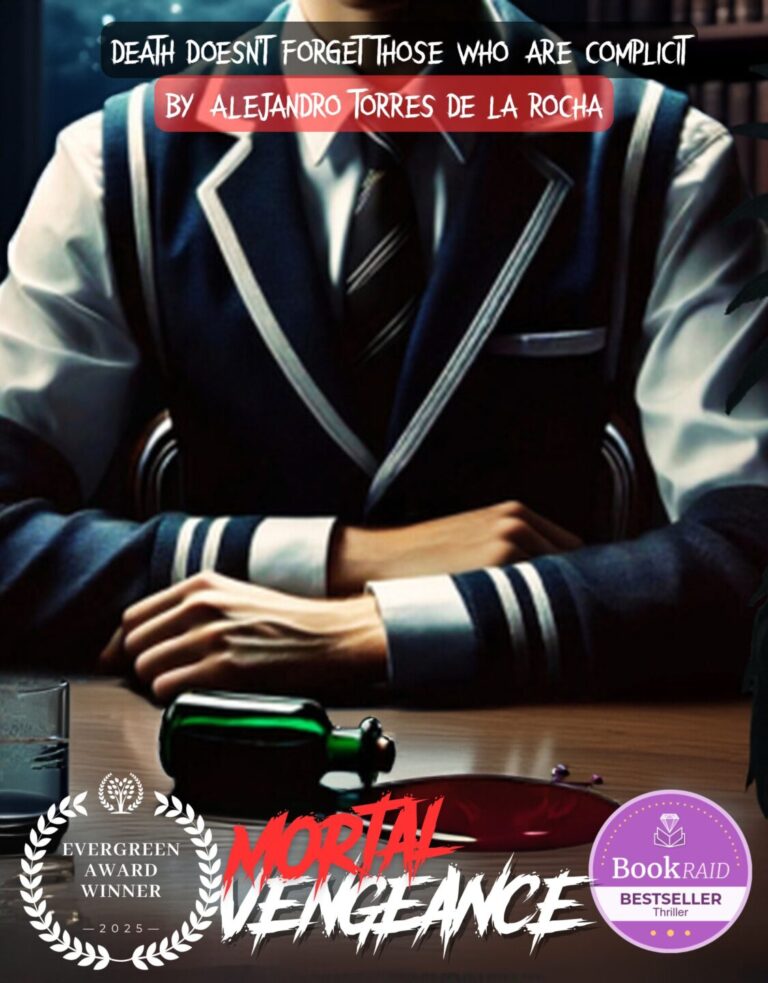
 MORTAL VENGEANCE
Winner of the 2026 IndieReader Discovery Awards in YA Horror, Fiction
What’s the book’s first line?
“The ceiling fan spun lazily, stirring the thick, hot air of the classroom like a spoon in a bowl of stale soup.”
What’s the book about? Give us the “pitch”.
Logline:
When a revenge plot against a sadistic teacher spirals into disaster, a tight-knit group of Dominican high school friends becomes the target of a masked killer who turns their secrets, guilt, and betrayals into a deadly social-media spectacle.
Synopsis:
In the suffocating heat of a strict Dominican high school, a fractured group of friends decides they have endured enough of Profesora Lourdes’s cruelty. What begins as an act of teenage rebellion quickly goes horribly wrong, leaving them trapped in the aftermath of a choice none of them can undo.
As guilt spreads through the group, so do suspicion, paranoia, and old resentments. Then something far worse emerges from the shadows: The Grim Cojuelo, a masked figure inspired by Dominican carnival folklore, who begins hunting them with theatrical precision and a taste for exposure.
The killer does not simply want revenge. He wants every buried lie, betrayal, and act of cowardice dragged into the light for an audience eager to watch the fallout unfold.
As the group unravels, manipulative Alex and grief-stricken Melissa are forced to confront a terrifying question: what happens when friendship is built on loyalty, silence, and shared guilt? In Mortal Vengeance, no one is entirely innocent, and survival may depend on which secrets are still worth protecting.
Why It Works
Mortal Vengeance blends the blood-pumping suspense of a 90s teen slasher with the voyeuristic cruelty of modern social media. The horror is not just in the killer’s weapon, but in the way violence becomes content, trauma becomes entertainment, and guilt becomes impossible to hide.
At its core, this is a story about a rotten friend group finally being forced to face itself. The Grim Cojuelo may be the monster chasing them, but the deeper horror is what they have done to one another, what they have allowed, and what they chose not to stop.
Set against the oppressive heat and cultural texture of Santo Domingo, the novel brings dark academia into a Caribbean world of Catholic-school pressure, social hierarchy, folklore, and silence. It is stylish, brutal, funny, emotionally messy, and deeply uncomfortable in all the right ways.
What inspired you to write the book? A particular person? An event?
Mortal Vengeance was born from a potent mix of 90s pop culture, Dominican teenage rage, and a literal, wonderfully petty act of revenge.
In 1999, I was a frustrated fifteen-year-old in Santo Domingo who had just failed freshman Spanish at a strict Jesuit school. My parents didn’t just ground me. They confiscated the TV and the phone cable. That meant no dial-up internet, no escape, and, tragically, no Nintendo 64 to soften the blow. Stranded in a house full of disappointment and emotions I didn’t yet know how to name, I turned that isolation into fuel.
I started writing. What began as a movie script about fictional characters paying for fictional sins eventually became the earliest version of this novel. It was powered by the very teenage belief that revenge could somehow restore balance. Writing became a healthy alternative to getting blood on my hands, which, in hindsight, was excellent branding for a future thriller writer.
Creatively, the story was shaped by the sharp dialogue and psychological warfare of Kevin Williamson’s Scream, I Know What You Did Last Summer, and Teaching Mrs. Tingle, mixed with the dark, genre-blending energy of Joss Whedon’s Buffy the Vampire Slayer. Those stories taught me that horror could be funny, cruel, stylish, and deeply human all at once.
Years later, revisiting the manuscript as an adult forced me to look more honestly at the emotional extremes that shaped its creation, including patterns connected to borderline personality disorder. What started as a revenge fantasy became something more complex: a story about guilt, silence, and the terrible things people allow when speaking up feels inconvenient, dangerous, or socially costly.
The Grim Cojuelo grew out of that same emotional and cultural foundation. Inspired by Dominican carnival folklore, specifically the Diablo Cojuelo, he is more than a masked slasher. He represents guilt, judgment, spectacle, and consequence. He is the monster born from everything a community tried to ignore.
Ultimately, transforming that raw childhood anger into Mortal Vengeance became its own kind of psychological reset button. The book let me take something painful, dramatic, and frankly ridiculous in the way only adolescence.
What’s the main reason someone should really read this book?
Mortal Vengeance blends the addictive, nostalgic suspense of classic 90s slashers with the morally messy, hyper-realistic friend drama of Euphoria. It infuses a distinctly Dominican setting with dark humor, intense psychological tension, and a monster that isn’t just chasing people—it’s exposing everything they tried to bury.
What makes the story stick is that these teenagers aren’t archetypal victims or villains; they are beautifully, frustratingly flawed. Their jealousy, fiercely toxic loyalty, and cowardice all feel incredibly real. Every single character had a chance to stop the domino effect, and watching them choose to look away until it’s entirely too late is genuinely chilling.
Furthermore, it does what very few thrillers achieve: it roots its horror deeply in Dominican culture and folklore without ever exoticizing it. The Grim Cojuelo isn’t a gimmick—he is a symbol of what happens when a society teaches people to keep their heads down, and the silence finally shatters. It’s a book for readers who want a thriller that entertains, unsettles, and then quietly leaves them with a haunting question: “So… what would you have done?”
What’s the most distinctive thing about the main character? Who-real or fictional-would you say the character reminds you of?
Alex is the most distinctive and unsettling character in the book because he refuses to fit neatly into the category of hero or villain. His defining trait is contradiction. He is brilliant, charming, volatile, funny, wounded, strategic, and emotionally reckless, often all in the same breath. He wants control more than peace, attention more than comfort, and love more than he knows how to safely receive.
What makes him compelling is that his intelligence is constantly at war with his emotional intensity. He can read a room with frightening precision, understand exactly what people want, and still sabotage himself at the worst possible moment. He has the instincts of a chess player and the nervous system of someone standing in a burning building.
Alex’s greatest flaw is spectacular self-sabotage. He can build something fragile and beautiful, place it carefully on the highest shelf, and then kick the whole structure down before anyone else gets the chance to take it away from him. Beneath the tactical exterior is a boy terrified of abandonment, desperate to matter, and furious at the idea that the world might keep moving without him.
That tension makes him both magnetic and deeply frustrating. You root for him, resent him, pity him, and occasionally want to shake him by the blazer. He is not designed to be easily loved, but he is designed to be understood, which is far more dangerous.
In terms of comparisons, there is a heavy streak of Tom Ripley in his velvet charm and clean hands, and a shadow of Heathcliff in the way love and destruction become tangled together. The closest literary parallel, though, might be Holden Caulfield if Holden had real friends, life-or-death stakes, and catastrophic consequences. Alex sees through everyone, including himself, but that clarity does not save him from his own spiral.
When did you first decide to become an author?
I use the label “author” on LinkedIn, but I don’t think there was ever a single, cinematic moment where I stood up and decided, “This is who I’m going to be.” Writing simply found me long before I fully understood what it was doing for me.
I started writing as a teenager to manage a well of pent-up anger and intense emotions I didn’t know how to verbalize. At that age, I was terrified to say certain things out loud, so the page became my release. It gave me a way to navigate what I was feeling without destroying myself or anyone else in the collision—which, looking back, was a surprisingly healthy coping mechanism.
But it was never purely about pain; I have always been deeply in love with the mechanics of storytelling. Fiction entertains us, yes, but more importantly, it lets us dissect human behavior. It lets us ask why people hurt each other, why they choose silence, why they pursue justice, and why they so easily mistake revenge for healing. Writing became the only sandbox where I could explore those patterns—both in others and in myself.
Is this the first book that you’ve written?
Yes, this is my first novel. I wrote a wealth of short stories when I was younger, most of which have since been lost to time, dramatic teenage chaos, and a few dead hard drives. But Mortal Vengeance is my first fully realized, completed work of fiction.
While I’ve spent my professional life navigating the corporate world, writing has always woven through my life in different iterations. This novel marks the first time I have taken the creative habits I developed in my youth and fully committed them to a long-form literary project.
What do you do for work when you’re not writing?
I’m a marketer with over fifteen years of experience spanning a bizarrely beautiful range of industries—including travel, home décor, digital marketplaces, SaaS, online communities, customer service, and even frozen-food manufacturing solutions. My career has always been driven by an insatiable curiosity about consumer psychology: how people think, behave, make decisions, and ultimately connect with one another.
That same curiosity is why I am a serial academic. I hold Master’s degrees in Public Relations and Corporate Communications, Advertising, Business Intelligence and Innovation Technology, and UX/UI Design, and I’m currently pursuing another in AI Consulting and Implementation.
At this point, I have collected so many postgraduate degrees that He-Man may genuinely need to surrender his title as Master of the Universe.
In reality, my professional background feeds directly into my fiction. Marketing taught me how to dissect consumer motivation, manipulate tension, and understand deep human desires. Writing psychological thrillers simply allows me to take that exact corporate toolkit and deploy it in darker, messier, and far more honest ways.
How much time do you generally spend on your writing?
An immense amount, though, when I am deep in the creative vortex, I completely lose track of the clock. I let the narrative take over and write for as long as the story’s pulse keeps coming. I know it will require heavy revision later, but during the initial stage, I refuse to interrupt the flow. The first draft is strictly about capturing the story while it’s still alive.
Writer’s block consumes an entirely different kind of time, and it is far more exhausting. Even when I actively step away from the desk and tell myself to stop, the subconscious machine doesn’t shut down. My brain continues circling the manuscript in the background, hunting for the missing structural piece or dissecting why a specific scene fell flat.
There is also a massive amount of invisible labor that doesn’t look like traditional writing but absolutely is: plotting trajectories, mapping character psychology, and tracing the invisible threads that connect the cast. You are never truly away from the book.
Ultimately, the drafting takes time, but the editing takes forever. If writing is where I allow the story to take possession of me, editing is where I walk back into the room with a scalpel to make sure it actually makes sense.
What’s the best and the hardest part of being an indie?
The best part is absolute creative control. I’ve written Mortal Vengeance and its prequel, A Grim Tale, and there are structural elements in both that likely would not have survived a traditional publishing filter unchanged. They explore dark, heavy territory, and I try to approach those subjects with as much care and tenderness as possible. Even though I write fiction, I am acutely aware that for some readers, these experiences are a lived reality. Because of that, I refuse to sensationalize trauma for cheap shock value. Being indie allows me to protect the integrity, tone, and delicate balance of the narrative. That freedom is non-negotiable.
The hardest part is the sheer lack of resources, and by that, I don’t just mean capital, though money is a massive hurdle. I mean access. Independent authors lack the institutional pipelines to major distribution channels, physical bookstores, and the deeply entrenched industry connections that systematically push a book into the spotlight.
Professional editing alone is an immense upfront expense. I am not diminishing the vital role editors play; their work is absolutely essential, but for an independent writer without deep pockets, funding production entirely on your own before a single copy sells is a staggering financial gamble.
Hitting publish isn’t the finish line; it’s the start of a grueling second job. Suddenly, you aren’t a writer: you are a marketing coordinator running Amazon campaigns, managing social media ads, organizing giveaways, and chasing reviews, all while trying to build visibility without becoming the person everyone mutes on Instagram.
It is an exhausting mental game. You sit there watching the numbers update: sales units, KDP pages read, rankings, engagement metrics. Sometimes there is a beautiful spike in traction. Sometimes there is dead silence. Sometimes a reader buys the book and vanishes. And sometimes, you finally secure a hard-won review, only to realize it isn’t the glowing, five-star masterpiece your delusional little author heart was secretly expecting.
It takes an undeniable psychological toll. But it also builds a rare brand of resilience. You learn to celebrate the micro-victories, adapt instantly, and maintain a fierce belief that your story deserves shelf space. You keep pushing, because at the end of the day, no one is ever going to fight harder for your book than you.
What’s a great piece of advice that you can share with fellow indie authors?
Trust your instincts and protect your story. If possible, don’t let anyone read a single page until you have a complete first draft. Feedback is vital, but timing is everything. When people read fragments of an unfinished manuscript, everyone has an immediate opinion: “This character needs to change,” “their motivation is thin,” “this scene doesn’t connect to the plot,” “you need to explain this right now.” Sometimes they are right. But more often, they are simply reacting to a setup that hasn’t had the chance to pay off yet.
Premature feedback forces you to second-guess yourself before the book has even found its own voice. It yanks you out of your creative skin. My advice is simple: finish the draft first. Let the characters breathe, allow the structure to reveal itself, and let the book speak. Once the skeleton is fully built, invite critique, listen carefully, and be ruthlessly honest about what serves the narrative and what doesn’t. But until then, do not let outside voices start rearranging the furniture while the house is still under construction.
Furthermore, never confuse market convention with quality. Study your genre inside and out, master the tropes, and then deliberately choose which ones actually serve your vision. Carve out your own specific style. Let the narrative be strange if it needs to be strange. Let it be long if the length is earned. Let it be deeply messy in the exact places where human behavior is messy.
If the primary criticism you receive is “this genre isn’t usually written this way,” treat that as a victory. It means you aren’t being generic; it means you are telling a story only you could write. This isn’t an invitation to ignore valid notes; it is a call to protect your boundaries. Never mistake an industry’s comfort zone for your creative limit.
Would you go traditional if a publisher came calling? If so, why?
I mean, they’re calling—but what exactly are they offering? Are they calling about Mortal Vengeance? Are they looking to acquire the series as it stands, or do they want entirely new stories? Those are fundamentally different business conversations. I certainly wouldn’t hang up on them. I also wouldn’t spit in their faces, because apparently that is still frowned upon in corporate settings. I would absolutely listen.
I’m not dogmatically anti-traditional publishing. The institutional advantages are undeniable: sweeping distribution infrastructure, dedicated marketing machines, physical bookstore placement, and global reach that is incredibly difficult to replicate as an independent creator. That caliber of structural backing is meaningful. But the fine print dictates everything.
If their interest lay in Mortal Vengeance, I would need absolute certainty that they understood the nuances of the narrative: the dark psychological themes, the Dominican cultural tapestry, and the delicate emotional architecture of the characters. I am always open to rigorous collaboration, but I am entirely closed to sanding down edges until a story becomes safe, flat, or generic.
If they were calling to commission entirely new manuscripts, that could be an exciting venture. But again, it would hinge completely on creative autonomy. I would need to know whether an editor genuinely wanted my distinct voice or was simply looking to rent my labor. So yes, I would take the call and listen intently. But I would ask a battery of very difficult questions before handing anyone the keys to the kingdom.
Is there something in particular that motivates you (fame? fortune?)
Sure. Fame, fortune, world domination—who wouldn’t want those things at least a little bit? The delusion is very real, but properly reined in. Are fame and fortune my primary drivers, or even a realistic expectation in this industry? Absolutely not.
My actual motivation is far more intimate: I want to share stories with people who might connect with them, enjoy them, or feel deeply seen. My goal is simply to publish the kind of books I desperately want to read—narratives that are intense, emotional, unapologetically messy, entertaining, and profoundly human. I am driven by the idea that a reader might recognize a fragment of their own soul in a character, a fractured relationship, an internal conflict, or even a terrible, destructive decision.
Fiction has a strange, almost miraculous capacity to validate our hidden spaces. It can pull someone out of isolation or act as a mirror that helps them decipher their own behavior and the motivations of those around them. That kind of quiet, subterranean connection matters infinitely more to me than commercial prestige.
Although, for the record, if fame and fortune happened to fall directly into my lap, I certainly wouldn’t shoo them away. So HBO, Netflix, Disney: my line is open. Let’s talk.
Which writer, living or dead, do you most admire?
This might sound like a standard pageant answer, but it is a fiercely honest one: I admire anyone who managed to tell their story despite a world designed to keep them silent. I admire creators who carved narratives out of whatever tools they had on hand—quills, typewriters, stolen notebooks, borrowed time, fear, rage, and raw imagination. Across history, writers have been mocked, censored, exiled, institutionalized, or executed simply because their words made the powerful uncomfortable.
I revere a vast, disparate pantheon: Jane Austen, Federico García Lorca, Oscar Wilde, Mary Shelley, James Baldwin, Toni Morrison, Miguel de Cervantes, Reinaldo Arenas, and Stephen King. They represent different eras, different worlds, and entirely different battles—but the unbreakable thread connecting them is that they wrote anyway.
I admire Jane Austen because she mapped human psychology with terrifying precision. Her prose seems elegant and restrained on the surface, but underneath that veneer lies a razor-sharp autopsy of class, money, gender, and survival. She could completely dismantle an entire social hierarchy with a single sentence—and still make it sound polite.
I admire Federico García Lorca because his work feels simultaneously beautiful and incredibly dangerous. He forced poetry, folklore, forbidden desire, and systemic violence to live in the exact same room. Beneath his lyricism, there is an unbearable atmospheric pressure: families suffocating under tradition, individuals crushed by expectation, and lives destroyed for reaching outside the boundaries.
Lorca’s execution in 1936, at the dawn of the Spanish Civil War, renders his legacy devastatingly heavy. His death remains inseparable from the danger faced by creators whose very existence threatens totalitarian systems. I admire him because his work is a permanent reminder that art can be powerful enough to terrify those who depend on silence to survive.
I admire the subversives who used the page to fight, to confess, to disturb, and to expose hypocrisy. I stand with those who wrote stories that their contemporaries labeled improper, dangerous, vulgar, too dark, or simply too much. Those are the artists who command my deepest respect: the ones who chose to pick up a pen when silence would have been infinitely safer.
Which book do you wish you could have written?
The Bible.
Not because I think I could improve it, obviously—I’m dramatic, not insane. But as a masterclass in raw storytelling, symbolism, contradiction, and psychological weight? Look at the themes: fear, faith, guilt, power, systemic betrayal, brutal punishment, redemption, sweeping family drama, poetry, and literal apocalypse. Come on. That book has range.
Whether approached as scripture, literature, history, or mythology—or a volatile combination of them all—it has unilaterally shaped art, global politics, language, legal frameworks, and human behavior for millennia. That level of pure narrative architecture is almost impossible to comprehend.
Also, strictly from a commercial publishing perspective, the market reach is unparalleled. Phenomenal word of mouth. Unbeatable long-term sales.
And a terrifying fandom.