
An Open Book with Matt Allcock
Awarded 4+ stars and the IndieReader Approved seal—here’s what the author has to say.
About the Book
In 150 words or less, give us your back-jacket summary — what’s this book about?
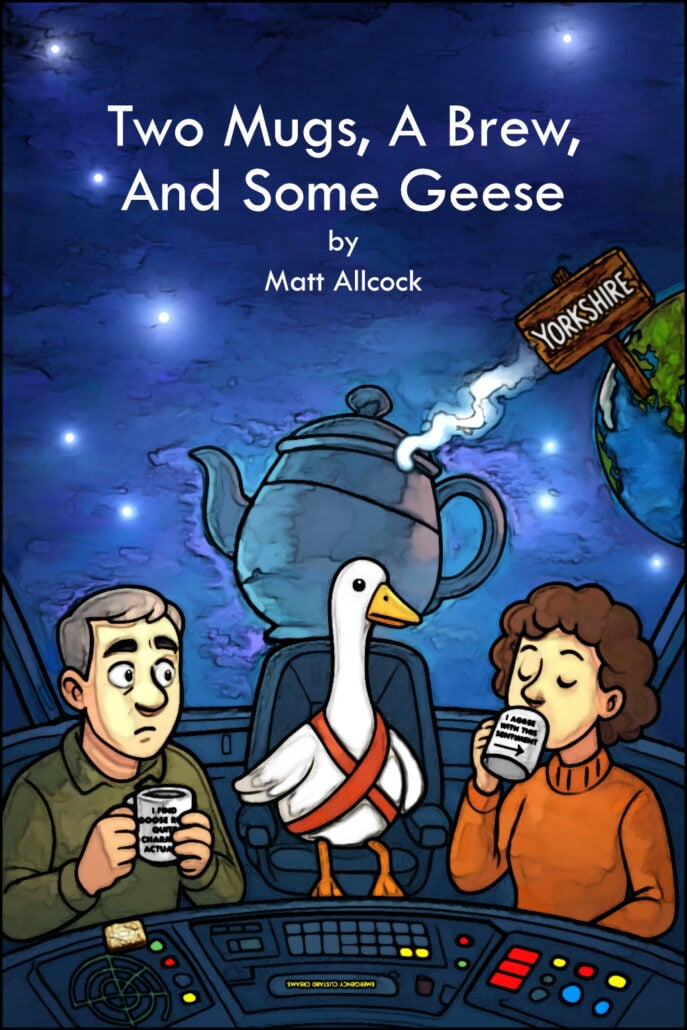
When the geese came for the bread, humanity didn’t stand a chance. When mutated geese came for the planet, Colin and Margaret did what any sensible Brits would do: they put the kettle on.
Now, armed with a couple of thermoses, one suspiciously indestructible potato salad, and the sheer power of mild irritation, they find themselves dragged from a quiet park bench in York to the farthest reaches of the cosmos.
Alongside Geoffrey, a goose of uncommon arrogance and surprising political influence, they must face hostile alien waterfowl, interdimensional honking, a teapot the size of Yorkshire, and the most terrifying enemy of all: a cliffhanger that might never be resolved tidily.
Can the universe be saved with a hot brew and a spatula?
Possibly.
Will Margaret ever eat Colin’s potato salad?
Absolutely not.
What’s the book’s first line?
“Every story ever written contains some semblance of truth, especially nonsense stories about mutant geese and mugs of tea.”
What inspired you to write this book?
Oddly enough, a mental breakdown.
I suppose it’s a good thing that what emerged on the other side wasn’t something dark or cynical, but a hopeful, optimistic comedy. Writing became the perfect way for me to process this difficult period. It just so happened that, somewhere along the way, my subconscious decided that a mutant goose apocalypse, told from the perspective of two indifferent, tea-obsessed almost-pensioners, was the ideal vehicle for doing that.
Once I’d nailed Colin and Margaret’s voices, their dynamic, and the tone of the story, the rest was an absolute joy to write.
Make the case — why should someone read this book?
Because of its sense of fun. From the outset, my aim was to write a fast-paced, absurd comedy packed with eccentric characters, ridiculous situations, and more geese than any sensible book should reasonably contain.
As a Brit with a lifelong love of comedy, the story wears many of its influences on its sleeve. At its heart, though, it’s a book that doesn’t take itself too seriously with the goal simply to entertain. If readers find themselves laughing at the absurdity of it all whilst they become unexpectedly invested in the fate of its characters, then I couldn’t be happier.
Share a line from the book you’re particularly proud of.
“Forms had piled up, committees had formed to discuss the forms, subcommittees had been created to monitor the committees, and before anyone could stop it there were directors, deputy directors, assistant directors, and assistants to the assistant directors.”
About the Author
When did you first decide to become an author?
It’s been an ambition of mine for a long time, although many of my early novel drafts never made it beyond the halfway mark. Given my background in archaeology and heritage, most of those unfinished projects were historical dramas, while others explored genres I was passionate about, such as science fiction and horror.
What I hadn’t seriously considered writing was comedy.
That was slightly odd, because it’s a genre I’ve always loved, particularly that distinctly British blend of satire, parody, and sketch humour. Until this book, I’d never actually sat down with the express goal of writing something funny, so it was heartwarming to discover that other people shared my slightly unhinged sense of humour.
What else have you written?
According to my ‘other works from the author’ list, absolutely nothing! That’s not quite true. I had a short story published in an anthology when I was eleven and some poetry published during my time at college. I’ve started more novel drafts than I care to admit, most of which have remained unfinished. This is simply the first one that’s managed to successfully escape into the wild.
What do you do for work when you’re not writing?
I’m actually an archaeologist (honestly, that isn’t a joke). I work in a local government heritage team and hold a BA in Archaeology and an MSc in Digital Archaeology. I’ve spent years working with heritage data, which probably explains why writing about mutant geese invading the planet felt like a refreshing change of pace. I also once failed at becoming a spy, but that’s another story…
What does your writing process look like?
Notes. Lots and lots of notes. I carry notebooks everywhere, but on the occasions where I don’t, I’ll often jot ideas down on my phone whenever inspiration strikes. Quite often I’ll write scenes as if they were from a play, complete with stage directions and dialogue, before I later convert them into prose. It’s a slightly chaotic system, but it seems to have worked thus far!
What does being an indie author mean to you?
For me, it’s been incredibly freeing. Given that I started writing the book during a difficult time, it became a meaningful creative outlet and a source of great enjoyment. Having previously worked in desktop publishing and design, I also loved diving into every aspect of the process, from writing and cover design to learning the ins and outs of self-publishing. There’s something very satisfying about creating a book entirely on your own terms.
What do you wish you’d known before you published?
The importance of building an audience before publication. Beyond a handful of close friends and family members, I did not have any ARC readers lined up and underestimated how important those early reviews would be. Publishing the book proved to only be half the challenge, finding readers after the fact turned out to be an entirely different one.
What’s a great piece of advice you can share with fellow indie authors?
Don’t be afraid to make your work personal. Drawing on your own lived experiences gives stories texture and authenticity, even when those experiences seem ordinary to you. The small details of everyday life often make characters feel real. Readers connect with honesty far more than perfection.
And, for the record, I can neither confirm nor deny any personal involvement in a goose apocalypse…
What are you reading right now?
I’m a lifelong James Bond fan, having worked my way through all of Ian Fleming’s original novels in my youth and yet I’ve only recently started exploring the continuation books. At the moment I’m reading Raymond Benson’s adaptation of Tomorrow Never Dies.
What’s next for you?
Most of my energy has been spent on getting the word out about this book, but I am already toying with ideas for its sequel. I’ve already started digitally painting a cover and I’ve been gathering my notes and sketching out where the story might go to next. In fact, to leave the door open, I made a point of secretly teasing the potential sequel’s title in this first book.
This post may contain affiliate links. This means that IndieReader may earn a commission if you use these links to make a purchase. As an Affiliate, IndieReader may make commission on qualifying purchases.