

An Open Book with Jonathan M. Bryant
Awarded 4+ stars and the IndieReader Approved seal—here’s what the author has to say.
About the Book
In 150 words or less, give us your back-jacket summary — what’s this book about?
Atlanta: July 1939
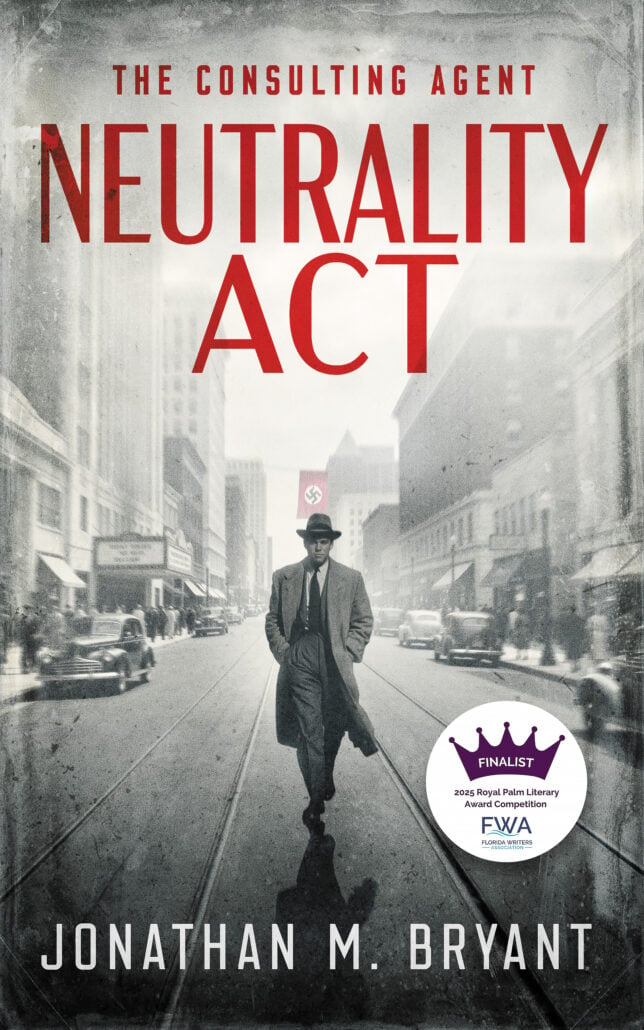
Broke, divorced, and disgraced, Mark Morgan takes a job that seems too good to be true. A mysterious Rabbi pays him a fortune to protect a visiting delegation of German Baptists. A simple job, until the threats turn real, the police turn brutal, and the bodies start piling up.
As Atlanta bakes under the bright July sun, Mark plunges into darkness. Entering a shadowy world of Klansmen, corrupt police, and spies, he uncovers a plot to twist American politics. If the scheme succeeds, fascism will gain a firm foothold in the United States.
Hunted by a phantom killer and suspected by the authorities of murder, Mark’s cynical commitment to neutrality is the only thing he has left. But in a city where no one is who they seem, neutrality may be the most dangerous choice of all.
What’s the book’s first line?
“I should have spotted the black Oldsmobile earlier.”
What inspired you to write this book?
I’m an academic historian. Years ago, I came across a photograph of Peachtree Street in Atlanta, Georgia, taken in July of 1939. It showed a very busy street with a Nazi flag hanging over the traffic. Figuring out what this meant eventually led me to think of a crime and espionage novel set in Atlanta just before World War Two broke out in Europe. You can learn more about this and see the photo in an essay on my website.
Make the case — why should someone read this book?
Because it’s fun and interesting. Neutrality Act can be read on two levels.
The most straightforward level is that of a noir espionage novel, like those by Alan Furst or Joseph Kanon. A down-on-his-luck Mark Morgan is sucked into ever growing danger as a war in the shadows rages around him. Meanwhile, he begins to build an investigative partnership with Emma Connor that threatens to grow into romance. It’s an enjoyable, fast-moving story with plenty of twists and turns, and it sets us up for future books with the same characters.
On a second level, the novel is a meditation upon the nature of social and political change in a particular historical time and place. Atlanta, on the cusp of massive growth and change, is very much a character in the story.
Share a line from the book you’re particularly proud of.
Whoa, you work on the book so much that you have many babies of which you are proud. But this one was pretty good:
“Odors disturb you too much, Mother often told me. The odor outside of Tub O’Brian’s blind pig was, however, disturbing.”
About the Author
When did you first decide to become an author?
When I was in college, a creative writing professor did a terrible thing; he told me I had “promise.” Soon after, I wrote some short stories and a truly bad western. Then, Law School and a Ph.D., meaning I had to write a lot.
As a history professor, I published books, chapters, articles, and reviews, so I was constantly writing. Then, because of the pandemic, I retired from my university. The big decision loomed. Could I completely shift gears, leave my platform as a historian, and write fiction? So, while I’ve been writing most of my life, writing fiction with the intent of publication is a relatively new thing.
What else have you written?
Many reviews, articles, and book chapters as a professional historian. Two history books, How Curious a Land (U.N.C. Press, 1996) and Dark Places of the Earth: The Voyage of the Slave Ship Antelope (W. W. Norton, 2015), which was a finalist for the Los Angeles Times Book Prize in History.
As a fiction author, a short story, Merchandise No. 5, and a novella, Blue Nude in Lowcountry Crime: Four Novellas, edited by James M. Jackson (Wolfs Echo Press, 2017). Neutrality Act, the first in The Consulting Agent series (English Street Books, 2026), and coming October 1, 2026, The Slaver’s Apprentice (Northampton House Press).
All of the books are available on Amazon or through Ingram and booksellers that use Ingram.
What do you do for work when you’re not writing?
I retired in 2021, so I now do a lot of volunteer work and speaking. I’m on the Board and a Trustee of the Amelia Island Museum of History. I’m also on the Board of the Amelia Island Book Festival and the Member Enrichment Committee at my local club. You get the idea.
What does your writing process look like?
For fiction, I research a particular event in depth, perhaps something I already knew about but not in enough detail. By putting together the story of a particular time and place, ideas for interesting tales begin to bubble up. I try those out, often sketching out the idea on paper, sometimes even building a storyboard. That said, I know that as soon as my characters start interacting, they will drag the story in completely unexpected directions. So, while I may start as a “plotter,” pretty soon I’m flying by the seat of my pants, trying to document what my characters are doing, seeing, smelling, tasting. Once the first version of the story is done, it turns from fun to work. Proper revision and editing are a grind, but absolutely essential to a good book.
What does being an indie author mean to you?
Surprisingly, while I had an agent as an author of history, I could not get an agent as a fiction author. I suspect I don’t present the “package” they think might bring a six-figure advance, and when you are working for 15 percent, that’s an important consideration. So, I decided to avoid that issue by self-publishing.
This also threw me fully into all aspects of the publication process, which was fun. For several years, I was associate editor at a history journal, so I had some idea of the publication process, but doing it all yourself is much more complex. I bought the ATTICUS program so I could format my work correctly. I tested things out when the rights to Blue Nude came back to me, throwing it up on Amazon KPD in 2023. From that, I learned I needed professionals to help. So, for Neutrality Act, I paid two different copy editors and found a good cover designer. By the end of 2025, I was ready to try it again, fully enjoying being in control.
I would have self-published The Slaver’s Apprentice, but then a small traditional press wanted it. The future volumes of The Consulting Agent series, however, will be independently published.
What do you wish you’d known before you published?
How lasting a modern book can be. How Curious a Land just celebrated its 30th birthday. It is still in press and still selling. That is truly remarkable, a result of the technological changes that made print on demand and e-books possible. But, I have no control over that book, and so can not change prices, improve the blurb, make marketing decisions, etc. The same is, of course, true of all my traditionally published books.
But, as an indie author, you are always in charge.
Therein lies a pitfall. When you publish on KDP, IngramSpark, or other sites, you have to pick categories and keywords for your books. I wish I had known more about that process and about choosing the best category for your book’s success. Once it enters the Amazon machine, it will change and modify your categories in mysterious ways, and not always to your book’s advantage.
What’s a great piece of advice you can share with fellow indie authors?
Cover, cover, cover. People may not judge books by their covers, but if you dig into the marketing data, the cover sells the book. If you are well known, just your name on the cover sells the book. If you have great testimonials on it, that may sell the book. Otherwise, you are down to the image and the presentation. In fact, I knew this was so important that in a recent book contract with a traditional press, I made sure I had a role in the creation and acceptance of the book’s cover.
What are you reading right now?
I’m one of those crazy people who read several books at a time. For history, I’m reading Liquat Ahamed’s Lords of Finance, a stellar account of the role of bankers in the Great Crash and Depression of the 1930s. For fiction, the late C. J. Sansom’s Tombland, the seventh book in his Shardlake historical novels set in Tudor England. Finally, I just finished a stunner, Kevin Powers’ new book, Children of the Wild. Read it, it will knock your socks off. He truly accessed his inner Hemingway.
What’s next for you?
I’m halfway through writing Cash and Carry, the second novel in The Consulting Agent series. Northampton House Press has asked me to do a sequel to The Slaver’s Apprentice, and doing the concept work suggests it will become a trilogy. A couple of teaser short stories are in the works. And, of course, a book launch in Savannah for The Slaver’s Apprentice in October.

This post may contain affiliate links. This means that IndieReader may earn a commission if you use these links to make a purchase. As an Affiliate, IndieReader may make commission on qualifying purchases.