
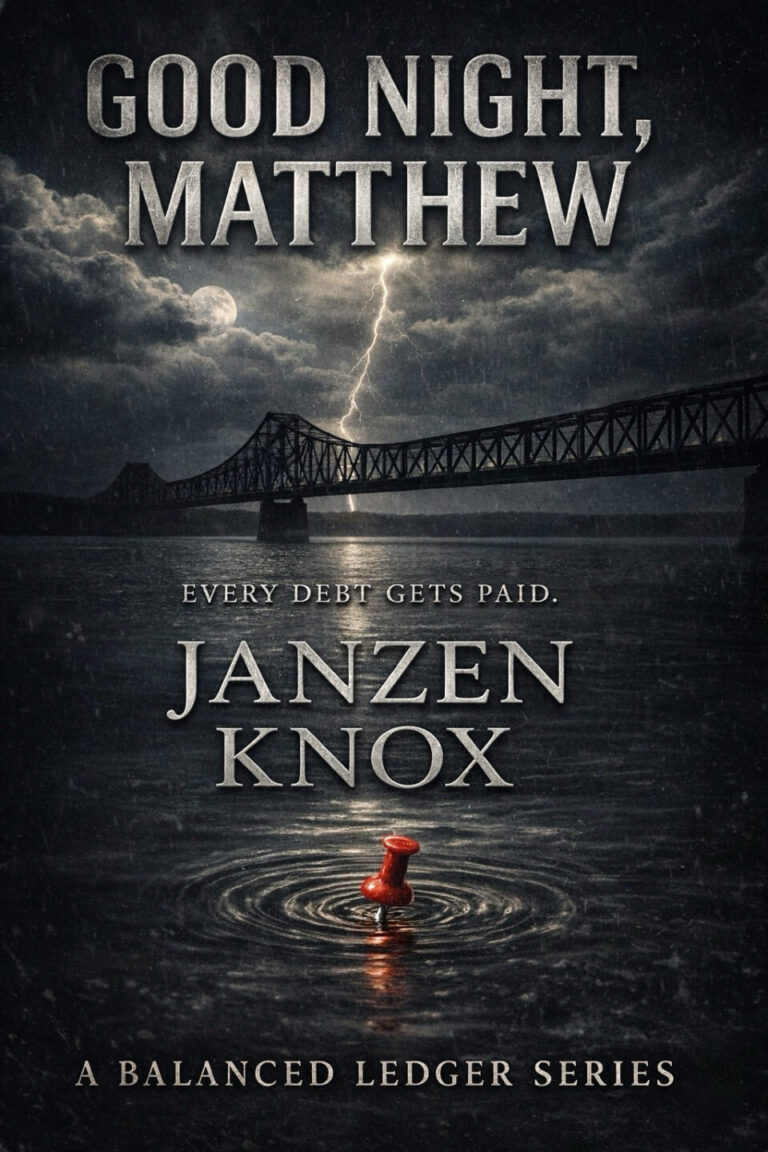
 GOOD NIGHT, MATTHEW (A Balanced Ledger Series, Book 1) received a 4+ star review, making it an IndieReader Approved title.

Following find an interview with author
What is the name of the book and when was it published?
Good Night, Matthew is Season 1 of A Balanced Ledger Series. It was published on March 2, 2026.
What’s the book’s first line?
“It happened during a pickup game behind Earl’s garage.”
I wanted the story to start small. A pickup basketball game. An accidental broken window. A childhood memory that looks ordinary until it isn’t.
That is where it all begins for Jaemson Moreland. Someone takes punishment for something he didn’t do. And Jaemson learns that staying quiet is not the same thing as being clean.
What’s the book about? Give us the “pitch”.
Good Night, Matthew follows Jaemson Moreland, a federal air marshal with a private system for tracking imbalance. People who escape consequence. People the world moves past before the debt is settled.
He’s not chasing revenge. Revenge is emotional, messy, and loud.
Jaemson believes in balance.
When Matthew Kincaid walks free after the death of his wife, Jaemson starts pulling threads through airports, bars, online aliases, construction sites, old memories, and a map marked with red pins.
Each pin represents a confirmed debt.
And every debt has to settle.
This is a psychological thriller about control, consequence, moral gray space, dark humor, and the terrifying calm of a man who notices everything.
The question at the center is simple:
What happens when the calmest man in the room decides the world left something unpaid?
What inspired you to write the book? A particular person? An event?
This book started as a seed years ago.
I remember watching Unsolved Mysteries with my mamaw. And yes, she is the inspiration for Mamaw in the book. One night, there was a case where the victim’s family ended up dying before the case was solved. My mamaw looked at me and said, “People need closure. If you don’t have closure, you can’t start to heal.”
That stayed with me.
Over time, it turned into something bigger than one case. I started thinking about imbalance. About people who are hurt and never get answers. About the way the world moves on before the people left behind are ready. About how unfair it feels when consequence never comes.
I wanted to create a character who doesn’t rant about justice or perform morality for the room. Jaemson Moreland does not need applause. He watches. He weighs. He acts.
The emotional root of the book came from that idea: some people carry a ledger in their head. Not because they want revenge, but because they cannot ignore what remains unsettled.
That became Jaemson.
And once Jaemson existed, the red pins followed.
What’s the main reason someone should really read this book?
Good Night, Matthew does not move like the typical revenge or vigilante thriller.
The story is quieter than that. I wanted something more intimate. Psychologically colder.
The hook is not the violence. It is what leads up to it.
I think this series has something for a lot of readers. If you like morally gray characters, dark humor, airport chaos, sharp dialogue, and the feeling that every ordinary place is hiding something ugly under the surface, I think you will enjoy it.
A yoga studio should feel safe.
A bar should feel normal.
An airport should feel routine.
In this book, normal places have teeth.
What’s the most distinctive thing about the main character? Who—real or fictional—would you say the character reminds you of?
The most distinctive thing about Jaemson Moreland is his ability to feel the full gamut of emotion, but separate from it when the moment requires surgically focused restraint.
He sees the room before the room sees him. He listens for what does not fit. He doesn’t need to dominate anyone because he has already measured the space, the exits, the patterns, and the threat.
His stillness is not passive. It is active.
I have a hard time comparing him directly to other characters because the great ones are specific. It is like arguing over the greatest basketball player of all time. The answer is Jordan, but the argument is still half the fun.
There are shades of Jack Reacher in Jaemson’s observation and controlled physicality, and maybe a trace of Dexter Morgan in the idea of a hidden system operating beneath a normal life. But Jaemson is more internal. More morally surgical. And he is not driven by bloodlust.
Dexter had a dark passenger.
Jaemson has a map and red pins.
And every red pin means something has been left unpaid.
When did you first decide to become an author?
I have always had fun with creative writing, but I don’t know that I had one clean moment where I decided to become an author.
There was one moment, though, where the idea became harder to ignore.
I was reading Knuffle Bunny with a tiny literary critic who proceeded to explain to me, in impressive detail, what an epilogue was. I was proud, amused, and a little confused as to why Knuffle Bunny had suddenly turned into English 101.
That was when I said, “When I write my book, I am going to make sure it has an epilogue.”
After that, it started to feel less like a random idea and more like something I had to do.
Good Night, Matthew has an epilogue.
So apparently, I keep promises made during children’s books.
Is this the first book you’ve written?
Yes, this is my debut.
Which probably explains why I felt free to get creative. I did not know enough to play it safe, and honestly, that helped.
I wanted to build a character who could shock the reader, but still earn enough trust that they would keep following him into darker places.
Jaemson Moreland is not clean and easy.
Clean and easy is boring.
What do you do for work when you’re not writing?
I am a former law enforcement officer.
That world teaches you to watch patterns. Read behavior. Notice silence. Pay attention to small shifts before they become large problems.
A lot of that made its way into Jaemson. Not directly. He is not me. But the way he sees rooms, movement, risk, and people comes from a real place.
I am fascinated by people. One thing I have learned is that most people will tell you everything you want to know, and likely more, if you just let them.
You just have to be paying attention when they do.
How much time do you generally spend on your writing?
As much time as I can steal.
I write around work, family, and life refusing to be convenient. Early mornings. Late nights. Notes in my phone. Lines saved before they disappear.
I haven’t really listened to the radio on my commutes in two or three years. If you are ever beside me and it looks like I am talking to myself, I am. Voice notes are huge for brain dumps.
The honest answer is that I am almost always writing, even when I am not typing.
Scenes keep moving in the background. Dialogue shows up at bad times. Characters start talking when they should mind their business.
They rarely do.
What’s the best and the hardest part of being an indie?
The best part is control.
The book stayed mine. The tone, the structure, the risks, the red pins, the dark humor, the slow pressure. Nobody softened the edges or asked Jaemson Moreland to become someone else.
He was my vision, and I got to create him exactly the way I wanted.
The hardest part is also control.
Because that control comes with everything else.
As an indie author, you are not just writing the book. You are figuring out editing, formatting, marketing, ads, websites, outreach, and a hundred small problems that suddenly belong to you.
Publishing Good Night, Matthew pushed me to create Ledger Work Studio. At first, it was just a home for my own work. The deeper I got into the process, the more I realized how many stories probably never get told. Not because they are not good enough, but because the path is confusing, expensive, intimidating, or built to make people quit.
I want Ledger Work Studio to become more than the place that publishes my books. I want it to become a place that helps the next person with a story worth telling.
What’s a great piece of advice that you can share with fellow indie authors?
Tell your story.
Marketing matters. Packaging matters. The business side matters. But the story still needs to be felt.
If you cannot feel it, the reader is going to struggle to feel it too.
I wish I had some magical advice for the rest of the process, but I am still learning that part myself. If I ever fully figure out marketing and advertising, fellow indie authors will be the first to know.
Until then, build momentum brick by brick. Rome was not built in a day, and neither is a readership.
Would you go traditional if a publisher came calling? If so, why?
Of course I would consider it, but it would need to make sense.
I think every author should keep their options open. Traditional publishing, indie publishing, hybrid paths, none of it matters if the fit is wrong.
I am proud of this work, and I have a clear vision for A Balanced Ledger Series. If a publisher believed in that vision enough to trust it, I would absolutely listen.
But I would not trade away the identity of the series just to say I had a deal.
The fit would matter more than the label.
Is there something in particular that motivates you (fame? fortune?)
I am a competitive person. That’s part of it.
But really, it is the next reader.
I want one reader to find Jaemson Moreland, the map, the red pins, the strange humor, the quiet menace, and feel like they stumbled into something they want more of.
I am also motivated by the idea of building something that lasts. Not just one book, but a series with its own rhythm, rules, and world.
If someone finishes Season 1 and says, “Where the hell does this go next?” then I did my job.
Which writer, living or dead, do you most admire?
This is a tough one because I am not sure I have one single favorite.
Stephen King has to be on the list. The Body is one of my all-time favorite stories, and I admire how he can make characters feel real before anything terrifying ever happens.
Jeff Lindsay is up there too. Dexter is one of those characters who changed how people think about morally complicated protagonists.
I also really admire Freida McFadden. Her pace is ridiculous in the best way. She understands momentum, readers, and how to keep delivering book after book.
And I recently read Scratch My Itch by Cyndy Mamalian, which pulled every emotion out of me. It was beautifully written and reminded me how powerful a story can be when it is honest enough to hit all the nerves.
So I don’t know if I have one answer. I admire writers who make me feel something and make me want to keep turning pages. That is the whole game.
Which book do you wish you could have written?
This is probably the hardest question on the list.
Every book that comes to mind is one that hit me in some way, and I do not think I would want to take that away by imagining it differently.
I could say The Body by Stephen King, but honestly, I am not sure I could do that story justice.
I don’t know that I wish I had written someone else’s book. I am glad those books exist exactly the way they do.
What I really want is to write something that draws readers in the way my favorite books did for me.
That is the goal.
I love hearing from readers. If you read Good Night, Matthew and find yourself wondering, “Did I catch something there?” or “What did he mean by that?” I want to hear about it. This series is built with red pins, callbacks, and quiet details hiding in plain sight.