
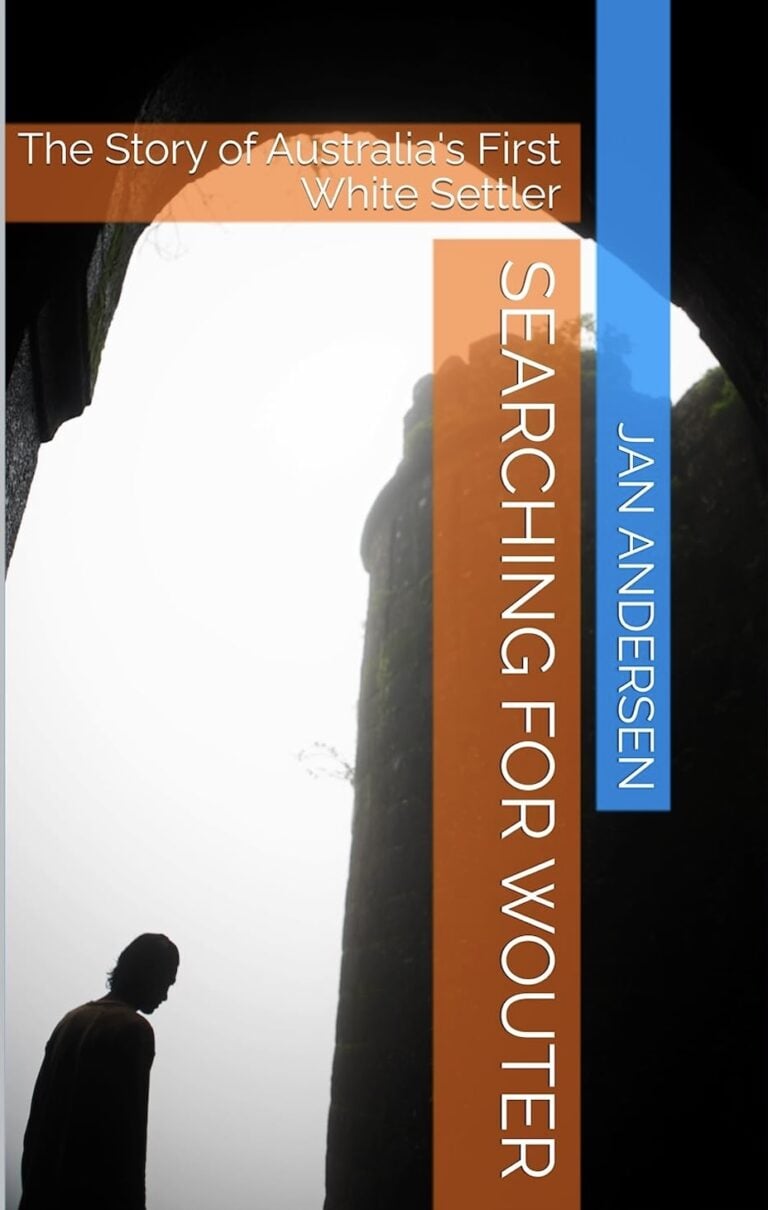
 SEARCHING FOR WOUTER: The Story of Australia’s First White Settler received a 4+ star review, making it an IndieReader Approved title.

Following find an interview with author Jan Andersen:
What is the name of the book and when was it published?
Searching for Wouter: The Story of Australia’s First White Settler, Publication date: 25 April 2026
What’s the book’s first line?
“On the night of 4th June 1629 with my sails at full mast, a vibrant moon paints her silvery path across the long stretches of dark sea before me, ready for my bow to slice asunder.”
What’s the book about? Give us the “pitch”.
150 years before Captain Cook arrives with the first fleet in 1788 at Botany Bay (Sydney), Dutch settlers began populating the other side of the Australian continent. The first of these was Wouter Loos, a young Dutch soldier, put ashore in 1629 at Hutt River in Western Australia, for his part in the mutiny of the Dutch retourship, The Batavia. There the history ends. No one knows what became of him.
This story tells of Wouter’s life among the indigenous community where he fathers a son. He is later joined by other Dutch who have come ashore from shipwrecks. Wouter’s story weaves its way through Australian history up to the present day, meeting up with historic characters and events. Finally, in the modern age, an attempt is made to locate his remains and tell his story.
This novel blends historical research and imagination to complete the story of Australia’s very first white settler.
What inspired you to write the book? A particular person? An event?
In 2006, whilst visiting the WA Shipwrecks Museum in Fremantle, Western Australia, I inadvertently placed my hands upon the ancient timbers of the hull of the Dutch retourship, The Batavia. This is arguably one of the most notorious of all the Dutch shipwrecks along the coast of Australia. Shipwrecked on the reef, a hour’s sail from Geraldton, The Batavia struck reef in the winter of 1629. In the ensuing three months, while waiting for a rescue ship, mutineers raped and murdered 150 people, including children.
My hotel was a short walk from the museum, situated right on the boat harbour, and my window opened out onto the vast Indian Ocean, the place of many shipwrecks just like The Batavia. The moon was full, and it cast its silvery path along the ocean into my window. That night I had a nightmare. I dreamed there was an evil force, hidden, trying to remain secret, behind a large wooden door, behind which untold atrocities were happening. I awoke in a sweat and went into the bathroom. It was then I saw what others later jokingly described as a stigmata on my left forehead, just over the eyebrow. A browny-red mark, the shape of a crucifix, had appeared. My initial remark, ‘What the hell?’ In the morning it was more pronounced, and earned its fanciful name from my wife.
I am not prone to nightmares. And I am definitely not prone to religious phenomena.
I didn’t realise until later that I had connected with a recorded memory, embedded in those ancient timbers of The Batavia. Today, I realise that memory can be recorded in many ways. Just as we record photos on film, or sounds and images on our silicon chips, so can memory be recorded in many places. In walls of a house, for example. We glimpse or feel something. This memory is recorded in places where strong emotional events have occurred. In the walls of houses (thus the “haunted house”; and within the timbers of old ships.
The story of The Batavia would not leave me alone. I had never heard of it before that chance encounter in 2006. I slowly began sourcing every available book and article on the subject, some of them privately printed. The story had hold of me. For it was here I learned that a 24 year-old soldier, Wouter Loos, was set ashore at Hutt River, thereby becoming Australia’s first white settler.
Years later, in 2017, I started writing. As soon as I began, I remembered something long forgotten. I forgot that I wrote a novella at the age of 13. It was a vampire story. Then at age 16 I won a short story competition. Suddenly I stopped writing. I decided to be “sensible”. I went to university to study Arts/Law. I graduated in 1980 and spent years first in book publishing, and then private practice in complementary medicine. In 2017 I finally picked up my pen once more.
In 2018 I decided to return to Western Australia. Here I explored the Hutt River region — the setting for my story about Wouter Loos from The Batavia. It was here, on 16 November 1629, that Wouter came ashore. Standing in his footprints on the beach, I followed where he would have traversed, along the Hutt River. A few hundred metres in you enter a highly charged area. Sheltered from the crashing surf, everything is still. Not a bird chirp. Not a kangaroo. Not a lizard. I picked up a river stone for a souvenir, only to put it back five minutes later, for I could tell I was not permitted to remove anything. The guardians of the place would not have that.
In the flats, between the river and Mount Victoria, just east of Pink Lake, is the place where the “native town” — so named by the British explorer, George Grey, and described in Searching For Wouter, was located. It is here that Wouter took part in the building of this “town”, with pitched roofs, wells, and stone-lined pathways.
It was while staying at Hutt River, that I received the story of Wouter. For there is no substitute for visiting the site of your story. And just as I have portrayed in Searching for Wouter, I no longer see time as linear; it is both circular and parallel. You can gain a glimpse into the past or the future, when the boundary between the parallels becomes porous. This is most likely to happen at dusk. Also at both the full and the new moon. I was attuned to Wouter’s story because I had read so much about the history (at least the part that is known). And then I stepped into his old abode.
To sharpen the historical narrative of this really important story, I took my manuscript in hand into the Masters degree in Creative Writing at Macquarie University (Sydney). There many of my peers and supervisors got to meet Wouter and friends. I submitted parts of the draft of Searching for Wouter for my manuscript development module in my Masters degree. My lecturer described it as “very ambitious.” This was his polite way of saying I was bending the genre too far, as well as creating some rather controversial material. I would have difficulty finding a traditional publisher brave enough to take it on. Despite his misgivings I earned a high distinction for the manuscript and forged ahead with my vision.
The story is a composite novel. There are seven main characters, four male, three female, across four hundred years of Australian history. Two of the characters are sailing ships, speaking in a motherly, omniscient voice. Each chapter is a self-contained story, although there are motifs and links which interconnect each perspective and time. The circular, non-linear, and porous nature of time underpins the narrative.
Bending genre is something I am drawn to. As another example, in my forthcoming novel, a modern crime thriller called To Kill or Not to Kill, the subject is date-rape and the shortcomings of the legal system. The novel has comic characters. How can you have comedy in a story about date rape? Never are the victims of date rape disrespected, and the moral and ethical undertones are never compromised.
What’s the main reason someone should really read this book?
For lovers of historical fiction, this is the true story we never have heard about, which “quietly dismantles the accepted history, that white colonisation of Australia began with Captain Cook in 1788.” The story is told, in intimate memoir style, via seven characters across four centuries. This is “a bold and ambitious achievement” taking the composite novel style to a new level.
What’s the most distinctive thing about the main character? Who—real or fictional—would you say the character reminds you of?
There are seven equal main characters, spanning four centuries. One of these is an insidious psychopath, darkly comic, yet unsettling, who brings about widespread death and destruction.
His adversary is the exact opposite, a deeply religious man, plagued by terrors of conscience, who seeks his spiritual redemption in his life with Australia’s indigenous people.
When did you first decide to become an author?
I wrote my first novella at age 13. I won the local short story competition at age 16. For the remaining years I devoted writing to book editing, and the writing of non-fiction, under a different pen name.
I returned to fiction writing in 2018 after which I completed the Master of Creative Writing degree at Macquarie University. Searching for Wouter was the product of that degree, as is my forthcoming novel, To Kill of Not to Kill.
What do you do for work when you’re not writing?
I am a clinician, specialising in the alternative treatment of Chronic Fatigue Syndrome. I write books and mentor other complementary medicine clinicians.
How much time do you generally spend on your writing?
Writing is definitely one of my happy places. That and walking in the forest. Two pleasures and treasures. When I am working on a project I try to stick to an hour each day.
What’s the best and the hardest part of being an indie?
Writing is an art form, as well as a discipline. That does not bring us up to speed with the social media and marketing realities in the current environment. I prefer someone else to do that instead. But beautiful writing survives time, so in the end, a great book will find its appreciative audience, one way or another.
Would you go traditional if a publisher came calling? If so, why?
My nature is to follow my own path, not just in writing but in life with all my decisions. So I would not editorialise my writing content to fit into someone else’s idea of market expectation. Searching for Wouter stretches the historical fiction genre, so it may discourage traditional publishers. Having said that, I am interested to see if my next novel, which fits into the genre of crime fiction, is of interest to a traditional publisher. But again, I have stretched that genre, maybe a little too far, so traditional publishers may not be confident in their perceived market.
Is there something in particular that motivates you (fame? fortune?)
I am not interested in fame. I want the untold stories to be told. I am interested in outing the truth. Searching for Wouter quietly dismantles the accepted view of Australia’s settlement by Europeans. A story well told will outlive its author, and that’s what I’d like to see.
Which writer, living or dead, do you most admire?
I am a Charles Dickens fan. Writing with a social purpose, capturing fully developed characters and placing them in the story world — he is a master. My second favourite author is a little known English author, Elizabeth Goudge., who created three masterly examples of character and place. These three novels, The White Witch, Gentian Hill and Island Magic are the stand outs of her great fiction and characterisation.