
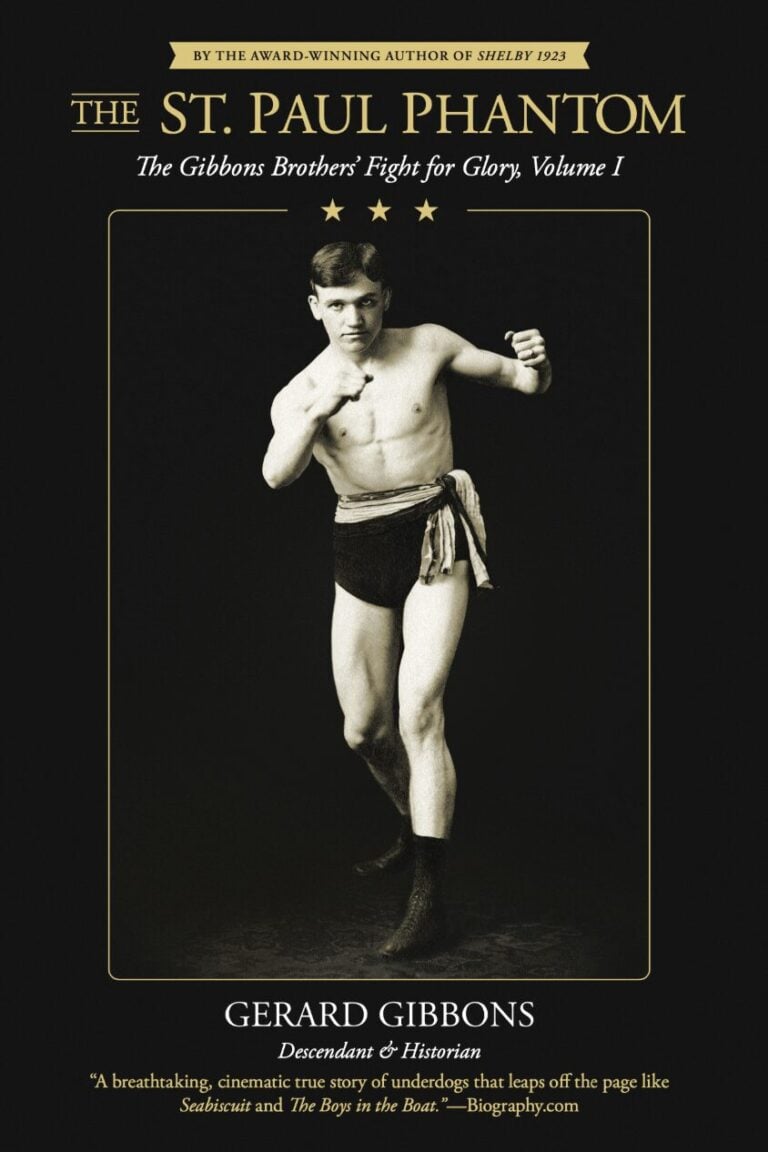
 The St. Paul Phantom: The Gibbons Brothers’ Fight for Glory, Volume I: Received a 4+ star review, making it an IndieReader Approved title.
 The St. Paul Phantom: The Gibbons Brothers’ Fight for Glory, Volume I: Received a 4+ star review, making it an IndieReader Approved title.
Following find an interview with author Gerard Gibbons:
- What is the name of the book and when was it published?
The book is The St. Paul Phantom: The Gibbons Brothers’ Fight for Glory, Volume I, published by Fight for Glory Press on June 9, 2026.
- What’s the book’s first line?
The first line of the narrative is: “Through the hush of midnight, Halley’s Comet listens, as she always has.”
- What’s the book about? Give us the “pitch.”
The St. Paul Phantom is the true story of Mike and Tommy Gibbons, two poor Irish Catholic brothers from St. Paul, Minnesota, who rose from the back alleys, railroad yards, illegal rooftop fights, and smoky gymnasiums of early twentieth-century America to become the greatest boxing brothers of their time. So highly regarded in history for their exemplary athleticism, distinguished military service during WWI, and lasting civic contributions to their communities and country, they were known as the Shining Knights of the Ring. But this is much more than a story about boxing. It is also a sweeping American saga about family, faith, immigration, ambition, brotherhood, love, unlikely friendships, sacrifice, and the fight to become something greater than circumstance permits. Mike Gibbons—“the St. Paul Phantom”—was one of the most brilliant defensive fighters who ever lived, a master of strategy, timing, intelligence, movement, and restraint. His younger brother, Tommy, who rose even higher, would later fight Jack Dempsey in one of the most famous heavyweight championship bouts in history. The brothers’ kaleidoscopic journey unfolds through the Golden Age of Boxing and the birth of modern America: outlaw prizefights, the vanishing old west, vaudeville, suffragists, sportswriters, gangsters, the rise of motion pictures and radio, the color line, World War I, the 1918 influenza pandemic, and the transformation of a young nation still inventing itself. At heart, it is a story about impossible dreams—and the cost of chasing them. As the twentieth century roars to life, everyone has a dream, so everyone has fight.
- What inspired you to write the book? A particular person? An event?
The deepest inspiration was my family. My grandfather was Tommy Gibbons, and my great- uncle was Mike Gibbons, the legendary Phantom. I met Tommy only once, when I was four 2 years old, sitting on his lap at our family home in the Mojave Desert. I remember feeling safe, loved, and somehow connected to something larger than myself. A few months later, he was gone. For years, my father, Tommy Jr., told me stories about Tommy and Mike. After my father passed away, he left behind sealed cardboard boxes and a locked trunk filled with family treasures—newspaper clippings, photographs, memoirs, diaries, love letters, and fragments of a nearly vanished world. For decades, I carried those boxes from place to place without really opening them. Then, in 2016, I finally did. What I found was not merely family keepsakes and souvenirs or fragments of a lost, magical sports story. What I uncovered over time were the roots and marrow of an authentic American family epic—a spiritual inheritance, a map of long-buried love, loss, courage, faith, and resilience. From there, the quest for deeper research and understanding took me around the world, to archives, libraries, museums, collections, and old newspapers—Minnesota Historical Society, the LA84 Sports Library, Trinity College, University of Notre Dame’s Sports Research Collection, Brooklyn College’s Hank Kaplan Boxing Archive, the National Archives and Library of Congress, International Boxing Research Organization, to name just a few. It took ten years of excavation. The more I discovered, the more I felt called to bring these people back to life—not as statues or statistics, but as flesh-and-blood human beings who fought, loved, failed, forgave, and endured. The core lesson for me: Never quit. Keep on fighting the good fight!
- What’s the main reason someone should really read this book?
Though many of the primary characters are boxers, and there are many pugilistic matches featured on the page, I’ve worked very hard from the outset that this would be a “boxing book” for people who may not think they care about boxing. The ring is the stage, but the true subject is the indomitable human spirit and the constant parallels and revelations of what all of us—regardless of class, creed, or color—have in common. The St. Paul Phantom is, in many ways, about what it takes to survive hardship without surrendering your soul. It is about brothers, fathers, mothers, wives, immigrants, dreamers, soldiers, outsiders, and underdogs. It is about the fragile, beautiful, brutal bargain of trying to make a life in America. Ultimately, I came to see the book as a roadmap for living with purpose today. If readers love cinematic nonfiction—books like Seabiscuit, The Boys in the Boat, Unbroken, or Cinderella Man—I believe they will find something here: action, history, romance, humor, heartbreak, and a forgotten American hero worthy of rediscovery.
- What’s the most distinctive thing about the main character? Who—real or fictional—would you say the character reminds you of?
This is a nonfiction title, so the question does not technically apply. But if I may answer in spirit: Mike Gibbons is distinctive because he was a fighter defined less by violence than by 3 intelligence, honor, grace, timing, and restraint. He was not a destroyer. He was an artist. A “problem” that no opponent could ever quite solve. In modern terms, Mike reminds me a little of a boxing Sherlock Holmes—cool, observant, analytical, always three moves ahead. (Holmes’ creator, Sir Arthur Conan Doyle, was a frequent visitor to the Twin Cities, and a huge fan of the Gibbons Brothers!) Mike also has something of (To Kill A Mockingbird’s) Atticus Finch in him: quiet dignity, moral seriousness, and an instinct to do the honorable thing even when the world rewards something louder.
- When did you first decide to become an author?
I think I first became an author before I had the courage to say so out loud. I grew up surrounded by stories—family tales, historical biographies, movie treatments, science fiction novellas, sports stories, spiritual parables, Mythical and American epics. My father was a born storyteller in regard to family lore and, professionally-speaking, sales. My mother was a short story writer and a voracious reader. On reflection, I suspect I inherited dad’s love of narrative and his reverence for memory, and mom’s love for discovery, characters, and dramatic exploration. But the decision to become an author in a true, committed sense came much later, when I realized that the Gibbons family story was not going to tell itself. If I did not do the work, much of it might vanish forever. That realization changed me.
- Is this the first book you’ve written?
No. The St. Paul Phantom is the beginning of the larger Fight for Glory literary franchise—a multi-volume American saga about the Gibbons brothers, the Golden Age of Boxing, and the turbulent birth of modern America. My earlier award-winning book, Shelby 1923: The Dempsey-Gibbons Fight for Glory and a Little Montana Town’s Impossible Dream, was published to coincide with the centennial celebration of the event and tells the kaleidoscopic story of Tommy Gibbons’ 1923 world heavyweight championship fight against the legendary “Manassa Mauler,” Jack Dempsey, in Shelby, Montana. It is a panoramic true underdog story that critics have said “reads like Rocky in the Wild West.” Tiny, desperate Shelby, Montana—dubbed “the little town that God forgot” by sportswriting giants like Damon Runyon and Grantland Rice—gambles everything on the high-stakes folly of staging a heavyweight championship fight in the middle of nowhere, and on an underdog hero (my grandfather) who lends heart, soul, and urgency to the town’s impossible dream. For my grandfather, facing Dempsey was a life-or-death proposition: a deeply personal mission to earn enough money to provide desperately needed mental healthcare for his wife—my grandmother, Helen—before it was too late.
- What do you do for work when you’re not writing?
My entire professional life has revolved around storytelling. I’ve worked as a historian, researcher, screenwriter, director, filmmaker, and creative producer—always searching for the emotional truth inside real events and shaping those stories in ways that allow other people to feel them deeply. At the heart of my work is a fascination with memory, legacy, and the stories families and communities pass down across generations. I’m drawn to the intersection of history and humanity: the place where large historical events become intimate, personal, and emotionally alive. As a storyteller, I value restraint, sincerity, and authenticity above all else. My goal is never simply to recount events, but to uncover the deeper emotional core within them. Whether I’m writing a book, making a film, or researching the past, I’m ultimately trying to preserve something meaningful before it disappears. When all is said and done, though, I’m simply a storyteller at heart. That is where I find my greatest joy, purpose, and sense of calling.
- How much time do you generally spend on your writing?
During the most intense years of working on The St. Paul Phantom, the honest answer is: almost all of it. This book required years of reading, research, travel, archival investigation, photo and document study, drafting, revising, restructuring, and reimagining. It became less like a project and more like a calling. Okay, let me not mince words; it was much more, even, than all of that. The Fight for Glory stories became my raison d’être. It took ten years, and there are many more stories ahead—at least two more books and we’re also working hard to develop this as a limited event series for television/streaming. Throughout the researching and writing process, there were long stretches when I’d wake up thinking about Mike and Tommy and go to sleep that night still trying to solve some historical, emotional, or narrative puzzle. Some details—plot points, character motivations, the “rhyming” aspect of history, as Mark Twain called it—took years to solve. There is, of course, additional gravity at play when it comes to investigating history and historical characters—and even more so, when it involves your own family. Think about it: even the greatest historical writers, the ones I most admire, are not typically asked to answer to their own bloodline!
- What’s the best and the hardest part of being an indie?
The best part of being an indie author is the freedom. I can follow the story where it needs to go. I can build the book with the intent, scope, images, structure, and emotional ambition it deserves. I can take risks, without having to answer to anyone else. The hardest part is that you’re never only writing; you must also become an evangelist, publisher, publicist, strategist, production manager, distributor, designer, marketer, and (sometimes) janitor. The independence of being independent is thrilling, but it is also relentless. You have to believe in the work enough to keep carrying the weight when no one else is helping you push the boulder up the hill. Sometimes the wins come quickly. Other times, the missteps come one after the other. Failure is often key to getting anywhere worthwhile, certainly as a storyteller. If you have failed, over and over again, that’s okay. That means you’re on the verge of a breakthrough!
- What’s a great piece of advice that you can share with fellow indie authors?
Do not confuse independence with isolation. Being indie does not mean doing everything alone. It means protecting the soul of the work while building the best possible team around it. (Can I get an “Amen!”) Find excellent editors, designers, proofreaders, readers, researchers, and champions/cornermen for your mission. Listen carefully. Then listen even more deeply than that. Stay humble. But never surrender the central reason you began. Also, not to overemphasize the obvious, but: Finish! That literally means, finish the damn thing! A flawed book that’s finished can be improved. An imaginary masterpiece cannot be read.
- Would you go traditional if a publisher came calling? If so, why?
Yes, under the right circumstances. I believe deeply in the independent path, and I am grateful for the freedom it has given this project. But if the right traditional publisher came along—one that understood the scope of the Fight for Glory franchise, the historical importance of the Gibbons brothers, and the cinematic, national, and emotional dimensions of the story—I would absolutely listen. The goal is not to be indie for its own sake. The goal is to get this story to the readers who need it.
- Is there something in particular that motivates you—fame? fortune?
Legacy–not in the egoic sense, but the kind of legacy that connects generations. The kind that says: these people lived, they mattered, they loved, they struggled, they gave something of themselves, and we are not going to let them disappear. Ken Burns describes his approach to history as “waking the dead.” I happen to strongly agree with that perspective, and take the responsibility very seriously. I am motivated by family, faith, history, gratitude, and the hope that this story might inspire someone else to keep fighting the good fight in their own life.
- Which writer, living or dead, do you most admire?
There are so many, including many of the early-20 th century’s sportswriting greats—dubbed the Golden Pens during the Jazz Age. But for this project, a genuine north star would have to be the inestimable Laura Hillenbrand, whose work I love and admire profoundly. Her book, Seabiscuit, showed how a great sports story can become something much larger and more resonant. On the surface, Seabiscuit is about a racehorse. But in Hillenbrand’s hands, it becomes a story about damaged people, unlikely hope, the Depression, American reinvention, and the mysterious bond between broken souls who somehow make one another whole. That was deeply instructive for The St. Paul Phantom. I never wanted to write a boxing book only for boxing fans. I wanted to write about family, ambition, immigrant striving, faith, fear, violence, love, celebrity, and the birth of modern America using the ring as the place where all of those forces collide. Hillenbrand also taught me the power of patient research in service of emotion. Her work is meticulously reported, but it never feels buried or burdened under research. Every detail earns its place because it reveals character, atmosphere, stakes, or time. That became a guiding principle for me: the history had to be accurate, but it also had to breathe. Most of all, Seabiscuit gave me permission to believe that a forgotten American story could still feel urgent, cinematic, and emotionally overwhelming if told with enough care. It has sweep, heart, discipline, and soul. It honors the past without embalming it. That is the standard I kept reaching toward with The St. Paul Phantom.