
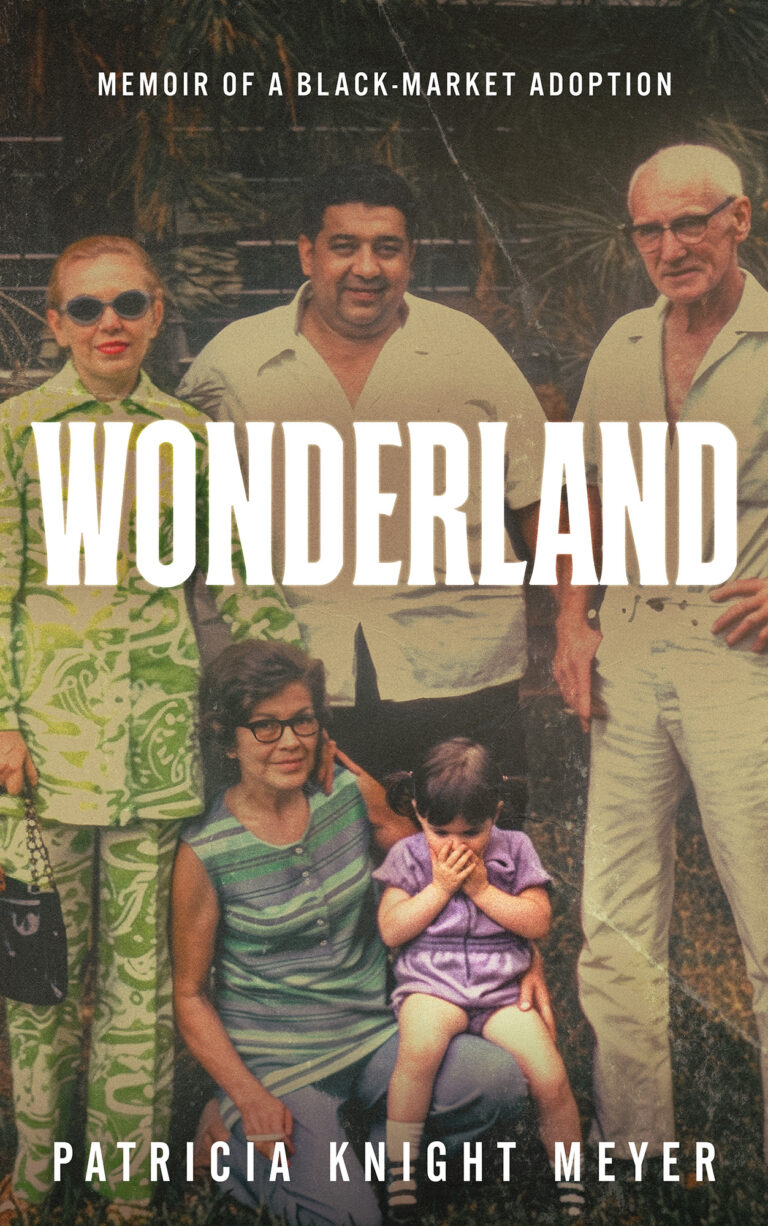
 WONDERLAND: Memoir of a Black-Market Adoption
Winner of the 2026 IndieReader Discovery Awards in True Crime, Nonfiction
What’s the book’s first line?
“‘Got it,’ I groan, reaching as high as possible, fingers curling around the edges.”
What’s the book about? Give us the “pitch”.
Handed over along a Texas hospital curb in 1970, no judge, no paperwork, no legal record of any kind, Patricia grew up celebrating a made-up birthday; trafficked through an black-market deal, haunted by nightmares of “The Dark Man.” Her parents, blackmailed by the shady attorney they hired to skirt the adoption system, faced an impossible choice: go to the police or pay up. They paid $30,000 to keep their paperless baby. Navigating her mother’s violent alcoholism and caring for her disabled 600-pound father, Patricia spent her childhood trying to save her saviors, unaware of the lifelong threat that haunted them: at any moment, someone could come back for their child.
Never legally adopted, Patricia used a fraudulent birth certificate for 47 years. Part detective story, part searing family portrait, part historical reckoning, WONDERLAND exposes what happens when maternal desperation meets need and greed, when falsified documents, dark family secrets, and systemic abuses can no longer sustain one woman’s relentless search for truth. A tumble down the rabbit hole of America’s baby trade, Patricia delivers a haunting reckoning with Baby Scoop Era exploitation that asks: as reproductive rights disappear, are we ready for Baby Scoop 2.0?
What inspired you to write the book? A particular person? An event?
I set out to find my birth parents because without them there would be no way to obtain a legal birth certificate. After I found them and finally began unraveling the full truth of my undocumented origin story, I realized this wasn’t just my story. The same attorney had brokered an adopted biological cousin and she too was missing papers. I wondered how many other paperless babies this man had left in his wake. And it wasn’t just us, thousands of babies were trafficked during the Baby Scoop Era through attorney-brokered deals like ours. The attorney who blackmailed my parents was never held accountable. Writing WONDERLAND is both a personal reckoning and an act of witness. I hope in sharing my story I may inspire others to find their truth and I might possibly find other paperless Texas “adoptees” sold by this man.
What’s the main reason someone should really read this book?
Because accountability requires a witness. We know that during the Baby Scoop Era, an estimated 4 million vulnerable women’s children moved through a system riddled with coercion, fraud, and greed. We know that in 1970 alone, 170,000 babies were surrendered, with 20 percent sold on the black market. What we don’t know — what we’ve never been asked to sit with — is what it costs a person to be one of those babies for the rest of their life.
WONDERLAND answers that question. And it arrives at a moment when the conditions that created the Baby Scoop Era are reassembling themselves in real time. As reproductive rights disappear, more babies will enter a system that lacks oversight and treats them as commodities and their mothers as vessels. The multi-million dollar for-profit adoption system needs better oversight, but that is not the true answer. The conversation we should be having isn’t about how to better regulate the industry. It’s about how we keep families together in the first place. First mothers need housing, healthcare, economic stability, and the radical idea that their children belong with them, and birth fathers need their rights recognized. Until that conversation replaces the one we’re having now, adoption remains ripe for exploitation and coercion. The system can still be circumvented. And when it is, it is always the children who pay.
When did you first decide to become an author?
I was ten when I wrote my first short story about two kids out in the country, whose parents die and whose greedy uncle comes to take them to the big city to receive their inheritance. He tries to kill them on the journey. Of course they outsmart him and make their way to their riches.
Is this the first book that you’ve written?
Yes it is.
What do you do for work when you’re not writing?
I do digital content marketing, book publicity and brand strategy. I also founded YAYDNA Genetic Greeting Cards — a co-op that donates 100% of proceeds to non-profit adoptee and first parent support organizations.
What’s a great piece of advice that you can share with fellow indie authors?
Write what you know and build you community long before you write your book. Build relationships with people who care about the subject matter. Support other authors on their journeys. For me I blogged, spoke at adoption conferences, and connected with my readers via advocacy work.
Which writer, living or dead, do you most admire?
Mary Karr. She defined the standard for a great memoir and proved that a working-class Southern childhood full of chaos and complicated love could be the material for literary art. She is raw, honest and gritty. She is vulnerable and funny and her writing cuts deep. But also she grew up a stone’s throw from where I did. So her stories and characters resonate deeply with me
Which book do you wish you could have written?
The Liars Club (of course)