
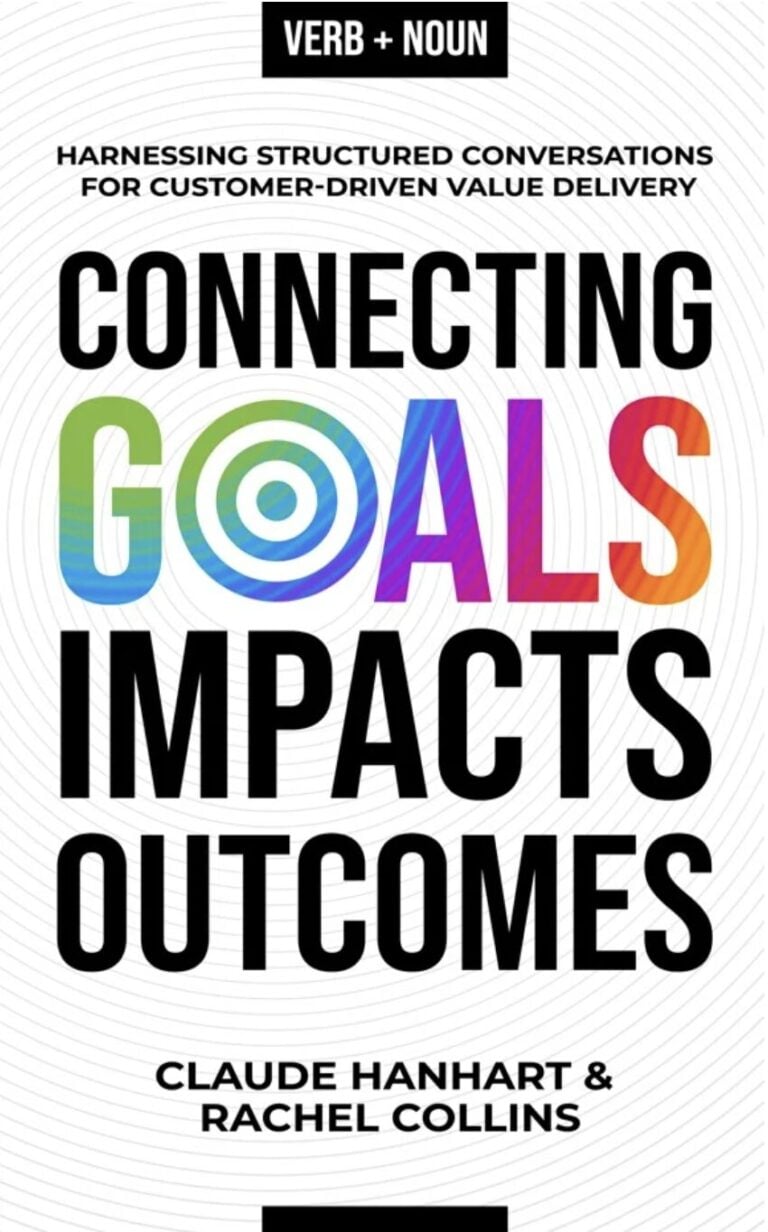
 Connecting Goals to Impacts and Outcomes: Harnessing Structured Conversations for Customer-Driven Value Delivery: Received a 4+ star review, making it an IndieReader Approved title.
 Connecting Goals to Impacts and Outcomes: Harnessing Structured Conversations for Customer-Driven Value Delivery: Received a 4+ star review, making it an IndieReader Approved title.
Following find an interview with authors Claude Hanhart and Rachel Collins:
1. What is the name of the book and when was it published?
The book is Connecting Goals to Impacts and Outcomes: Harnessing Structured Conversations for Customer-Driven Value Delivery, published in January 2026 through Structured Conversations Press.
2. What’s the book’s first line?
There’s a gap between what product teams build and what customers actually need.
3. What’s the book about? Give us the “pitch”.
Most teams aren’t failing because they work with the wrong tools or the wrong people. They’re failing because they’re having the wrong conversations — or not having them at all.
This book is a practical guide to fixing that. My co-author Rachel Collins and I introduce a set of techniques called Structured Conversations, built on three pillars: precise language using VERB+NOUN syntax, visual mapping techniques that make alignment visible, and collaborative facilitation that brings the right people into the room in the right way.
The result is a clear chain — Goals → Objectives → Impacts → Outcomes — that connects what an organization wants to achieve to what a team actually builds. Every concept is illustrated through a single running example, a restaurant app team, followed across all 24 chapters so readers see the ideas working in real conditions rather than in theory.
Simply put: the quality of your conversations determines the quality of your results. This book gives you the tools to raise both.
4. What inspired you to write the book? A particular person? An event?
It was less a single moment and more an accumulation of the same moment, repeated across different teams and organizations over many years. I’d watch smart, committed people leave a planning session and immediately begin building in different directions — not because they disagreed, but because they’d each heard something slightly different. Nobody had lied. Nobody had been careless. The conversation itself had just lacked the structure to produce shared understanding.
The turning point came when I started noticing that the problem wasn’t the team events — the standups, the refinements, the retrospectives — but what happened inside them. Language was vague. Visuals were absent. Outcomes were assumed rather than defined. I began calling this the “missing layer,” and once I saw it, I couldn’t unsee it.
Rachel and I wrote this book because we wanted practitioners to have a name for that missing layer — and practical techniques to fill it.
5. What’s the main reason someone should really read this book?
Because delivery without direction is just motion. This book gives you a repeatable way to ensure that what your team builds actually connects to what your customers need and what your organization is trying to achieve. It’s not abstract — it’s the kind of shift you can apply in your next meeting, your next refinement session, your next strategic planning cycle. Readers who’ve put it into practice tell us the biggest change is that conversations stop going in circles and start producing decisions. That’s the outcome we wrote it for.