
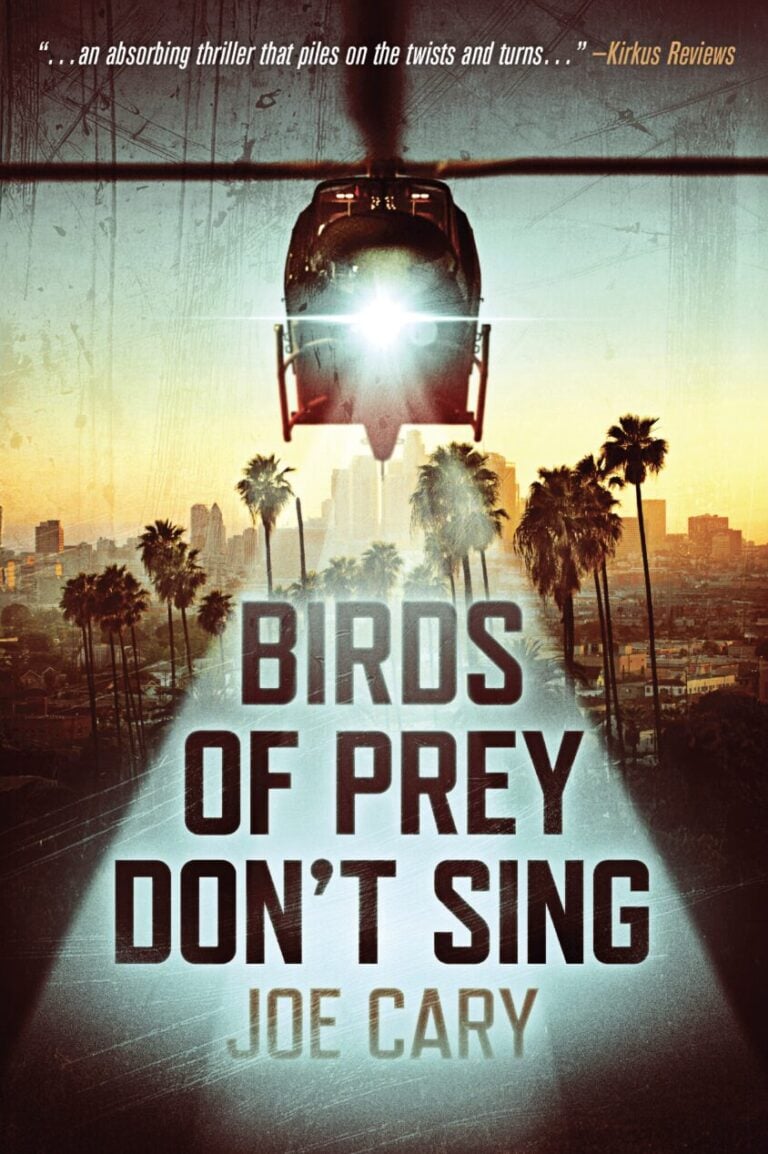
 Birds of Prey Don’t Sing: Received a 4+ star review, making it an IndieReader Approved title.
 Birds of Prey Don’t Sing: Received a 4+ star review, making it an IndieReader Approved title.
Following find an interview with author Joe Cary:
1. What is the name of the book and when was it published?
“Birds of Prey Don’t Sing” was published on 4/07/2026.
2. What’s the book’s first line?
“The chaos quelled the urge to squeeze the trigger.”
3. What’s the book about? Give us the “pitch”.
Assassin Michael Harrier is hired to kill a priest and frame the job as Divine Judgment, but his schemes founder when a woman entangles him and an LAPD sergeant hunts him down.
4. What inspired you to write the book? A particular person? An event?
I’ve always enjoyed assassination thrillers and I wanted to write one that broke from traditions. Once I had the antihero’s two-for-one M.O. established, it came down to choosing the best target for the first book in the series. Nothing seemed more perfect than a seemingly impossible job.
5. What’s the main reason someone should really read this book?
This is a character-driven thriller that delivers on plot and pacing while introducing two truly unique features in the genre, and early readers have found that refreshing.
6. What’s the most distinctive thing about the main character? Who-real or fictional-would you say the character reminds you of?
How he operates and how he got there. Nearly every assassin in the genre is ex-government or ex-military, foreign or domestic, and that’s a formula that sells. After all, if your assassin is ex-CIA or a former SEAL or MI6, then that character is a pre-packaged badass with requisite skills. Michael Harrier was not trained by the government or military, a backstory intended to make him more interesting. In addition, he has a unique, elusive M.O. for the genre. His clients choose two targets: one to kill, and one to frame for the hit, which enhances the intrigue and complexity of each job.
He doesn’t remind me of anyone in particular, which again was the point, but I did draw a lot of inspiration from Forsythe’s Jackal and his intelligence, expertise, attention to detail, and ingenuity.
7. When did you first decide to become an author?
I’ve wanted to be an author for a long time, since at least fourth grade when I read my first thriller, Follett’s Eye of the Needle. I think I wrote my first story in around eighth grade.
8. Is this the first book you’ve written?
Yes. I previously published a handful of short stories, several of which I wrote as I took breaks from this novel.
9. What do you do for work when you’re not writing?
I work in financial crime prevention—thwarting money laundering, fraud, identity theft, that sort of thing.
10. How much time do you generally spend on your writing?
Not enough. I have more ideas than time, but I do try to carve out early morning hours every day.
11. What’s the best and the hardest part of being an indie?
The best part is the autonomy, the freedom to be able to trust your instincts. The hardest part (aside from knowing whether your instincts are correct) is that there is so much you need to know about the business, apart from the craft of writing. I’ve come to appreciate the role an agent and a publisher might play.
12. What’s a great piece of advice that you can share with fellow indie authors?
Experiment, even if those experiments don’t get published. Try your hand at short stories or flash fiction, practice different points of view. I learned a lot about character and diction and voice from doing so. It’s a lot harder to hide bad writing in a flash fiction or short story, where every word really has to count. And read your work out loud at least once, this is a must for me.
13. Is there something in particular that motivates you (fame? fortune?)
The challenge of trying to create something unique in a genre I enjoy. And to write something that won’t embarrass me too much in ten years.
14. Which writer, living or dead, do you most admire?
Shakespeare. I still cannot believe that one person compiled that numinous catalogue.
15. Which book do you wish you could have written?
Tough question, so many answers. Today I’ll go with Wuthering Heights.