
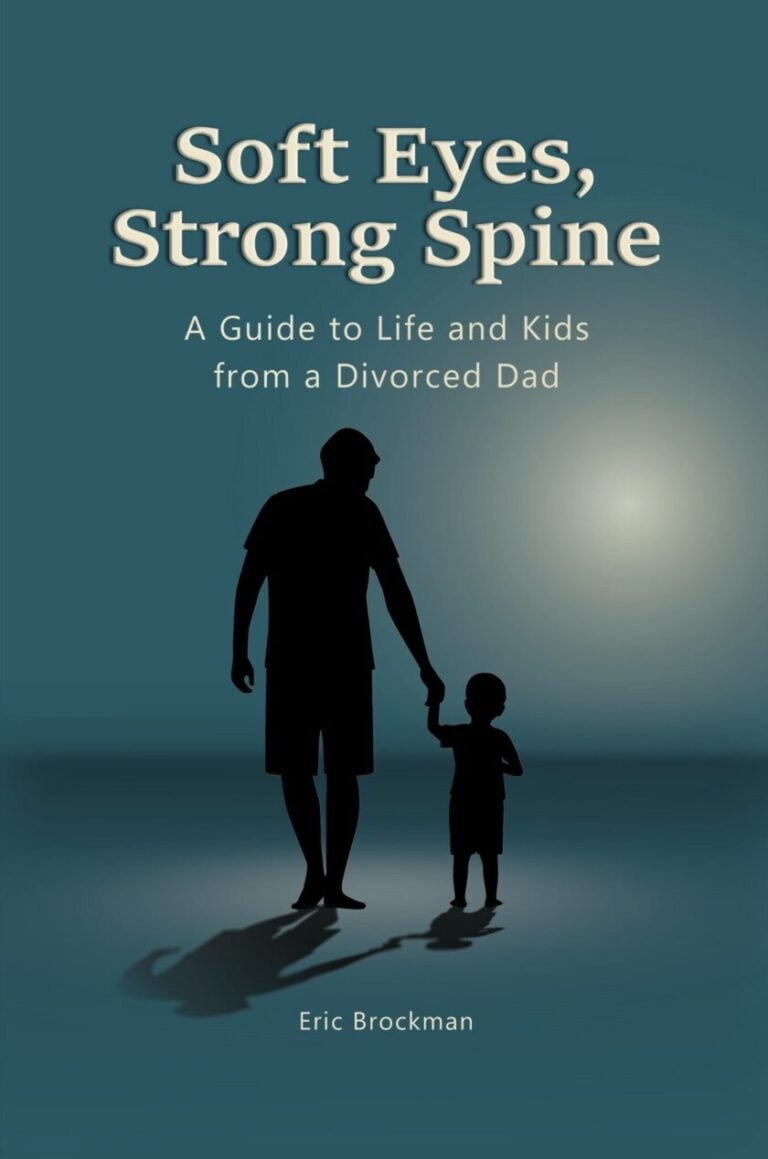
 The book is Soft Eyes, Strong Spine: A Guide to Life and Kids from a Divorced Dad: Received a 4+ star review, making it an IndieReader Approved title.
 The book is Soft Eyes, Strong Spine: A Guide to Life and Kids from a Divorced Dad: Received a 4+ star review, making it an IndieReader Approved title.
Following find an interview with author Eric Brockman:
1.What is the name of the book and when was it published?
The book is Soft Eyes, Strong Spine: A Guide to Life and Kids from a Divorced Dad. It was published on March 27, 2026.
2. What’s the book’s first line?
“The mirror is a mean thing because it never lies. And when you’re a divorced guy in his late fifties, the mirrors seem to multiply.”
3. What’s the book about? Give us the “pitch.”
Soft Eyes, Strong Spine is a memoir-driven field guide for divorced dads—and for anyone trying to stay steady, human, and connected while life is being rearranged. It is written for men who look functional on the outside but live with a constant internal tightening—scanning, bracing, trying not to make the one mistake that costs them their relationship with their kids. There is no therapy-speak here. No hype. No polished performance. Just practical steadiness. At its core, the book is about helping men move from fear-based control to grounded connection. It is about staying emotionally present without collapsing, hardening, performing, or turning every difficult moment into a quiet emergency. It is about learning how to stay close to your children without losing your footing. The central framework is simple, memorable, and durable: Soft Eyes / Strong Spine. Soft Eyes means warmth, awareness, and the ability to stay open. Strong Spine means steadiness, boundaries, and the ability to remain grounded under strain. The book is built out of real scenes, not lectures. It is plainspoken, direct, and rooted in lived experience. The goal is not to impress the reader. The goal is to offer something clear, usable, and emotionally honest. Some of the key themes and takeaways include:
-regulating emotional reactivity without shutting down
-moving through conflict without collapsing or controlling
-holding boundaries with calm awareness and firm steadiness
-navigating tough conversations without escalation
-staying connected to kids without making them carry adult strain
-learning to show up at what I call the right frequency—clear, steady, and true
It is a book for newly divorced men, for fathers committed to staying close to their kids, for parents navigating co-parenting, teenagers, or the quiet house, and really for anyone trying to rebuild steadiness in a season of transition.
4. What inspired you to write the book? A particular person? An event?
It was not one event so much as a compression of several at once. I did not begin writing this book because I wanted to become an author. I began writing it because life had cornered me into a deeper honesty. Life had gotten louder than I could keep up with—raising boys, losing a marriage, carrying too much at work, and trying to keep everyone else calm while I quietly braced for impact. On the outside, I could still function. On the inside, there was a great deal of tightening, scanning, and effort going into simply holding the line. The book grew out of the introspective journey that followed. I began writing as a way to make sense of what I was living through, what I was getting wrong, what I was learning, and what it might look like to become steadier without becoming harder. At first, it was not “book writing” in my mind. It was survival writing. It was truth-telling. It was a way of trying to hear myself clearly in the middle of a noisy life. Over time, those pages became something larger. They became a way of naming what many men live but do not always know how to say. So while the source of the book was deeply personal, it was never only personal. I knew I was not the only father trying to love his kids well while also trying to rebuild himself in the middle of change.
5. What’s the main reason someone should really read this book?
Someone should read this book because life does not only test us when things break. It also tests us in transition—when the old structure is gone, the new one has not fully formed, and the people we love still need something steady from us. This book offers an emotional operating system for those moments. This book is not about having the perfect response. It is about learning how to stay grounded enough to give a true one. It gives readers language, structure, and lived examples for how to regulate themselves and remain connected when life is shifting under their feet. Whether someone is navigating divorce, fatherhood, co-parenting, grief, pressure, or identity change, the deeper question is often the same: How do I stay human, steady, and connected when everything around me feels unsettled? That is the question this book is trying to answer.
6. When did you first decide to become an author?
I did not grow up thinking of myself as someone who would write a book. What happened instead was that I went through a season of life that demanded a much deeper level of reflection than I had ever practiced before. The early writing was not “authorial” in my mind. It was simply a way to think clearly, tell the truth, and sort through what I was learning in real time. At some point, I realized the writing had shape, continuity, and a voice of its own. That was probably the moment I understood I was becoming an author—not when I declared it, but when the writing itself began asking to become something larger than notes to myself.
7. Is this the first book you’ve written?
Yes, this is my first book. But writing it unlocked something in me that feels larger than a single project. It opened up a genuine love of writing that has continued beyond the book itself. I now write a weekly email newsletter and continue building a body of work around many of these same themes. My hope is that this is not a one-time effort but the beginning of a longer writing life, including the next book.
8. What do you do for work when you’re not writing?
I am a longtime sales professional in the aerospace composites industry, with more than 35 years in sales. That background shaped me in many ways—discipline, resilience, communication, and the ability to stay composed under pressure. It also gave me a front-row seat to how easily performance, responsibility, and output can crowd out reflection. In some ways, this book was written from inside that tension.
9. How much time do you generally spend on your writing?
As much time as I can make for it. I generally write in the mornings. I find the very early hours calming—before the day starts pulling in every direction, before the noise gathers, before practical demands take over. There is something about that quiet window that allows me to hear the deeper current underneath things. I would like to create even more room for writing in the future. It has become one of the clearest ways I know to think, to tell the truth, and to be useful.
10. What’s the best and the hardest part of being an indie?
The best part is the flexibility and the full creative control. I can shape the voice, the design, the message, the timing, and the direction without forcing the work into someone else’s mold. That matters to me because this book is deeply personal, and I wanted every part of its presentation to remain aligned with what it actually is. The hardest part is distribution and discoverability. Writing the book is one challenge. Getting it into enough hands is another one entirely. That side of the work requires persistence, outreach, creativity, and a willingness to keep building momentum without the built-in machinery of a large publisher behind you. That said, I am fully engaged in that part of the journey as well—through outreach, media, events, and a 2026 book fair tour with eight dates across the Southeast.
11. What’s a great piece of advice that you can share with fellow indie authors?
Keep showing up. A lot of the indie path is less glamorous than people imagine. But if you keep showing up and keep stacking real work, the signal gets stronger. It sounds simple, maybe even too simple, but the indie path can pull your attention in a hundred directions at once. You are writing, editing, publishing, designing, marketing, networking, and trying to stay encouraged all at the same time. So my advice is to keep stacking the right things: good writing, good content, good outreach, and honest momentum. Keep making work you believe in. Keep putting it in front of people. Over time, if what you are building is real, it begins to align in a congruent way. A great deal of this journey is simply staying present long enough for the work to compound.
12. Would you go traditional if a publisher came calling? If so, why?
I created my own imprint, Soft Eyes Strong Spine Press, so in that sense this is not purely self-published in the most casual way. At the same time, it obviously does not come with the scale, infrastructure, or reach of a major traditional house. If a traditional publisher came calling, I would absolutely take a serious look. Anyone would. But I would weigh it carefully. Creative direction matters to me. So does the ability to shape the message and guide the marketing in a way that remains faithful to the heart of the book. So yes, I would be open—but not at the expense of the book losing its voice.
13. Is there something in particular that motivates you (fame? fortune?)
Like most people, I would not pretend fame and fortune have no appeal. But the deeper motivation is much simpler and much more meaningful than that. I want to help other dads and parents who are walking the same confused paths so many of us find ourselves walking at one point or another. I want to offer something steady, honest, and useful to people who may look composed on the outside while quietly coming apart inside. If this book genuinely helps someone—if it helps a father stay closer to his kids, or helps someone move through a hard season with more steadiness, humanity, and self- awareness—then the effort behind it is worth it.
14. Which writer, living or dead, do you most admire?
I have always admired Vince Flynn. There was something about the directness of his writing, the pace, and the clarity of his style that always stood out to me. His work did not waste motion. It knew what it was trying to do and did it with confidence. That kind of directness appeals to me. It is obviously a very different genre from mine, but the underlying principle still carries over. I respect writing that is clean, decisive, and unafraid to say what it means.
15. Which book do you wish you could have written?
The Four Agreements by Don Miguel Ruiz. There is a simple elegance to that book that I deeply admire. It is clean, memorable, and lasting. It carries wisdom in a way that feels both accessible and profound, and that is a rare combination. I think every writer admires books that make difficult truths feel simple without making them shallow. That book does that.