
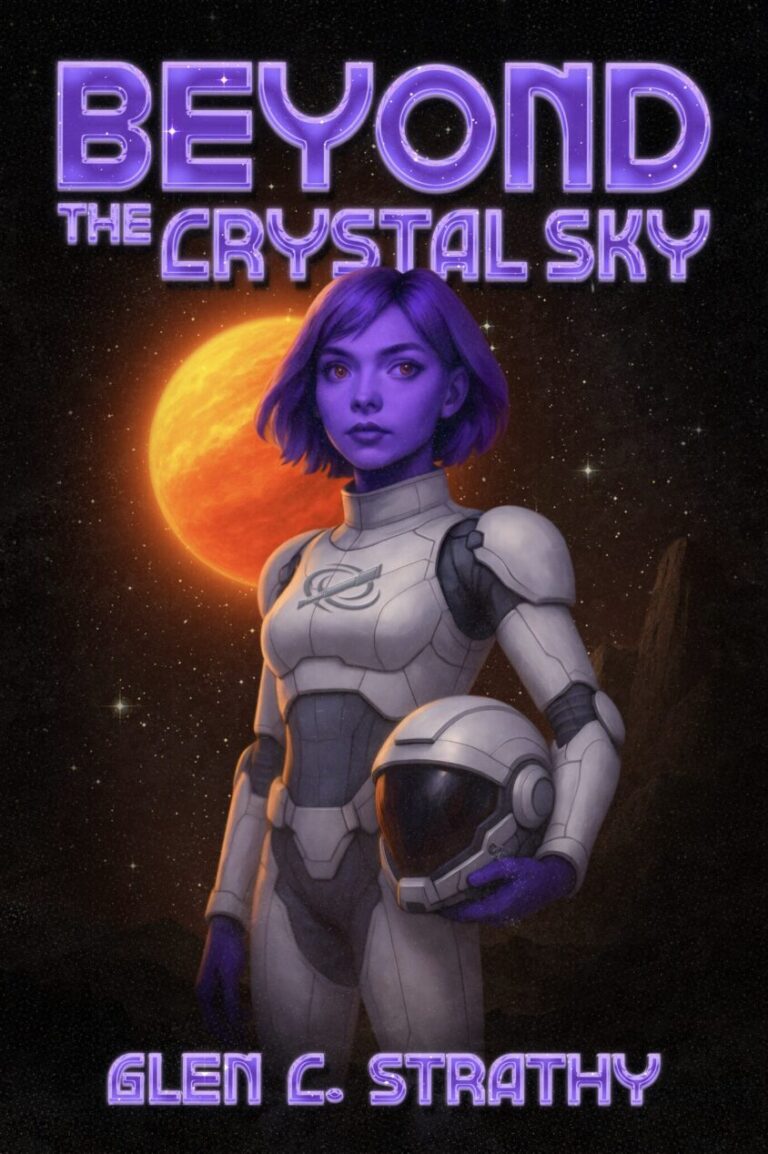
 Beyond the Crystal Sky: Received a 4+ star review, making it an IndieReader Approved title.
 Beyond the Crystal Sky: Received a 4+ star review, making it an IndieReader Approved title.
Following find an interview with author Glen C. Strathy:
1.What is the name of the book and when was it published? Beyond the Crystal Sky. It was published a few months ago. (Officially 2025.)
2. What’s the book’s first line? The book opens with an interview, the first line of which is: “You are Perdit Agy-Cort. Female. Age 17. Born resident of Colony Deck 1.” However, the line that actually begins the story is… “When I was twelve years old, the sun stopped.“
3. What’s the book about? Give us the “pitch”. It’s a young adult, science fiction story about a 17-year-old girl named Perdit who is born on a gigantic generation spaceship (a ship that takes many generations to reach its destination) where most people live on colony decks that imitate the environment of a planet. However, the environment on Perdit’s colony seems to be slowly collapsing threatening the people’s survival. And the all-seeing Navcrew who are supposed to deal with such problems are nowhere to be found. Perdit makes it her goal to pass the Ability Trial and join the Navcrew, but encounters no end of obstacles. including a forced marriage, unfair punishments, a villain with his eyes on her DNA, and harsh interrogations from the ship’s AI. Nonetheless, she perseveres, gathers allies, and embarks on a heroic quest to leave her colony, solve the mysteries of the great ship, and save her world.
4. What inspired you to write the book? A particular person? An event? My main inspiration was the science fiction stories I grew up reading. There’s a whole subgenre within science fiction that explores generation ships and the challenges they might face. I was also interested in the story of this girl who rebels against a society that has gone off course, but in a very positive way.
5. What’s the main reason someone should really read this book? If you love classic science fiction adventures and strong female characters, the story offers you a unique combination of the two. If you like stories that explore themes such as the individual vs. society, institutional dysfunction, and the post-apocalyptic dystopia, the story offers what I hope is a unique take on the tropes. And if you like the combination of heroic adventure and a main character wrestling with her own self-doubt, I think you’ll enjoy spending time with Perdit.
6. What’s the most distinctive thing about the main character? Who-real or fictional-would you say the character reminds you of? I don’t think I’ve ever experienced a character or real life person who I would say strongly reminds me of Perdit. She’s pretty distinct. She has a combination of advantages and disadvantages that I intentionally gave her in hopes of making her admirable, but also unlike many of the “girl-bosses” we’ve seen in genre media in recent years. Some of her traits also result from growing up in a community very different from ours, and different (I hope) from what the reader has encountered before.
7. When did you first decide to become an author? When I was a tween, 10-13 years old, I became hooked on classic science fiction writers like Isaac Asimov, Ray Bradbury, Harlan Ellison, and Arthur C. Clarke. I’d read anything with a spaceship in it. A lot of the SF anthologies they edited would have a forward in which they talked about their lives a little. As a lonely child, it made me feel like there was a bigger circle of friends waiting for me if I became a writer. So I taught myself to type on an old manual typewriter and began writing my own stories.
8. Is this the first book you’ve written? No, I also wrote a middle-grade novel about a decade ago called, Dancing on the Inside. It’s the story of a 12-year-old girl who wants to become a dancer but suffers from severe social anxiety. So it’s a totally different genre from Beyond the Crystal Sky. I’ve also written several nonfiction works and a novelette prequel to Beyond the Crystal Sky called, Near Sight.
9. How much time do you generally spend on your writing? It depends what else is going on in my life. I have two more books on the go at the moment, so I will be pretty busy for the next few months.
10. What’s the best and the hardest part of being an indie? The hardest part of being indie is promotion and making sales. That’s true of traditional publishing too, and most other businesses, but it’s particularly challenging for writers, many of whom have temperaments that are not well-suited to those tasks. The best part is that you don’t have to jump through the hoops laid out by the traditional publishing industry to get your book in print. You don’t have to worry about spending a year or more writing a book only to discover that publishers aren’t currently interested in your particular genre. Mind you, you still have to face the hurdle of promotion.
11. Would you go traditional if a publisher came calling? If so, why? The kind of traditional publisher every writer dreams of probably doesn’t exist anymore. Maybe it never existed. What every writer wants is a way to outsource all the business aspects of publishing so they can focus on the fun and fulfilling part — writing. The ideal publisher would provide you with a great editor, handle all the marketing, promotion, distribution, rights issues, sales, taxes, etc., pay you a lot of money, and generally leave you free to write and enjoy family, friends, and hobbies.
12. Is there something in particular that motivates you (fame? fortune?) The only purpose of fortune is that it lets you do more of what you enjoy doing. It lets you have time to write and take enough time to think through what you’re writing. The only purpose of fame is that it makes it easier to get fortune and opportunities. I’m mainly motivated by the personal fulfillment I get from writing, from taking ideas that interest me and turning them into a story. Of course, a little cash would be welcome too. Buy my books.
13. Which book do you wish you could have written? Offhand, I can think of two, both from the fantasy genre. Obviously everyone would love to write the next Harry Potter, if for no other reason than the money and fame would give you the freedom to do whatever you wanted next. The other is Lord of the Rings, because no one has ever done world-building better than J.R.R. Tolkien.