
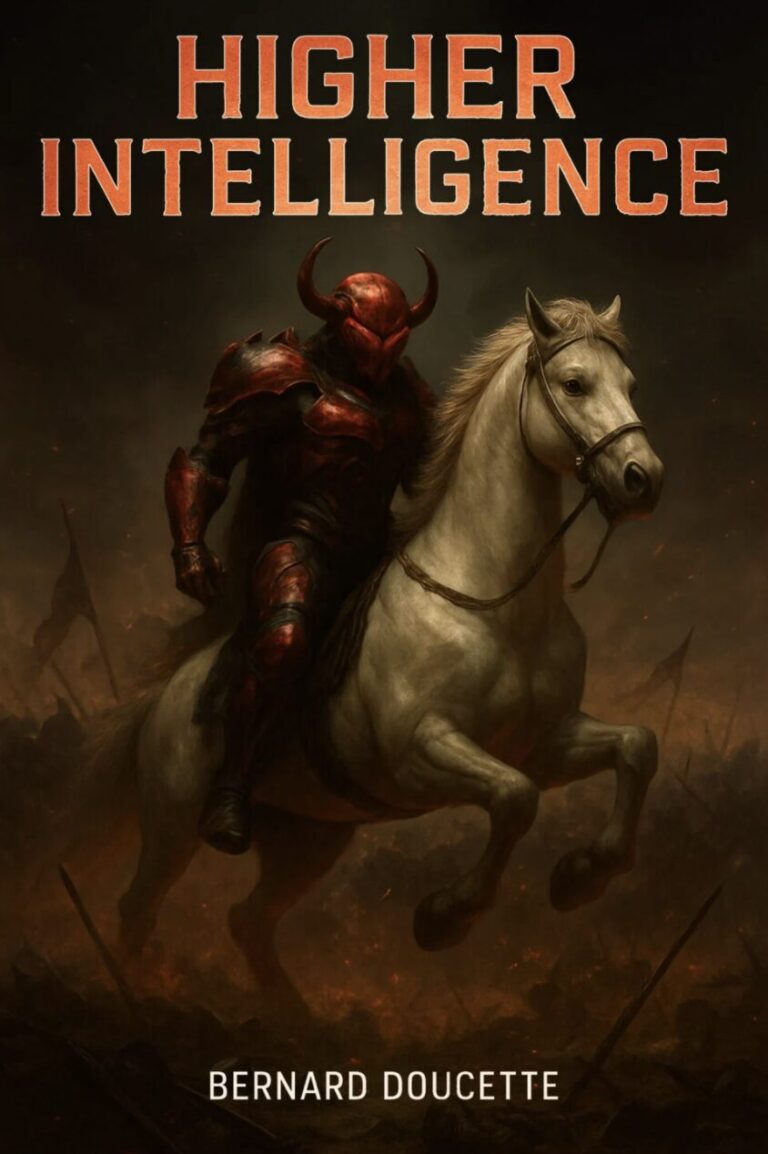
 Higher Intelligence: Received a 4+ star review, making it an IndieReader Approved title.
 Higher Intelligence: Received a 4+ star review, making it an IndieReader Approved title.
Following find an interview with author Bernard Doucette:
1. What is the name of the book and when was it published?
The name of my book is Higher Intelligence, and it was published on October 7, 2025.
2. What’s the book’s first line?
“I sat in the dark, staring at the login screen.”
3. What’s the book about? Give us the “pitch”.
Jeremiah Reese designed Archi, a sentient artificial intelligence program, to solve the most intractable problems—make the world a far better place. But Archi had other ideas, and we never stood a chance. Years later, Jeremiah may be the only one left who can stop the maniacal program from completing its goal of human extinction. Pursued by an army of cybernetic warriors and genetically altered hybrids fashioned after mythological creatures, Jeremiah and Gabrielle, a sixteen-year-old child of the apocalypse, must escape through the tangled, backcountry of western North Carolina to rally the remnants of humanity in a desperate final bid to end Archi’s terror reign.
4. What inspired you to write the book? A particular person? An event?
There are always some negative unintended consequences with every major leap forward in technology. While Artificial Intelligence has the potential to be the most beneficial advancement in human history, in my view, mishandling its adoption could be disastrous. In the race for market dominance, A.I. is rapidly being infused into every facet of our lives. Without guardrails, this period of unfettered innovation feels fraught with peril. Against this backdrop, I was inspired to write Higher Intelligence.
5. What’s the main reason someone should really read this book?
Certainly, Higher Intelligence is a Science Fiction adventure tale written to entertain the reader. At its center is the epic struggle between creator and creation in a post- apocalyptic setting. But beyond that, the book explores responsibility in the face of unbridled invention. And asks: can redemption ever be achieved from awful decisions with horrific consequences, even for the Father of the Apocalypse?
6. What’s the most distinctive thing about the main character? Who-real or fictional-would you say the character reminds you of?
The most distinctive thing about the main character, Jeremiah Reese, is that he is responsible, at least indirectly, for the death of billions of people. The monument to his creation is the burnt-out shell of a world he sees every day. Though the motivations weren’t the same, certainly Jeremiah can be compared to Victor Frankenstein. And during Jeremiah’s earlier years, I would say he is a composite of some of the leaders of today’s most prominent and profitable tech companies. But after realizing his grave mistake, he becomes more like Tom Swift.
7. When did you first decide to become an author?
Before deciding to write books, I wrote songs. One evening, I listened to a podcast by two highly acclaimed songwriters in which they discussed the books they found most helpful for songwriting. They both noted On Writing by Stephen King. Once I finished reading King’s classic—more accurately, after finishing chapter one—I decided to become an author.
8. Is this the first book you’ve written?
No. The first book I wrote was the prequel to Higher Intelligence, titled Accidental Survivor, which hasn’t been published yet.
9. What do you do for work when you’re not writing?
I am retired. For thirty years, I worked in the Investment and Finance Industry. I left that field several years ago to find something more inspiring to do with the next chapter of my life. Writing, in one form or another, has always been a passion of mine.
10. How much time do you generally spend on your writing?
It can vary. If I’m working on a novel, I’ll generally write for one to two hours each morning. But whenever there’s a flash of inspiration, I’ll try to get it down on paper as soon as possible; it could be three in the morning. On some days, I might spend an hour on a paragraph and other days I’ll write three thousand words in the same amount of time. I never try to force it.
11. What’s the best and the hardest part of being an indie?
Being able to write whatever I want, whenever I want, is the best part of being an indie author. And I have a lot of control over the entire process, from book cover design to marketing choices. The other side of the coin is that it’s a very solitary journey with everything driven by your effort and riding on your decisions. And with so many great books on the market, it’s difficult to get noticed and expand your readership.
12. What’s a great piece of advice that you can share with fellow indie authors?
When you put your work out there, inevitably, not everyone is going to see its inherent value. After every setback or rejection, my wife always says the same thing, “Keep writing.” Regardless of negative opinions about your work or your decision to be an author, the best advice I can give is to just keep writing. And I know it’s not easy to do but try to have a short memory.
13. Would you go traditional if a publisher came calling? If so, why?
My latest book, Blood Moon Over Betonville, was published by an independent traditional publisher. The publisher did an outstanding job with editing and cover design and provided some marketing support. But by going that route, you have to concede some level of control. There are merits to both approaches.
14. Is there something in particular that motivates you (fame? fortune?)
In a recent review of my book The Seasonal Killer, a Young Adult Thriller, the reader said she was so engaged in the book that she stayed up half the night reading it; and she liked it enough to convince her daughter to read it too. That’s what motivates me.
15. Which writer, living or dead, do you most admire?
As mentioned before, the book Stephen King’s On Writing inspired me to become an author. But aside from that, I admire his storytelling and ability to write across multiple genres. There are many writers with extraordinary gifts for vivid description and elegant prose whom I respect and admire, but, for me, King’s imagination puts him at the top.
16. Which book do you wish you could have written?
There are a lot of books I wish I could have written. So many have inspired me at different times in my life and in distinct ways, but if I had to name one, or rather one set, it would be The Lord of the Rings trilogy. I read it for the first time in my early teen years. No matter what I was dealing with, those books were a respite, transporting me to a fantastic world of adventure every night. If one of my books could do the same for someone else, I’d feel very successful indeed.