
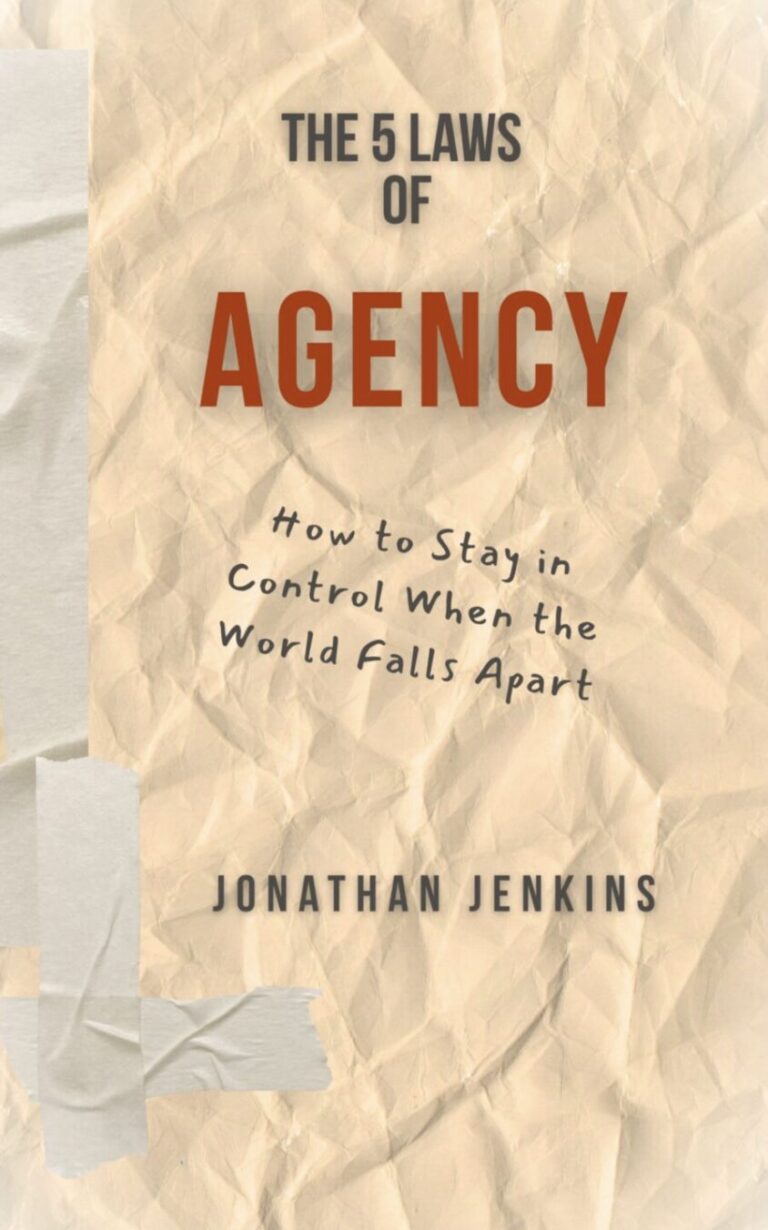
 The 5 Laws of Agency: How to Stay in Control When the World Falls Apart: Received a 4+ star review, making it an IndieReader Approved title.
 The 5 Laws of Agency: How to Stay in Control When the World Falls Apart: Received a 4+ star review, making it an IndieReader Approved title.
Following find an interview with author Jonathan Jenkins:
- What is the name of the book and when was it published?
The 5 Laws of Agency: How to Stay in Control When the World Falls Apart. Published in 2025.
- What’s the book’s first line?
“You are not overwhelmed because you are weak.”
- What’s the book about? Give us the “pitch”.
Most people are living from momentum, not intention. They are reacting to a life they never consciously chose, running systems they never designed, interpreting reality through frames they inherited before they could evaluate them. The 5 Laws of Agency is built on one foundational truth: the human mind was never designed to experience consciousness alone. Your brain evolved as part of a distributed system, a tribe, and modern life stripped that scaffolding away without replacing it. The five laws rebuild that architecture. They cover how you interpret reality, where your energy actually comes from, why direction matters more than speed, why your brain is a compass and not a container, and why leverage is the only thing that survives in an accelerating world. This is a structural manual for people who are tired of coping and ready to rebuild.
- What inspired you to write the book? A particular person? An event?
I kept watching capable people collapse quietly. The kind of collapse that looks like functioning. People going to work, raising families, answering emails, performing competence while something inside them had gone dim. They did not need another morning routine or gratitude journal. They needed someone to explain why everything felt so heavy despite doing everything right. The self help industry profits from never actually solving the problem. It keeps people cycling through books and seminars and hacks, always buying the next answer. I wanted to write something that ended that cycle. Five laws. Internalize them. Move on with your life.
- What’s the main reason someone should really read this book?
Because you have probably read books like this before and you are still searching. That is not your failure. That is a design flaw in the genre. Most self help gives you surface tactics for structural problems. This book goes underneath. It explains why rest does not fix your exhaustion, why speed has not produced progress, why your mind feels cluttered no matter how organized you are, and why grinding harder keeps making things worse. The five laws work whether your life is stable or falling apart, and the daily practice takes seven minutes. Read it once for the framework. Return to it when things break. It was built to age with you.
- When did you first decide to become an author?
I did not set out to become an author. I had something to say that nobody else was saying the way it needed to be said. The writing followed the message, not the other way around.
- Is this the first book you’ve written?
It is the first I have published. The ideas in it developed over years, tested in real environments under real pressure before they became chapters. The book exists because the framework worked. I wanted other people to have access to it.
- How much time do you generally spend on your writing?
It depends on the phase. During a writing cycle it is hours a day, usually early morning or late at night when the world is quiet. But the real work happens between the sessions. Frameworks restructure themselves while I am driving. Sentences land in the middle of unrelated conversations. The mind keeps working on what it cares about whether you are at the desk or not. The discipline is showing up to capture what surfaces.
- What’s the best and the hardest part of being an indie?
Best: total creative control. Nobody told me to soften the tone or add inspirational quotes or chase whatever trend is selling this quarter. The book says exactly what I wanted it to say, the way I wanted to say it. Hardest: you are the entire operation. Writer, editor, marketer, strategist, fulfillment. There is no team absorbing the parts you do not enjoy. You either build the infrastructure yourself or the book dies quietly regardless of how good it is.
- What’s a great piece of advice that you can share with fellow indie authors?
Write the book that does not exist yet. Not the one the market is asking for or the one that fits neatly into a trending category. Write the book you needed and could not find. If you write from that place the voice will be authentic, the message will be specific, and the right readers will find you because nobody else is saying what you are saying. The market rewards originality more than it rewards imitation. Most authors are afraid to be the only one on their shelf. That is exactly where you want to be.
- Would you go traditional if a publisher came calling? If so, why?
For the right deal, yes. Traditional publishing offers distribution reach and institutional credibility that are difficult to replicate independently. But the offer would need to preserve the book’s identity. The 5 Laws of Agency works because it does not sound like everything else on the shelf. If a deal required diluting that to fit a formula, I would walk. The edge is the value. Remove it and you have another forgettable title collecting dust in a warehouse.
- Is there something in particular that motivates you (fame? fortune?)?
Impact. I want someone to pick up this book during the worst stretch of their life, read that opening line, and feel something shift. Not motivation. Recognition. The feeling of finally having language for what has been breaking them quietly for years. Sales and reviews and growth are evidence the message is reaching people. But the real fuel is the reader at two in the morning who needs someone to tell them they are not broken, that their overwhelm is architectural and not personal, and that there is a way to rebuild.
- Which book do you wish you could have written?
Meditations by Marcus Aurelius. He wrote it for himself. No audience, no market, no strategy. A man under impossible pressure writing the truths he needed to survive each day. It accidentally became essential to millions of people across two thousand years because it was real, written under real conditions, with no concern for how it would be received. That is the standard. Say something true under pressure and trust that the people who need it will find it.