
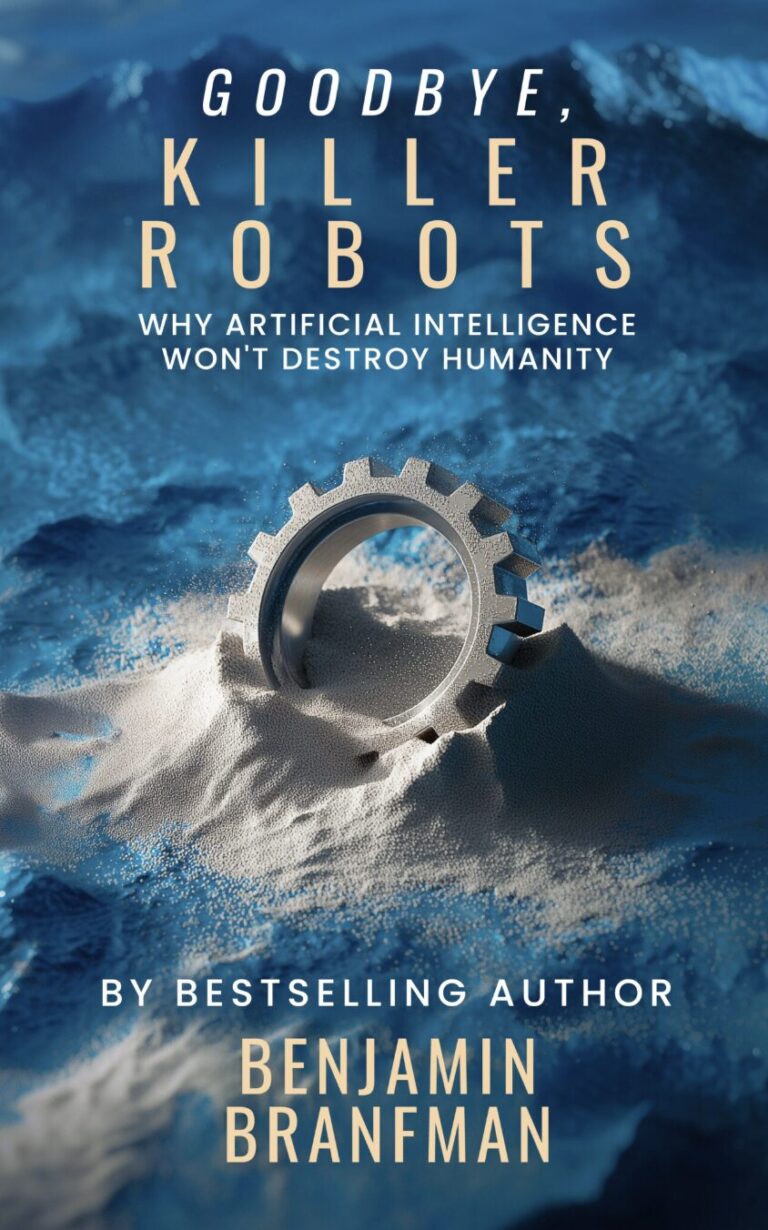
 Goodbye, Killer Robots: Why Artificial Intelligence Won’t Destroy Humanity: Received a 4+ star review, making it an IndieReader Approved title.
Following find an interview with author Benjamin Branfman:
What is the name of the book and when was it published?
Goodbye, Killer Robots: Why Artificial Intelligence Won’t Destroy Humanity. It was published August 21, 2025, in paperback, hardcover, and e-book formats, all available on Amazon.
What’s the book’s first line?
“Ah yes, the end of the world.”
What’s the book about? Give us the “pitch”.
In a time when many people are afraid of AI, this book presents a welcome perspective on why everything will be all right. Goodbye, Killer Robots offers in-depth commentary on how AI is far less competent than you might expect, how AI won’t care about conquering anyone, and how AI-generated content won’t send our society into chaos. It also covers other pertinent topics, like how AI will affect the job market and warfare. Overall, this book shows a totally different side of AI in stark contrast to the fearmongering that usually overwhelms this topic.
What inspired you to write the book? A particular person? An event?
I’ve always been very vexed by how people tend to make every problem worse than it needs to be. Turn on the news anywhere, and you’ll likely see a bunch of angry folks ranting about whatever issue will supposedly end the world this week. But despite decades of sensational doomsday speeches by “experts,” it’s all just been a bunch of hot air. Fear and anger are strong tools to make people pay attention. If you tell people that something could destroy them all, they’ll be more likely to watch your channel or buy your book or so on. I wanted to write a book that was honest. Even if I would have sold more copies with a book called ROBOTS WILL EAT YOU IF YOU DON’T BUY THIS BOOK RIGHT NOW, I wanted to reassure people that AI is really just another overblown issue that will ultimately be fine. It might cause problems, just like plenty of other technology, but it’s not some kind of inevitable apocalypse.
What’s the main reason someone should really read this book?
This book is a lot more honest than many other books on the topic. My book is designed to help inform people, not to stoke fear as a cash-grab.
Additionally, you can choose to answer any or all from the following ten:
Is this the first book you’ve written?
No, I’ve written about 15 other works, including full-length books, short booklets, and a couple manuscripts that I’ve never (yet) chosen to publish. Funnily enough, my very first published book was a joke book—but it became Amazon’s #1 bestselling joke book for almost two years continuously. I wish I could say that’s because the jokes were amazing, but really I just marketed it extremely well. I was apparently the first person to realize how, when you write a joke book, the target audience is NOT people who like jokes. The real target audience is the FRIENDS of people who like jokes, because the friends are the ones who are actually buying the book as a gift for the joke lover. Lots of families have that one offbeat uncle who loves puns—but that guy doesn’t go onto Amazon to buy a pun book. You’re the one who goes looking for the book, the day before your uncle’s birthday, when you realize you’ve forgotten to get a gift for him. My competitors were sending ads like “If you love puns, you’ll love this book!” Meanwhile, my strategy was more like “Is it Christmas Eve, and you still need to get a gift for your quirky uncle? Buy this.” And it flew off the shelves.
It’s called The Little Book of Giant Puns, it’s still available on Amazon today, and… oomph, if I’d known how successful it would be, I would have written better jokes! Sorry!! I’ve had other #1 bestsellers, and my favorite is probably a short booklet on memory improvement called How to Make an Awesome Mind Palace.
What do you do for work when you’re not writing?
I spent a decade working in the corporate office of a Broadway production company, handling contracts, marketing, fundraising, and other business logistics behind theater shows. I still do a bit of that, but my books have been doing well enough that I’ve mostly been writing full-time for the last few years.
How much time do you generally spend on your writing?
If you set a specific goal for yourself, it’ll actually slow you down. If you tell yourself “I have to write 10 pages today,” or “I have to write for 2 hours,” then every second will feel like a brutal chore. You’ll just endlessly be comparing where you are to where the finish line is. So instead, I tell myself that literally any progress I make in a day is totally fine. I could type a single punctuation mark, and be done. But since the pressure is off, I usually sit down and write all day long with no problem. Whenever I get tired, I tell myself—truthfully—that I can absolutely stop at any time. That relaxed attitude prompts me to think, “Well, in that case, I don’t mind typing just one more sentence.” And then I’ll end up writing for another few hours. A big part of why writing is hard is because of the stress/psychology, and how you know you’ve got so much work left to do. If you can remove that stress from the equation, the writing becomes sublimely easier.
What’s the best and the hardest part of being an indie?
The best part is that nobody else tells me what to write about. The hardest part is that, after I’ve put months or years of effort into writing something, I have no guarantee that many other people will even see my work (much less buy it and like it). If I had a huge publisher behind me, then there would presumably be enough of a marketing budget to make sure that I got at least some strong circulation and exposure. (But the truth is, nowadays, even huge publishers don’t always have budgets as big as they used to. So being mainstream isn’t necessarily as lucrative as it’s cracked up to be!)
What’s a great piece of advice that you can share with fellow indie authors?
Some things should be difficult. The reason why so many people want to be a successful writer is because almost no one ever will be. If anyone could write a popular book easily, then no one would want to do it anymore, because there would no longer be anything remarkable about the achievement. Writing is a lot more fun than working in an office, but it’s still a job that requires real effort. Lots of people say that they “would write a book if they had the time,” but I think the real hurdle is that they don’t want to put in so much effort. They have an idea, but they can’t bring themselves to actually sit down and write about it. They write to the bottom of page 1, then they realize how much work writing really is, and they give up. If you want to be a writer, then you need to put in a lot of effort. If that’s difficult, good! It’s supposed to be.
Would you go traditional if a publisher came calling? If so, why?
Oho, you found my one long answer! Here goes…
I’d go traditional if the publisher didn’t censor me. Some big companies set a lot of guidelines, while others respect the authors and give a lot of freedom. I often talk about controversial topics, or I present a standard topic in a very controversial way. And I don’t want to change that writing style, because I think it’s helpful and informative to readers. Take my current AI book, for example. Do you think many publishers would accept a book with the message “Everything is fine?” No, I think they’d rather encourage the author to stir up a scandal, to boost sales.
Beyond just the main topic itself, my AI book also discusses at least two other ideas that are extremely spicy. The first spicy topic is cancel culture: In my chapter about AI deepfake misinformation, I talk about how people often believe things that aren’t true. On social media, we can block or unfriend anybody who says anything we dislike. Pretty soon, website algorithms figure out what kind of ads we like to see. And before we know it, we’re in an isolated world where we only ever see what we want to. It’s the “echo chamber,” a sealed social situation where all of the content reinforces what we already believe (true or not), and makes us more radical and polarized. We start to think that we’re the only sane people in the world, and everyone different from us is crazy, and we need to cancel those people. It’s a very deluded and unhelpful mindset, and I roast it pretty hard in Goodbye, Killer Robots.
I’ve noticed that literally everyone who has reviewed my book has conveniently ignored that section, but given me a very positive review anyway. I think it’s because a lot of people agree with me that cancel culture is insane, but other people don’t want to publicly admit that, because they’re afraid of getting canceled themselves. We should be able to talk about things like this without fear, so that our society can actually address the problem and improve.
The second spicy topic is the afterlife, but not for any religious reasons. I see the afterlife as a purely logistical issue: If death is the end, then is anything else worth talking about? Why are we getting so obsessed with things like oil prices or taxes, if everything eventually just vanishes anyway? What achievements are really worth our time, if death will erase them? I think we all understand this problem, but we’re afraid to talk about it because it’s too stressful. In my opinion, just procedurally, it’s necessary to consider the idea that an afterlife could potentially exist, because otherwise there’s really no point in doing anything. I understand that some people will write off that stance as some kind of zealotry, but I’m not even religious at all. I just understand that most of our goals are based on achieving something, and those achievements will only matter if they last indefinitely. So I talk about the afterlife, quite a bit, and I’m not sorry about it.
Would I have been able to sell those two ideas to a mainstream publisher? Maybe. But it wouldn’t have been a sure thing.
Is there something in particular that motivates you (fame? fortune?)
I like to help people to understand difficult topics. I think a lot of unnecessary harm happens in the world, because people have no idea what they’re doing or talking about.
Which writer, living or dead, do you most admire?
Alive, it’s Garth Nix. His fantasy stories are deeply imaginative and rich in lore.
Dead, it’s Edgar Allan Poe. His ability to craft atmospheric and effective stories, in a short length of writing, is exceptional.
Perhaps in a few years, you’ll be one of my favorite writers. And I’ll be flattered if I’m one of yours!