
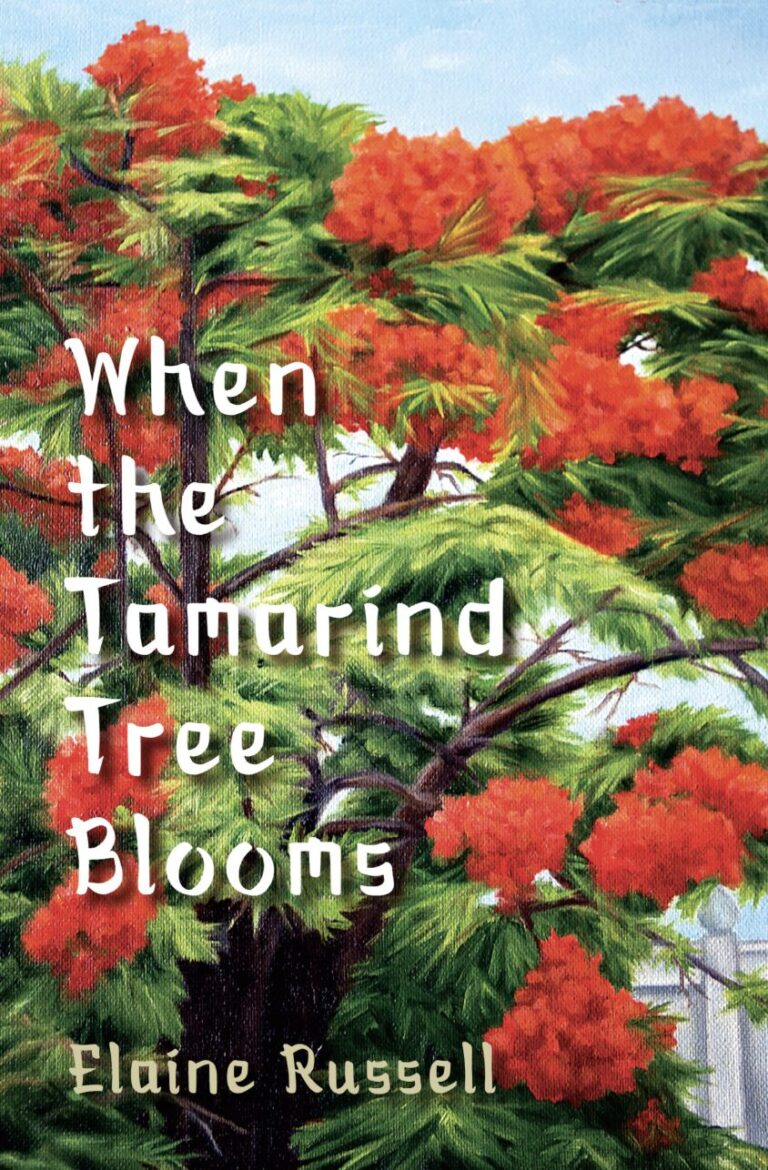
 WHEN THE TAMARIND TREE BLOOMS: Received a 4+ star review, making it an IndieReader Approved title.

Following find an interview with author Elaine Russel:
1. What is the name of the book and when was it published?
When the Tamarind Tree Blooms, was published on April 1, 2024, in print and ebook. An audiobook was just released in October 2025. All are available on all retail venues online.
2. What’s the book’s first line?
“Vientiane, Laos—May 14, 1931
On a Thursday in mid-May, I balanced on a bough of the ancient tamarind tree, gazing over the wall of the home for orphaned girls.”
3. What’s the book about? Give us the “pitch”.
Short pitch: The coming of age story of a young métisse, half-Lao, half-French, in 1931 French colonial Laos, who is searching for her past as she tries to determine where she fits in among the deeply divided Lao and French communities, one foot in each world.
Longer Story Summary: Geneviève (Vivi) Dubois, a métisse, half-Lao/half-French, turns eighteen and leaves the French orphanage in Vientiane where she has been trapped for fourteen unhappy years. With only a distant memory of being torn from her mother’s arms at age four, she is determined to uncover what happened to her parents and locate her missing twin brother. But where to start? Orphanage and government officials refuse to reveal her origins. She leaves her strict, Catholic upbringing behind and emerges into the deeply divided communities of 1931 French colonial Laos. Neither French colons nor native Lao readily accept her mixed heritage. Where does she fit in as she navigates her way, one foot in each world? She is grateful for the kindness of her former French teacher, who offers her shelter and support. But she meets with prejudice, mistreatment, and rejection at every turn. Even falling in love is fraught with the cultural restrictions of two dissonant societies. A long circuitous route leads her to the past and a way forward to a better future, one where she is proud of who she is and rightfully claims her life as her own.
4. What inspired you to write the book? A particular person? An event?
First, I need to explain that I have a deep connection to Laos, which began almost 20 years ago when I was writing my first historical novel, Across the Mekong River. The following is a section from my website on this: https://www.elainerussell.info/copy-of-about
I first traveled to Laos in 2006 to research my novel Across the Mekong River (the story of Hmong refugees), and immediately fell in love with this beautiful country and its warm, kind people. Traveling to the Plain of Jars in Xieng Khouang Province—where many of the Hmong refugees in the U.S. came from—I wandered among the ancient stones vessels scattered across the beautiful landscape. I heard a loud explosion and saw a plume of dark smoke rise from a rice field below. My guide explained it was an unexploded cluster munition (known as a “bombie” in Laos) that had gone off. He hoped it was the clearance team detonating cluster munitions they had found and not a farmer who had hit a bombie with his plow, an all too frequent occurrence. There are close to 80 million unexploded cluster munitions remaining in Laos from the civil war during the Vietnam War-era.
I soon learned that from 1964 to 1973, the U.S. dropped more than 2.5 million tons of ordnance in 580,000 bombing sorties, targeting over one-third of Laos: equal to a planeload of bombs, every 8 minutes, 24 hours a day, for 9 years. Laos is the most heavily bombed country per capita in history. Since the war ended in 1973, over twenty thousand civilians, many of them young children, have been killed or maimed—losing limbs, being blinded, or severely burned—from cluster munitions and other unexploded ordnance (UXO. This problem also created many economic and social impacts for the country. I was deeply moved by this ongoing tragedy more than fifty years after the last U.S. bombs fell.
On returning home, I wanted to find a way to help end the insanity of what the unexploded bombs were doing to the Lao people. I connected with the American non-profit, Legacies of War (https://www.legaciesofwar.org), founded by a group of Lao immigrants and other interested people. It led me down a very rewarding path, as I served for six years on the Legacies’ Board of Directors, working with a wonderful group of people. I continue to occasionally help out when needed. Legacies has been successful in dramatically increasing U.S. funding to clear cluster bombs and other UXO. But much remains to be done.
I traveled to Laos with Legacies of War in 2008 to assess the situation first hand and coordinate with the efforts of other organizations working on this problem. During a second trip in 2010, our group attended the First Meeting of the State Parties to the Cluster Munitions Convention. Laos was the first country to sign on to the Convention, as it is by far the most heavily contaminated country with unexploded cluster munitions.
As part of my work with Legacies of War, I authored two articles on the history of the civil war in Laos (part of the wider Vietnam War), the roll of the U.S., and the aftermath of the bombing campaigns. These articles were published in two anthologies:
“Legacies of War: Cluster Bombs in Laos,” by Channapha Khamvongsa and Elaine Russell, The United States, Southeast Asia, and Historical Memory, Edited by Mark Pavlick with Caroline Luft. Chicago, Illinois, Haymarket Books, June 2019.
“Living with Unexploded Ordnance: Past Memories and Present Realities in Laos”. In: Vatthana Pholsena & Oliver Tappe (eds.), Interactions with a Violent Past: Reading Post-Conflict Landscapes in Cambodia, Laos, and Vietnam. Singapore: NUS Press, 2013.
About six years ago, I decided to write a book set in French colonial Laos, as this period led to decades of chaos and two wars, as the people of Indochina struggled for independence.
I was unsure of the exact topic for the story until searching the history books at the UC Davis library, where I came across: The Uprooted: Race, Children, and Imperialism in French Indochina, 1890–1980, by Christina Firpo, a professor at CalPoly in California. This is the first history book to reveal the shocking treatment of mixed-race children in Indochina by the French colonial government. The French forced mothers to give up their children to be raised in French orphanages as French citizens. The children were not allowed to learn their native language or culture, and were often hidden from their families. In many cases, siblings were separated and never told about each other.
5. What’s the main reason someone should really read this book?
This book takes the reader to a different time, a different world, which very few people know about. They will find a fascinating and unique setting and unusual story. Here are a few of the comments from readers on Amazon saying how much they loved learning about this world:
“This is a beautifully written coming of age tale that effortlessly transports the reader back to 1930s French Colonial Laos and carries us along on Genevieve’s captivating journey. After leaving a French orphanage where she has spent most of her 18 years of life, she searches for answers about her long lost parents and brother. The author’s vivid descriptions and fully drawn characters bring this haunting story to life. I highly recommend! “ Deborah Larkin
“What an insightful look into both colonial Laos and the lives of those children left behind—-caught between two worlds and usually scorned by both. Beautiful character development and lovely descriptions of Laos.” Momofsix
“Excellent read! The characters are easy to connect with and the story is very heartfelt. The author does a fantastic job with scene description and the reader is transported back in time to another country. Not only is the story entertaining, but it is also educational about a time in history that is not as well known. It is a well-researched and well-written story, definitely recommend it!” Jessica S.Z.
“I could not put this book down. Tired of reading all the political and global news daily, I decided to pick up this book and was so thankful for a welcome respite. I became enthralled with the romantic themes centered around this very attractive Laotian-French girl coming of age, but I also found the detailed history of Laos in the 1930’s to be extremely interesting, a place and era of which I knew nothing. The author impressed me with all the historical details portrayed in the book throughout. I highly recommend this book for a good vacation read or for a quiet weekend read or for anytime when you just want to escape to another time.” Amazon Customer
6. What’s the most distinctive thing about the main character?
Genevieve Dubois is a mixed-race character representative of all people in this situation in any country, who struggle to determine who they are and where they belong. She confronts prejudice and painful situations as neither side of her heritage readily welcomes her into their lives.
7. Who-real or fictional-would you say the character reminds you of?
There are countless novels and movies about people with a mixed cultural heritage, but this is the first to portray life in the unknown world of Laos in Southeast Asia. For example, the Australian movie Rabbit-Proof Fence is about mixed race children sent to government schools to force their integration into white society, much like the métis in Indochina.
8. When did you first decide to become an author?
I wanted to write from the time I was a young teen and read Little Women, hoping to be like Jo March. English and writing were always my strongest abilities in school and in my career. For many years I dabbled in writing nonfiction articles and short stories, but given the demands of life, I never truly had the opportunity to seriously write until I was in my early forties. Since that time, writing has been my passion. I can’t imagine doing anything else.
9. Is this the first book you’ve written?
No. When the Tamarind Tree Blooms is my third historical novel. I also authored six children’s books: two picture books on Thailand (Tuttle Publishing), a young adult novel, and a three-book adventure series for middle-grade kids. All of my books come from a love of history (I have a Bachelor’s in history) and travel, a love of learning about other people and cultures, and wanting to share this.
10. What do you do for work when you’re not writing?
I retired from my career as an energy and environmental consultant almost 30 years ago to write full time. Now when I’m not writing, I am mostly traveling.
11. How much time do you generally spend on your writing?
I spend about 60% of my time researching, writing, editing, publishing, and marketing my books. I belong to a small writing group, whose members help me a great deal with their comments on drafts, and I always use professional editors once and sometimes twice on drafts of a book. Getting professional help on editing, cover design etc. is essential for indie writers. Not doing this is the biggest mistake an indie writer can make.
There are never enough hours in the day to do all the things I want to accomplish. But I keep working as best I can. One of the problems with being an indie writer is you don’t have editors and publishing houses setting deadlines to meet. Sometimes it’s hard to keep the impetus moving forward. You just have to set goals and try to stick with them.