
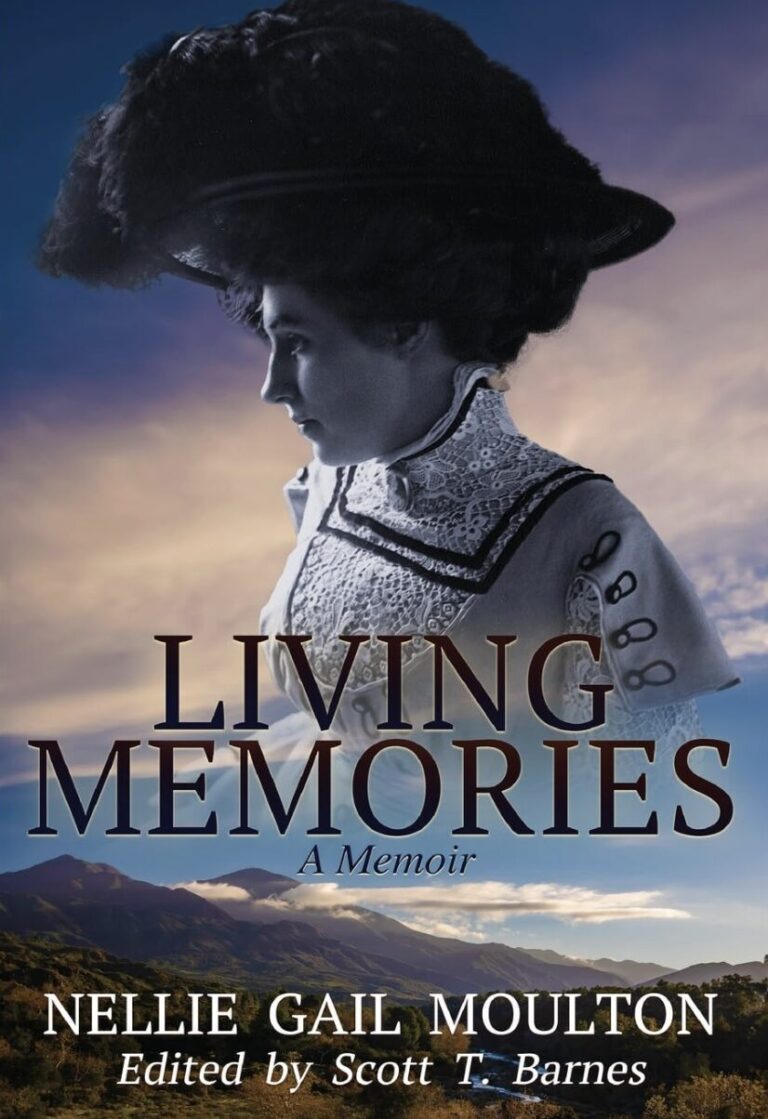
 Living Memories–A Memoir: Received a 4+ star review, making it an IndieReader Approved title.
Following find an interview with author Scott Barnes:
1. What is the name of the book and when was it published?
Living Memories–A Memoir, published on September fourth of this year—but finished in 1970.
2. What’s the book’s first line?
“Providence has widely bestowed upon us the noble gift of memory.”
3. What’s the book about? Give us the “pitch”.
In a charming, flamboyant style, Nellie Gail Moulton looks back on her 88 years and tells of crossing Kansas in a covered wagon; of becoming an accountant, school teacher and principal—and giving it up for love; of studying plein air painting with the California masters; of managing a 22,000-acre cattle ranch, and of founding the Laguna Playhouse and Laguna College of Art and Design.
4. What inspired you to write the book? A particular person? An event?
I edited Living Memories. This book was written by my great-grandmother when she was 88, and discovered by a museum archivist in a box in a closet some 50 years later.
5. What’s the main reason someone should really read this book?
While Nellie Gail Moulton’s story is of special importance to Orange County, California, anyone with an interest in westward expansion and western US history will find much to enjoy here.
6. When did you first decide to become an author?
I wanted to be an author since the age of 11. Unfortunately, it took me a very long time to develop the discipline to write daily.
7. Is this the first book you’ve written?
I have published three other works of nonfiction, two oral histories and an illustrated fourth grade reader. Besides writing about the old west, my other passion is fantasy and science fiction, and my young adult fantasy Memories of Lucinda Eco received a very positive review on IndieReader.
8. What do you do for work when you’re not writing?
In some ways, I still work for Nellie! I am the CFO of a small family office which manages real estate investments for Nellie Gail’s descendants.
9. How much time do you generally spend on your writing?
Two hours per day, usually in one of Orange County’s family-owned coffee shops.
10. What’s the best and the hardest part about being an indie?
The best part is that I’m writing for myself. I don’t have to worry about trends or editors or ‘sensitivity readers’ or any of that sort of thing. Nor do I have wait on pins and needles wondering if today is the day I will receive an acceptance letter from an agent and/or publisher.
The two hardest things are 1) finding readers, and 2) finding the time to look for readers. When you publish and market a book you are literally starting a small business.
11. What’s a great piece of advice that you can share with fellow indie authors?
For most wannabe authors, I would say, “Don’t over-edit.” Make the manuscript as good as you can make it now. Rather than tinkering endlessly with sentence structure and wording, and wondering whether the heroine should have blue eyes or green eyes, move on to the next book. You will learn more writing the next project than fiddling with this one.
Nonfiction isn’t much different, although getting lost in research can be a huge time suck there. You have to know when enough is enough.
Unless you intend to write only one book, ever. Then, by all means, take as much time as you like.
12. Would you go traditional if a publisher came calling? If so, why?
Probably. It depends on the details of the contract.
While no one has a magic formula that always works, I do think that traditional publishers are better than most indie authors at matching books with readers. In fact, the most successful indie authors that I know all started as traditionally published authors, built up an audience, and only then, with an established name, did they go indie.
13. Is there something in particular that motivates you (fame? fortune?)
I love telling stories. Even if I knew that no one would ever read my stories, I would still write them. That would be sad, but I’d still crank out the words.
14. Which writer, living or dead, do you most admire?
Probably my good friend and mentor Robert Enstrom, author of Beta Colony and Encounter Program. I reread both of these novels every couple of years. Bob’s clear and concise prose builds up tremendous tension without ever using swear words or on-page sex or violence, and he manages to fill every page with thought-provoking ideas. The books are a tour-de-force in compact writing.
And now that Bob’s contract with Del Rey has ended, I have become his publisher through New Myths Publishing.
15. Which book do you wish you could have written?
Nonfiction: Peter the Great by Robert Massie. Fiction: Lord of the Rings by J.R.R. Tolkien.