
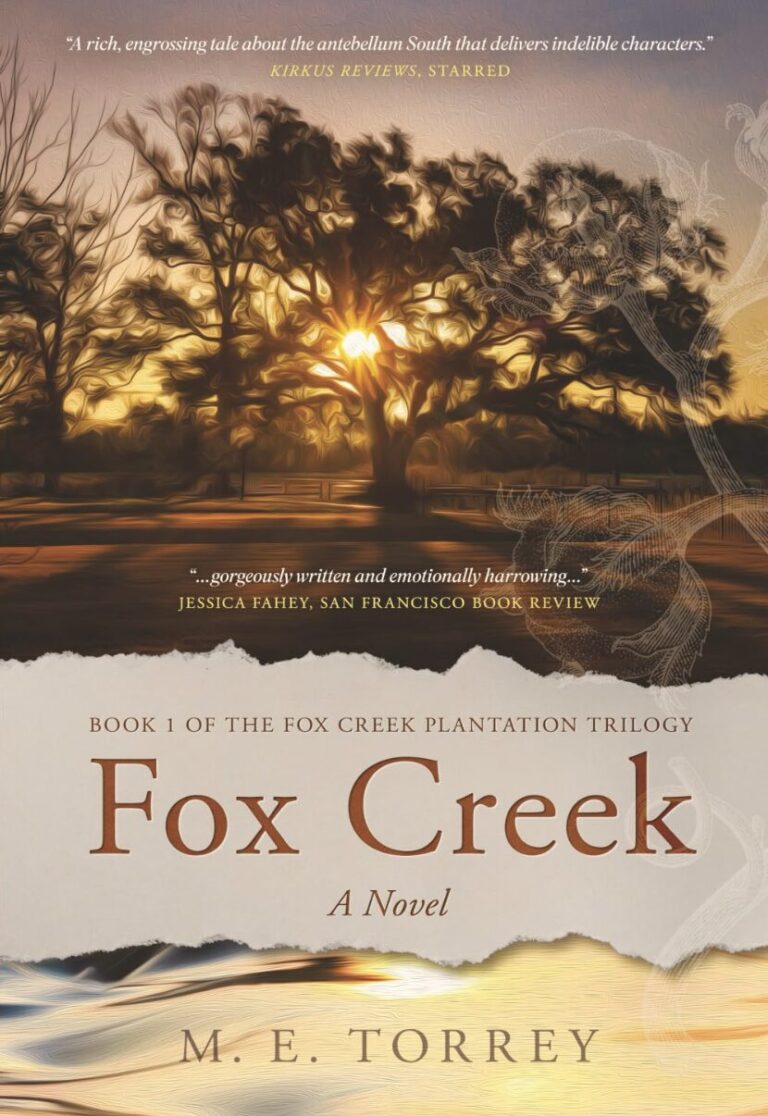
 Fox Creek: A Novel: Received a 4+ star review, making it an IndieReader Approved title.

Following find an interview with author M.E. Torrey:
1. What is the name of the book and when was it published?
Fox Creek: A Novel
Published Sept. 1, 2025
Book 1 in the Fox Creek Plantation Trilogy
2. What’s the book’s first line?
The morning the wagon came to take Monette away, the air was biting crisp, and a sheen of frost covered the cane fields.
3. What’s the book about? Give us the “pitch”.
In 1843 Louisiana, the beloved, biracial daughter of a wealthy planter is sold into slavery and must survive while caught between the world of the white elite and the brutality of slavery. Sold along with her is Cyrus, a boy big for his age, torn from his mother without a chance to say goodbye. Together they are purchased by the Jensey family, where soon, their destinies will collide. Fox Creek is a story of race, privilege, and destiny. But most of all, it is a story of love, a love that transcends all that threatens to tear it apart.
4. What inspired you to write the book? A particular person? An event?
The quick answer: I joined my husband on his business trip to New Orleans. It was my first trip to the South. I felt compelled by the history of the plantations, especially the intersection between the White and the Black narratives. As I explored it, I knew I wanted to write about it.
The long answer: While the above is indeed true, I will say that even as a very small child, I have always felt drawn to the issue of slavery, and to the injustices that I saw in the world. I was in elementary school during the ’60s and vividly recall watching the riots on our small TV—riots about school desegregation, civil rights, and the Vietnam War. I listened intently to Martin Luther King, Jr.’s speeches, especially the “I Have a Dream” speech, where “little Black boys and Black girls will be able to join hands with little White boys and White girls.” As a family, we would discuss all these issues around the dinner table, my parents instilling in us the understanding that all people are created equal. I feel in my soul that one of the purposes of my life is to bring injustice to light. One of the tools for doing this is to help us remember the past—not for the purpose of self-flagellation, finding blame, or reliving pain, but as a source of growth and healing in our understanding of ourselves as human beings.
5. What’s the main reason someone should really read this book?
Well, if you’re looking for a quick beach read, better keep looking. Instead, Fox Creek bears witness to the silences history leaves behind. If you’re willing to look into those silences, into the crevices that are disturbing and yet vital to our understanding of who we are today, then Fox Creek is essential reading.
6. What’s the most distinctive thing about the main character? Who-real or fictional-would you say the character reminds you of?
The most distinctive aspect of young Monette is her willingness to trust and her longing for human connection, even in the face of her tragic past.
I would compare Monette’s character to that of Rosa Parks. Rosa sat clutching her purse on her lap and refused to move from her “whites-only” bus seat when commanded to do so by authorities. She was subsequently arrested. Monette, too, engages in quiet moments of rebellion. This resilient spirit of rebellion will grow as the trilogy progresses.
7. Is this the first book you’ve written?
Fox Creek is my debut novel for an adult audience. However, I have published twelve books for middle-grade and young adults with Penguin, Random House, and Sterling Publishers. I have worked for over twenty years in the publishing industry.
8. What do you do for work when you’re not writing?
I volunteer for an organization I co-founded called, Orphans Africa. We work in Tanzania building schools for children who have been orphaned due to disease and poverty. We have educated thousands of children, ages 3 to 21, in boarding schools ranging from nursery through Vocational-Technical College. It’s a lot of work, but we are helping to empower some of the most vulnerable children in the world.
9. What’s the best and the hardest part of being an indie?
The best part of being an indie author is having full control over editorial and design decisions. The hardest part of being an indie author is having full control over editorial and design decisions. It’s all on you! The buck stops with you, yet sometimes you don’t know enough to realize how much you don’t know.
10. Is there something in particular that motivates you (fame? fortune?)
After more than twenty years of writing for a younger audience, and as I have grown older, I am no longer motivated by fame, fortune, or success of any type. I am instead motivated by the desire to alleviate human suffering, to bring healing to individuals, and peace to a divided world. I believe that by looking calmly at our shared past, we can begin to walk the path toward unity.
11. Which book do you wish you could have written?
The Handmaid’s Tale by Margaret Atwood