
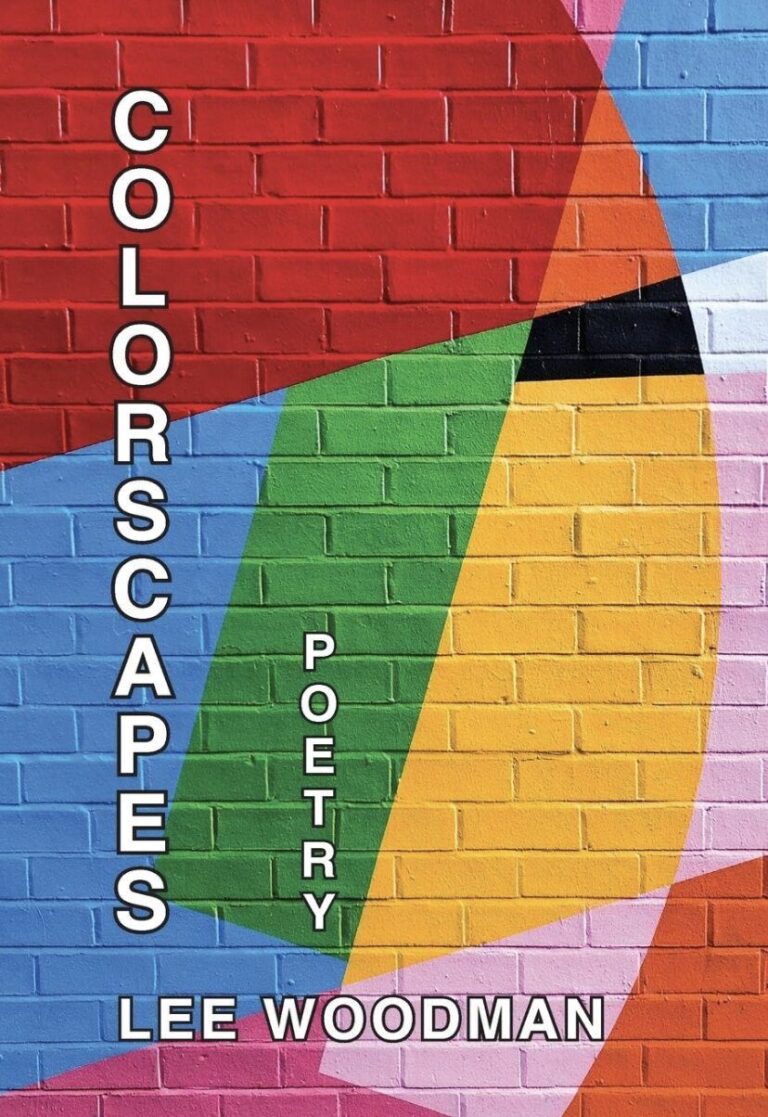
 Colorscapes: Received a 4+ star review, making it an IndieReader Approved title.

Following find an interview with author Lee Woodman:
1. What is the name of the book and when was it published?
COLORSCAPES, published Oct 28, 2025 by Shanti Arts Publishing
2. What’s the book’s first line?
“Black is not a color”
3. What’s the book about? Give us the “pitch”.
The poems in Lee Woodman’s Colorscapes,
are born from deep study and a passionate enthusiasm for color,
which she explores in the natural world, at the heart of stories,
and in the hands of artists. She charges us to live and breathe
through color, noting that it suffuses our lives with meaning and
memory, bidding us to relive experiences we’ve had,
people we’ve met, and passions that have enriched our lives.
Colorscapes is for artists, educators, designers, travelers,
cultural advocates, scientists, dreamers,
gamers, and the intellectually curious.
4. What inspired you to write the book? A particular person? An event?
My life has been drenched in color, one joyful splash after another. As a kid in India, I absorbed the rich oranges and red spices in the marketplace and the wild combos of yellows, greens, and purples in village women’s saris. In the spring festival of Holi, I got smeared with bright blues and pinks, and the smells are still in my nostrils.
College studies in European and American art history introduced me to color theory and the phenomenology of perception. I took many studio courses—painting, silk screen, graphic design, ceramics—and broadened my art horizons during a year at the University of Paris’s l’Institut d’Art et d’Archéologie and the Louvre.
Then came a career at The Smithsonian Institution, the Library of Congress, and other wonderful stewards of art, architecture, technology, and science.
Color in nature and the laboratory continues to fascinate me. Where do different dyes come from—shells, rocks, insects, chemicals? What did artists Josef and Anni Albers teach us bout color relationships? And what do psychologists and philosophers from Goethe to Isaac Newton to Carl Jung tell us about color perception for human beings?
Why is a particular music style called the Blues? The red chroma of Coca-Cola a closely-guarded trade secret? The turtleneck in a catalog sold as Sea Foam green one year and Mysterious Mint the next? How does your favorite color make you feel? What is chiaroscuro, anyway? Join me on a journey to talk about, revel in, and see color in a brand-new light.
5. What’s the main reason someone should really read this book?
Poetry slows us down, makes us think, encourages problem solving, offers new perspectives, shapes culture, inspires change, spurs conversation, highlights injustices, and builds community.
Poetry uses language to convey complex emotions and ideas, invites readers and listeners to think about shared experiences. They write their own stories alongside the poet.
Creativity and commerce make a great combination: art improves the image of artists and business owners and promotes related businesses like restaurants, shops, transportation.
As reviewer from Los Angeles, Kyle Eaton remarks:
“Artists, writers, and even gamers who love world-building could vibe with Lee’s imaginative detail. Colorscapes doesn’t lecture; it invites. It’s like having coffee with someone who can talk Kandinsky and Kermit in the same sentence.
Woodman paints with words in the same way great artists paint with pigment, layering emotion and memory until the image glows. Her voice has this contagious, creative energy that makes you want to pick up a brush, a pen, or even just go outside and pay attention to the shifting light.”
6. Who are the main characters?
Although this is a poetry collection, not a novel, the colors themselves are characters like Provocative Pink, Contradictory Red, and Purple Passion. And many more!2. Is this the first book you have written?
Colorscapes, published by Shanti Arts Publishing, is the sixth in a series of Scapes poetry books. Each book explores a singular subject: Lifescapes (love and relationships), Mindscapes (wishes, lies, and dreams), Homescapes (cultural identity and place) and Artscapes (artwork) Soulscapes considers spirituality, and “other ways of knowing.” My collections have received critical attention from leading publications and industry awards, including The Independent Press Gold Award for Poetry 2025, the Nautilus Gold Award for Poetry 2025, and the Independent Press Award for Distinguished Favorite in Poetry 2024. I am also winner of the 2020 William Meredith Prize for Poetry, the 2021 Atlantic Review International Poetry Competition Merit Award, and First Prize in Poetry and Prose Contest for Carve Magazine 2022.
7. Is there something in particular that motivates you?
I’ve been writing for my whole career – radio shows, TV shows, museum scripts and strategic plans, but after I retired from the Smithsonian in 2014, I have been writing poetry exclusively.
My New England parents wanted to see the world, which gave me a childhood in India and France. Our family was passionate about art, dance, and learning just about anything: Dad worked in education for the State Department and the Ford Foundation, and Mom started her own ballet school. My literary career got its start with family newspapers and plays produced in the driveway with my sisters.
An undergraduate degree in Art and French and a graduate degree in Art Education led to teaching and performance in dance and drama groups. Next came a career in radio, television and film production. I was an early adopter of the Internet and interactive media.
I served as Manager of Multimedia and Executive Producer at the Smithsonian Institution, Senior Advisor to the Director of the National Museum of American History, President of Lee Woodman Media, Inc., and VP of Media and Editorial at K-12, Inc. (now Strive), an online education company.
Now I have found the perfect medium for combining all my interests: Poetry!
I believe poetry is a reflection of all creative expression: dance, music, drama, visual arts, and language. I do make royalties from my books, but my major motivation is performing poetry, not fortune.
I write poems to turn sound and images into emotion and story, and to share with fellow human beings the surprising turns our lives take. I use forms from traditional to contemporary—sestina, sonnet, villanelle, free verse and narrative. Scents, tastes, and textures inspire me.
I search and struggle to understand the territory of the heart, the fascination of nature, love, longing, fear, and rage. A moon, a turtle, a conversation with a mystic, a reggae lyric— all provide image and metaphor for considering what it means to be alive. Poetry can remind us all that fantasy and beauty—no matter how strange or different—can be found in unexplored alleys and unexpected corners.