
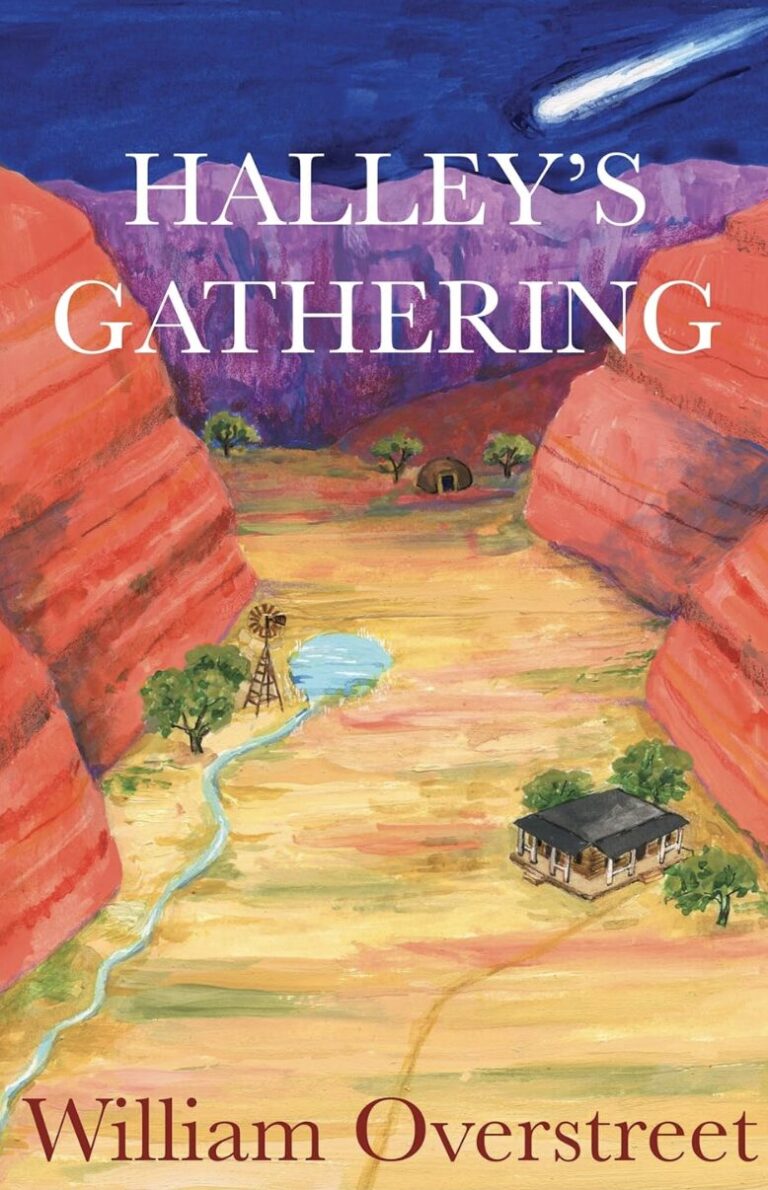
 Halley’s Gathering: Received a 4+ star review, making it an IndieReader Approved title.

Following find an interview with author William Overstreet.
- What is the name of the book and when was it published?
Halley’s Gathering, published in March 2025.
2. What’s the book’s first line?
Julia Halley flung another piece of firewood into the stove and then, holding the spiral handle in her apron, slammed the cast iron door shut.
3. What’s the book about? Give us the “pitch”.
On the Navajo Reservation in 1910 Julia Halley, the unlikely owner of the Many Springs Canyon Trading Post, gathers about her a small but devoted circle of friends—her “gathering”—both Anglo and Indian, all with their own stories to tell and uncertain futures.
4. What inspired you to write the book? A particular person? An event?
I lived within the Navajo Nation for four years, read a lot about the history of its people and about the land itself.
5. What’s the main reason someone should really read this book?
If Halley’s Gathering has an over-arching theme, it concerns the transition from the Old West to the Modern, a subject that tends not to be addressed in genre westerns or in what’s usually called the neo-western. I tried to explore that impact on a variety of people as well as on Native American cultures.
6. What’s the most distinctive thing about the main character? Who-real or fictional-would you say the character reminds you of?
Julia Halley, the main character, is stubborn, scrupulously honest, conflicted about her own past and future, and charismatic. Moreover, her close friends recognize her, to repurpose T.S. Eliot’s observation, as “a still point of the turning world”—reliable, accepting of their flaws, and, as one character puts it, “a woman who does what needs to be done.” Julia isn’t modeled on any individual, real or fictional, but she might get along well with Dorinda Oakley in Ellen Glasgow’s Barren Ground (a 1925 novel that isn’t read much anymore) and Susan Burling Ward in Wallace Stegner’s epic Angle of Repose.
7. When did you first decide to become an author?
I’ve been a nonfiction writer for my entire professional life. Although my father had many jobs, he was primarily a newspaperman, which was a major influence.
8. Is this the first book you’ve written?
This is my first published novel, but not my first book.
9. Which writer, living or dead, do you most admire?
Strictly as a writer, probably William Faulkner. I consider him to be the greatest American novelist. (In second place, there’d be a tie among at least a dozen others.)
10. Which book do you wish you could have written?
I’m not a poet, but I’d have to say Walt Whitman’s Leaves of Grass.