
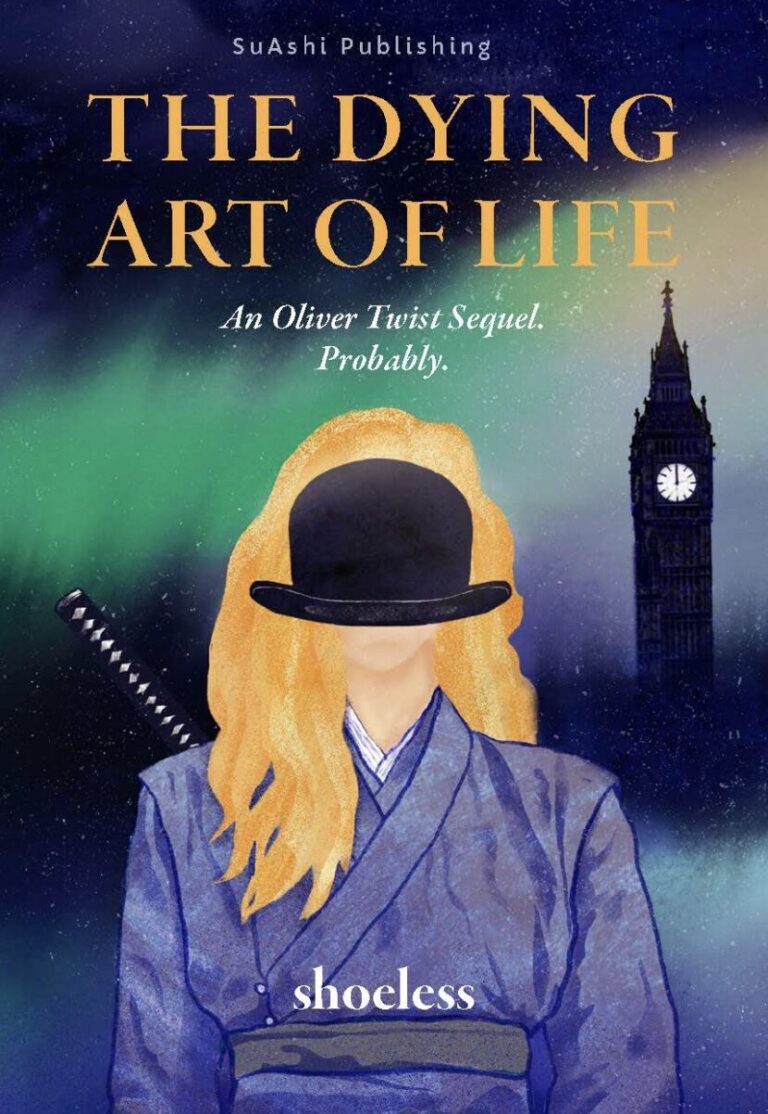
 The Dying Art of Life: An Oliver Twist Sequel. Probably.: Received a 4+ star review, making it an IndieReader Approved title.
Following find an interview with author Shoeless.
- What is the name of the book and when was it published? My novel is called “The Dying Art of Life: An Oliver Twist Sequel. Probably.” It was published on July 1st this year, a date unlikely to go down in literary fame or infamy.
- What’s the book’s first line? “With all the genius of water running downhill, the populace of the world flows towards its great cities.”
- What’s the book about? Give us the “pitch”. Who cares for Oliver Twist? If Charles Dickens was right then we all would, praying that the innocent orphan boy can overcome the depravities of nineteenth century London. There were those who wished evil on him but then evil they must be. Yet what, The Dying Art of Life argues, if Charles Dickens was not the master of his own tale? In this sequel to the classic novel, we learn that the author has unwittingly released characters who are free to act in defiance of his pen. They escape their literary destiny by the simple expedience of changing their character. Like real people. As Nancy’s daughter Olivia arrives from America she finds a story in a constant state of flux. She becomes acquainted with some of Charles Dickens’s characters, most notably the recently ennobled Sir Oliver Twist, who even lends her a copy of the original novel as the standard reference on his life. In its narrative she hopes to resolve the mystery of her mother’s murder, only to discover a riddle hidden inside an enigma. An innocent abroad in a strange city, she has only her samurai sword Kawanegi to protect her and she knows how to use it. It is with this tool that she can divine friend from foe and cut through to the truth, the one that Charles Dickens worked so hard to keep from us.
- What inspired you to write the book? A particular person? An event? I always felt that Charles Dickens was callous towards some of his characters in Oliver Twist. The Victorian era was already brutal to the poor underclasses, epitomised by his creations Nancy, Fagin and The Artful Dodger. Similarly, Mr Bumble is treated as a cartoon figure, little more than a plot device. Dickens’s genius is that he is able to draw his characters so acutely that we can make up our own minds and even disagree with the author. My purpose was to allow these maligned characters to speak up for themselves and present their lives in the round. At the same time, I have had second thoughts about Dickens’s angelic protagonist: was Oliver Twist too good to be true?
- What’s the main reason someone should really read this book? It is for someone who wants to see literary justice being done! They will see characters with whom they have secretly sympathized being allowed to breathe and speak for themselves. They might also get to see a goody-two-shoes get their long-awaited comeuppance!
- What’s the most distinctive thing about the main character? Who-real or fictional-would you say the character reminds you of? Like the original Oliver Twist, in The Dying Art of Life the reader will recognize their own struggles: we are all trying to do good in an imperfect world. The narrative may be set in 1870, the year Charles Dickens died, but the themes are eternal. Cynical readers may even identify elements of the modern world creeping into the story.
- When did you first decide to become an author? There are two kinds of writer: the wordsmith, and the storyteller. The wordsmith is a craftsperson, able to use their total command of the language to fashion works of literary beauty. For them, writing is a learned skill they apply with ease. I am not a wordsmith. The storyteller, on the other hand, has narratives come to them uninvited. For them, writing is the toil of taking dictation from their imagination. I am a storyteller. I did not decide to become an author, I am merely the amanuensis to my imagination.
- Is this the first book you’ve written? No: I have written a couple of academic books and one other novel, “Out With Time”, the prequel to both Charles Dickens’s “Oliver Twist” and my latest, “The Dying Art of Life”.
- What do you do for work when you’re not writing? I am an academic at a British university.
- How much time do you generally spend on your writing? About two hours of an evening, with the target of 1,000 words. Always a chore!
- What’s the best and the hardest part of being an indie? Being able to act on one’s instinct for how best to serve the story and the characters is hugely satisfying. However, it does mean having to take on all the tasks of publishing when all I ever wanted to do was write.
- What’s a great piece of advice that you can share with fellow indie authors? No one has the right to judge your creativity, they can only advise. Once the first book is done, future publications take on their own momentum.
- Would you go traditional if a publisher came calling? If so, why? If the book has mass appeal then the marketing muscle of a traditional publisher can be crucial, but only if you are one of their anointed ones. My intention is to prove that my novels have broad appeal and then, maybe, seek out a traditional publisher.
- Is there something in particular that motivates you (fame? fortune?) As the song has it, would it be “so terrible if I had a small fortune?”. Of course not, but I doubt it will come from writing. As a novelist, I eschew fame because I want the characters to be the only ones in the spotlight; this is why I use the pseudonym “shoeless”. So what then are my motivations? To give life to the stories that exist in my imagination; for the thrill of seeing them in print; pride in doing them justice.
- Which writer, living or dead, do you most admire? Laurence Sterne, author of Tristram Shandy, who fully exploited all the possibilities offered by the format of the novel, doing this at the very birth of the form. Everything since then has merely been style.
- Which book do you wish you could have written? This is my dark secret: I rarely read novels! I found Laurence Sterne’s Tristram Shandy to be a dazzling read but never easy. R D Blackmore’s Lorna Doone was like running through treacle until I decided it must be a comedy, from which point I galloped through it; I doubt the author would take that as a compliment. As for Oliver Twist, I was so annoyed by the treatment of some of the characters that I did not simply wish that I had written it but that I had re-written it. So I did.