
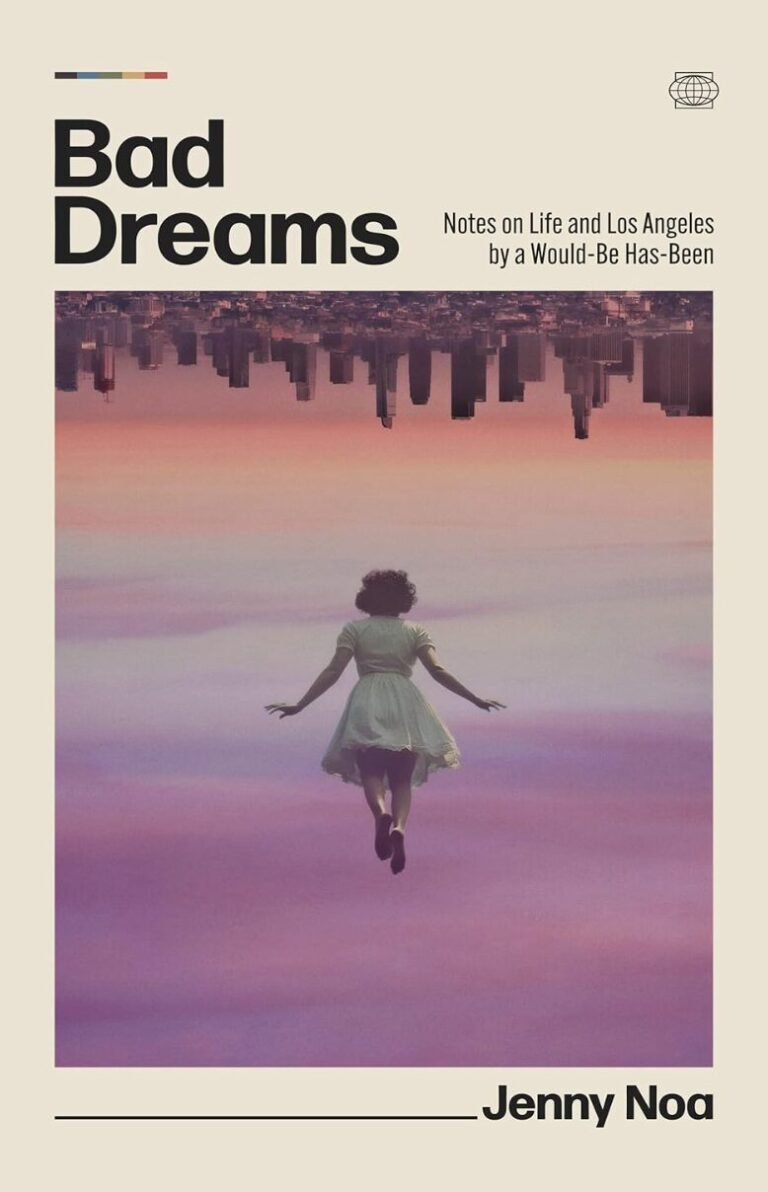
 Bad Dreams: Notes on Life and Los Angeles by a Would-Be Has-Been: Received a 4+ star review, making it an IndieReader Approved title.
Following find an interview with author Jenny Noa.
1. What is the name of the book and when was it published? Bad Dreams: Notes on Life and Los Angeles by a Would-Be Has-Been
2. What’s the book’s first line? “When I was four years old, I woke up in the middle of the night and threw up on my own pillow.”
3. What’s the book about? Give us the “pitch”. The book is dedicated to those with unrealized dreams and undiagnosed mental disorders, and that’s really the crux of it. It’s about my wanting to both be seen and to hide, and what that did over time to my creative aspirations. Life will always throw obstacles in your path, but in my case, the biggest blocks were invisible, and it took a long time to accept that I was on the wrong path.
4. What inspired you to write the book? A particular person? An event?’ In the last years in LA, my creative work had centered around reading my written work at live essays shows. When I finally left in 2020 for a job in the Bay Area, I had a vague plan to compile and publish my favorite essays – to be honest, I wanted something to show for all that time I spent in LA. But within six weeks of my move, we were in lockdown. So, distance, time, solitude and the existential dread of the pandemic created surprisingly fertile ground for a more complete memoir. I’m not sure if it was inspiration or desperation, but I won’t nitpick!
5. What’s the main reason someone should really read this book? I think most people can relate to the central theme, which is about not getting exactly what you hoped for. I tend to get pretty granular about things, parsing language and feelings, peeling back all the layers. You’d think that would create niche work, but I’ve learned that the more specific you are about your own experience, the more people seem to relate to it. I think there are lots of points of connection in the book – creative goals, grief, sticky family relationships, mental disorders, Los Angeles itself, a splash of humor. Something for everyone, I hope.
6. When did you first decide to become an author? I don’t remember a time when I didn’t want to be an author. However, It took a long, long time to feel like I could actually do it.
7. Is this the first book you’ve written? It is! For a long time after I finished, I thought I’d never write again, but happily I am starting to feel some seeds sprouting.
8. What do you do for work when you’re not writing? I work full time as an Executive Assistant in the East Bay. I love my job, and the company helped me not only leave LA but fund the Bad Dreams project, so I’m very grateful on several fronts.
9. How much time do you generally spend on your writing? The actual sitting down and writing is very difficult for me to get to. I am a champion procrastinator, which I know is a common trait among writers, but I’ll do anything to avoid sitting down and writing – despite knowing how good it feels on the other side of having written. It’s a problem I talk about in the book, in fact. That said, I carry a project notebook and am constantly mulling over the topic at hand, so that certainly is part of the process. And when I do finally sit down for a few hours on the odd weekend, I perhaps get a little more on the page than I might have otherwise. But it’s unfortunately a constant battle for me.
10. What’s the best and the hardest part of being an indie? The answer to both is “it’s all up to you.” It’s so creatively freeing to have no gatekeepers to get past, but on the other side, you really have to either be everything – cheerleader, web designer, marketer, etc. – or else pay for as much of those things as you can. And all the decisions are still on you. Everything feels so fraught, and as a first-timer, it’s like flying in fog. Still, I think it’s so important to be able to make decisions based solely on what feels right to you, what the work deserves. It truly feels amazing to have done this difficult thing, there’s nothing like it. And I have so much less anxiety and self-doubt as I look toward the next project.
11. What’s a great piece of advice that you can share with fellow indie authors? Make sure your cover is something you really love. It helps me turn, “so, hey, I wrote this” to “you have GOT to see this,” and really gets the conversations going.
12. Would you go traditional if a publisher came calling? If so, why? The idea of that sort of professional validation is extremely seductive, but I’d need to carefully weigh what would be required of me against what I’d be giving up. Even just thinking about that pressure makes me lean towards no. I’m not interested in answering to anyone but me right now.
13. Is there something in particular that motivates you (fame? fortune?) Just being heard, honestly. I’m notoriously bad at self-promotion – it’s a big part of my LA failure equation – but being found is an amazing feeling. Just knowing it’s out there and that people might find and connect with it is enough.