
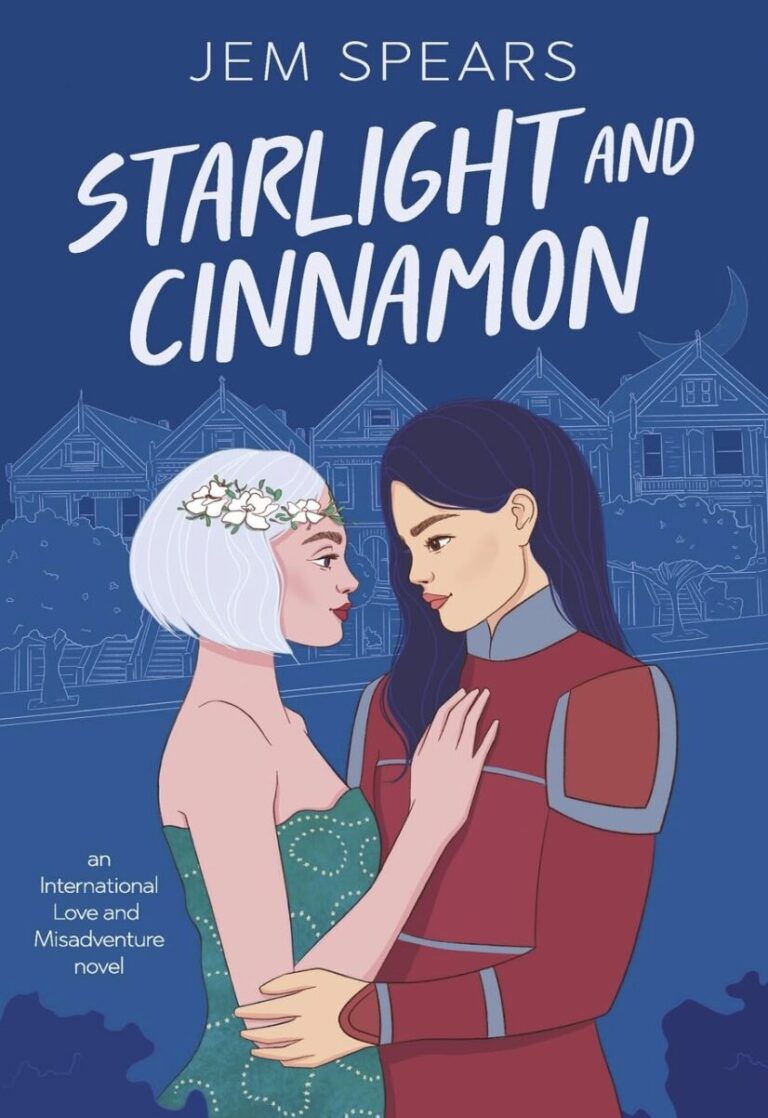
 Starlight and Cinnamon: Received a 4+ star review, making it an IndieReader Approved title.
Following find an interview with author Jem Spears.
- What is the name of the book and when was it published? This contemporary queer romance novel is titled Starlight and Cinnamon, and it was released September 9, 2025.
- What’s the book’s first line? “Daphne hurried down the wide and sterile hallway, its overhead lights flickering on like the eye of a sleeping giant as she approached and closing back to darkness as she passed.”
- What’s the book about? Give us the “pitch”. Daphne (a love-obsessed corporate spy) and Cinnamon (a therapist with a hero complex) are, unbeknownst to them, both trying to take down the same billionaire Silicon Valley techlord who’s making their friends’ and clients’ lives miserable. When the women meet at a masquerade party, it’s love at first sight, but their secret social justice campaigns have made them wary and slow to trust. When Cinnamon is doxxed and hunted by the techlord’s minions, Daphne takes her in—and begins to form a dangerous plan to finally expose the billionaire for the criminal he is.
- What inspired you to write the book? A particular person? An event? While marginalized communities have become more and more oppressed, tech billionaires have launched themselves into the stratosphere of influence and entitlement, and I wanted to read a story where queer love wins AND the people who oppress them actually suffer consequences. Starlight and Cinnamon takes place during the week before San Francisco’s Pride weekend in 2015, when the Obergefell decision was rumored to be dropping any day now. It’s a time and place full of tension and hope, where the characters can fall in love while pursuing social justice. The character of Daphne was already in my mind and she clamored to have her own story about how she met her wife and went on a dangerous heist for love. As you’ll see, she’s headstrong and convincing and I couldn’t tell her no.
- What’s the main reason someone should really read this book? The women get their Happy Ever After and the vile billionaire suffers. You know, the best reasons to read a book.
- What’s the most distinctive thing about the main character? Who-real or fictional-would you say the character reminds you of? Daphne doesn’t know she could fail. She gets an idea in her head and never thinks about the chances of success, because she’s already off and doing it. This might be cheating, but she most reminds me of The Fool in a tarot deck: easily distracted by beautiful things, putting one foot in front of the other because that’s the only way she knows to go but she doesn’t actually look at where the path is taking her. Always open to new experiences and expecting it to go wonderfully. When things do go wrong, she shrugs, tells herself it wasn’t meant to be, and moves on to whatever’s next. Until she meets Cinnamon, of course.
- When did you first decide to become an author? This is such a fun question, because I don’t remember ever choosing to become an author. I simply wrote, and wrote and wrote and wrote, ever since I learned how to write. Flash fiction, short stories, fanfic, poetry, plays, screenplays, novels…I bounced from one to another, knowing it was something I would always be doing. I stapled together pages for a family newspaper, then cobbled together my own chapbooks at Kinko’s, then published poetry collections on Amazon, and now I’m writing novels that are distributed through Ingram. Being an author is just a part of who I am, and getting my stories into people’s hands is something I always figured out how to do with the tools available to me at the time.
- Is this the first book you’ve written? Starlight and Cinnamon is the third novel I actually finished writing. The first was a novel-length fanfic that’s posted online, and the second novel I wrote, A Courtship in Quarantine, has become book two of the series that Starlight and Cinnamon begins, and its publication date is December 9, 2025.
- What do you do for work when you’re not writing? I’m writing something every day. Some days it’ll be notes for my WIP. Other days it’ll be my newsletter or a blog post or a review. Occasionally it’ll be a letter or email. I’ll jot down a poem. When it comes to whatever novel I’m working on, I need to block off six to eight weeks to devote all my time to drafting it in one go. It’s hard to get my neurodivergent mind to concentrate, and I need at least a half hour to get into the headspace to write, so it’s only doable for me in large chunks of time. I envy the people who can write for ten minutes or a half hour here and there and end up with a beautiful and cohesive novel. That’s a skill I just don’t have.
- What’s the best and the hardest part of being an indie? The best part of being an indie author is the control we have over every detail of our books. The hardest part is that one of those details we have total control over is marketing, which I am simply rubbish at. That and formatting are my arch-nemeses.
- What’s a great piece of advice that you can share with fellow indie authors? You can’t do it alone. You may want to. You may wish to. I, introvert and curmudgeon that I am, certainly wished to. But it’s never just you, at your computer, or sitting with a notebook, writing your novel. It’s every story you ever read and everything you felt about it. It’s your life experience, your affinities, your curiosity. It’s Wikipedia and research books and librarians. It’s editors and cover designers and everyone who supported you along the way. We need to befriend other writers and support each other and be each others’ cheerleaders and street team. It can feel overwhelming and like one more thing we have to do that isn’t writing, but we’ve gotta do it. And I promise it’s not as scary as it seems.
- Would you go traditional if a publisher came calling? If so, why? It was my dream, for a long time, to be published traditionally. But at this point, the only part of publishing I have trouble with is the marketing, and from what I’ve read of the industry now, marketing is barely even offered. There was a joke I read on some social media site a while ago, saying that traditional publishers’ entire marketing plan was “Do you personally know Taylor Swift, and can you get a picture of her with your book?” I can fail at that just as well as a trad publisher can, so for now, I’ll keep the extra profits for myself.
- Is there something in particular that motivates you (fame? fortune?) Growing up autistic and undiagnosed, I felt a huge disconnect between all the emotions I felt and what was socially appropriate to emote. Outwardly, I decided to emulate the best person I knew, Captain Jean-Luc Picard (obviously), but I found connection and answers to my inner life through books. It’s so cathartic to read a book and think, “Yes, yes, that’s exactly how I feel, too!” Sharing my writing, my poetry, my stories with people is a way for me to acknowledge my feelings and the feelings of others who thought they were the only one. It’s all about that connection!
- Which writer, living or dead, do you most admire? Octavia Butler. Her talent is unparalleled, her stories explore social justice issues in the face of racism and misogyny and are as enlightening as they are entertaining, and her writing process demonstrates how much dedication, how much work it takes to write a book. I admire the heck out of her and nobody else comes close.
- Which book do you wish you could have written? This Is How You Lose the Time War, by Amal El-Mohtar and Max Gladstone. As a poet who writes novels, I’m wildly jealous I didn’t write this book. I take solace in the fact that it took two people to do it, but I’ve read their other work and they’re both so talented, that solace is always short-lived.