
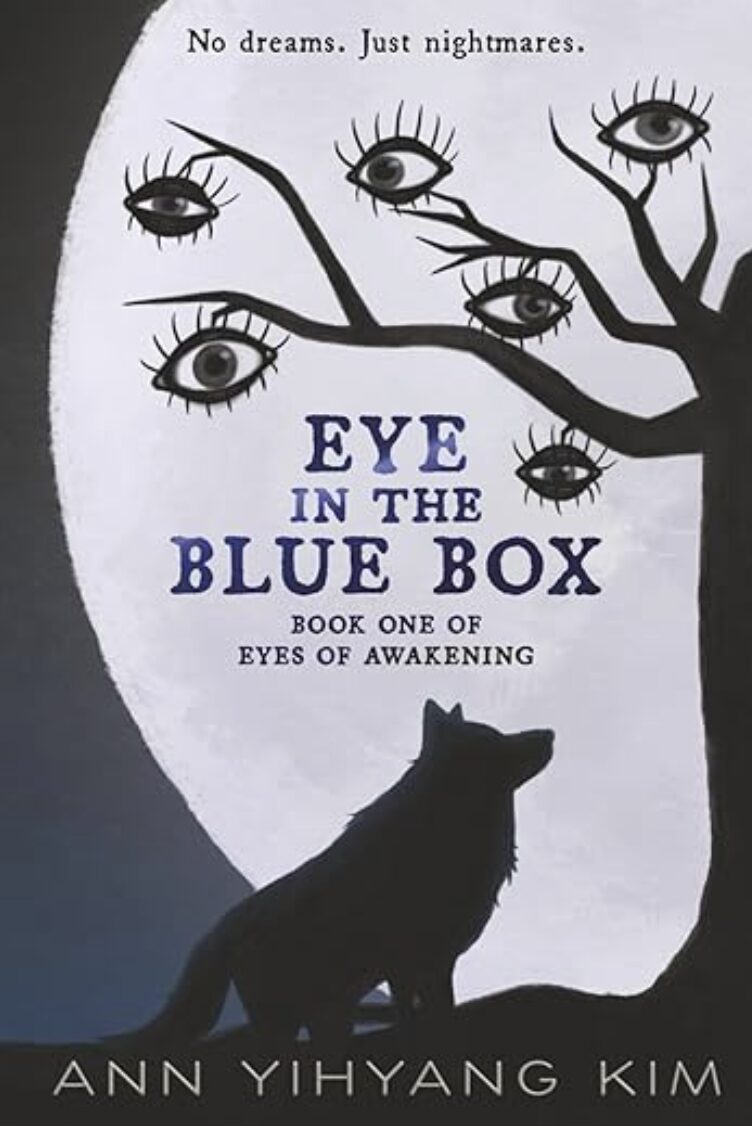
 Eye in the Blue Box: Book One of Eyes of Awakening: Received a 4+ star review, making it an IndieReader Approved title.
Following find an interview with author Ann Yihyang Kim.
1. What is the name of the book and when was it published?
Eye in the Blue Box: Book One of Eyes of Awakening was published August 30, 2025.
Fun fact: August 30th marks the night that James, the protagonist, was born into the Flowering, a surreal and dangerous dimension he must always enter from then on whenever he falls asleep. So, not only is August 30th the date my protagonist was born into the main plot, but it’s now also the day he was born into our own real world via publication. I thought setting up the publication date in this manner could act as an additional, fun way to bring the book’s themes of duality and different dimensions to life. I also hoped to give my very first readers the opportunity to follow James’s adventures roughly in real time as he starts his journey on August 30th then ends it late December.
2. What’s the book’s first line?
“Sunlight poured onto the asphalt.”
A common piece of creative writing advice is to craft your first line into a powerful hook that’ll impress readers enough to keep them reading. Another common rule is to make the first pages representative of what readers will experience throughout the book. In other words, the first pages should act as an appetizer that acclimates and whets readers’ appetites for the main course to come.
But my first line contains zero sensationalism, mystery, or intrigue. Furthermore, my initial pages are devoid of the high-octane, blood-splattering action sequences and the surreal, fantastical elements that define the rest of the story. Instead, my book starts off with a normal, Joe Shmoe type of guy living his normal, Joe Schmoe type of life.
As you can imagine, I was very worried that readers wouldn’t take a chance on my book because of the first few pages. However, I decided to stick to my guns and keep the beginning as I’d envisioned it, and in exchange for the absence of action and fantasy, I tried to incorporate as much humor, relatability, and good ol’-fashioned wordsmithing as I could. There’s also a good amount of foreshadowing and setup, believe it or not. Everything from the weather to James’s internal monologue of complaints do actually build the foundation of pivotal plot points that appear later on.
Plus, it was wickedly fun to laugh at James and look down on his bad but embarrassingly relatable habits, which compose the first few pages. His story is ultimately a coming-of-age story that shows continual growth via small and big steps, so I really wanted to start the book with how … well … pathetic, lazy, and self-absorbed he is so that readers can clearly see and, as a result, savor his transformation over time.
I’m happy to say that despite going against a lot of good creative writing advice, everything still worked out! My readers unanimously love the first pages, especially the descriptions of James shoveling down instant ramen, rolling around on the carpet, and watching one Korean variety show after another into the night.
(And yes, I’m amused and ashamed to admit that many of his bad habits were inspired by the habits of yours truly.)
3. What’s the book about? Give us the “pitch”.
James Mun can’t stand “the Flowering,” the harrowing and surreal dimension he must enter whenever he falls asleep. However, as he and his friends find themselves entangled in the return of an ancient monster, he learns to embrace what he had formerly despised and guide the lost toward a hopeful future.
4. What inspired you to write the book? A particular person? An event?
Those who follow my blog already know several parts of the story behind the making of Eye in the Blue Box. (For those interested, please check out these two blog posts! https://www.ann-yihyang-kim.com/how-to-write-part-2-inspiration/; https://www.ann-yihyang-kim.com/why-i-wrote-it-the-way-that-i-did/)
But one source of inspiration I haven’t talked much about was a really bad blind date I went on when I was around the age of my protagonist, James.
I don’t want to rag on my blind date too much because he was not at all a mean or malicious person. In fact, he was a very normal, typical Korean American guy. But boy … he was just so immature!
For example, when he picked me up and drove us to the restaurant he’d picked out, he kept complaining the entire drive about how his parents had made him come on this date and kept asking me if I’d been forced out here too. (We had family members who attended the same church and had gone on to set us up on this date.) I told him very honestly that I hadn’t been forced at all, but he just kept going on and on with his monologue of how burdensome this date was.
When we got to the restaurant and stood in line outside, he turned to a random street vendor selling some sort of random tickets nearby and kept trying to chat him up instead of talking to me. It was to the point that the street vendor got uncomfortable and stared at me with a look that plainly asked, “Girl … why is he talking to me and not you?” To which I stared back with the silent answer, “Dude … I have no idea.”
When we finally got into the restaurant (which was way too overpriced and fancy for a couple in their mid-twenties going on their first date) and received our food, I offered to share some of my pasta with him. He accepted my offer, so I gave him around half my plate to be courteous. He, in turn, gave me approximately three small clams from his seafood pasta then went on to shovel down the entirety of his plate along with what I’d given him.
By the end of dinner, I was frustrated and exhausted and ready to go home. This guy was treating me so poorly, and he obviously didn’t want to be there with me. To my very great surprise, though, he asked if I wanted to get dessert. I consented to be polite (or maybe I was simply too surprised to say anything else). Dessert, too, was a disaster, though, because when we got in line at the boba shop, he mumbled that he had to go to the bathroom and disappeared, only reappearing very conveniently right after I had paid the bill for both of us.
The story goes on (and yes, it gets worse, and yes, he did ask me out on a second date), but in short, it was a rather infuriating and confusing experience.
In hindsight, I think he was just a normal, awkward guy with very little experience with women (or people in general), and I think his awkwardness had been exacerbated by the fact that he’d actually been quite nervous to be on a date with me, which I think (again, all in hindsight) is a bit sweet.
At the time, though, I had felt nothing but exasperated and even insulted (so I’m a burden to take on a date, huh?), and because that first date had coincided with the time I started earnest work on my book, I took out all my rage on poor James by fashioning him into a loose likeness of my date and making him go through all sorts of wild and crazy adventures that would be sure to thrust him into not only emotional turmoil but also extreme physical pain.
Moral of the story? Don’t piss off writers, especially on a date.
5. What’s the main reason someone should really read this book?
The author’s note I inserted at the end of Tree of Eyes, the sequel to Eye in the Blue Box, goes into greater detail about some of the overarching reasons I wrote this saga, so I hope you’ll give it a read when it comes out in January 2026! Without giving too much away, though, I wrote my books when I was slowly coming out of a series of very traumatic and lonely chapters of my life, chapters that included everything from family drama to financial hardships to abuse.
During those chapters, I’d often felt like I’d been forced to walk on an endless tightrope, and one misstep would mean I’d plummet to my doom. It hurt that there were so many people around me who had a net to catch them whenever they’d make mistakes, even stupid and careless mistakes. But for me and others like me, we couldn’t afford to make even a single mistake. There was no net to catch us. And no one cared whenever one of us slipped and fell.
In writing these books, I hoped any readers who’ve ever felt similarly would find some kind of encouragement or healing through the experiences of my characters. I also hoped that readers who’ve never had to experience anything extreme or traumatic would grow to understand that there are a lot of people who are suffering in this world and struggling just to survive, and they do need kindness, compassion, and love. My protagonist, James, literally enters another world in order to experience struggles he’d never imagined, but sometimes, we in the real world need to try and live in another world – in other words, we need to put ourselves in others’ shoes – in order to help them. That kind of empathy can really change the fate of everything.
So, why should you read Eye in the Blue Box? Because I made sure to write it in a way that would help readers learn about and process some really dark stuff in a fun and easy way. Readers will walk away smarter and, perhaps, a bit more hopeful.
6. What’s the most distinctive thing about the main character? Who-real or fictional-would you say the character reminds you of?
Hands-down, it’s his love for instant ramen. Across the board, whenever someone has to describe James, his love for instant ramen immediately pops up as one of his primary distinguishing traits.
Other than ramen, though, I’d say his use of a spear is distinctive. Inspired by Akira Kurosawa’s film, Seven Samurai, I tried to give each of my characters a weapon, a verbal tick, or some sort of unconscious, physical habit (like shaking back hair, pointing the nose in the air, etc.) to help readers easily tell one character apart from another even within the wide cast I’d created.
James definitely resembles the bad blind date I described in question 4, but he’s really an amalgamation of many men I’ve met throughout my life. Obviously, there are good men in this world, some of whom I’ve had the great privilege of befriending. But, for whatever reason, I’ve also met a good number of men who are characterized by entitlement, pettiness, laziness, and cowardice, and I got so tired of running into such people that I decided to write an entire saga to try and combat their awful qualities. It’s especially aggravating to see because many of these men have so much potential to add something great to this world, and they would if they’d simply confront their own flaws first.
7. Is this the first book you’ve written?
Yes, this is my debut novel.
8. Would you go traditional if a publisher came calling? If so, why?
I want to preface the below by saying that I recognize that everything I’m about to say is totally and completely counting my eggs before they hatch!
But to answer the question: it really depends. The choice to go with self-publishing was a very conscious decision on my part. I had a specific vision for my saga and knew that going with traditional publishing would pose a very real threat to that vision.
For example, it’s an all-too-common story for new authors to be taken on by an enthusiastic agent and/or editor only to be left in an endless limbo once their greatest advocates leave due to turnover. Sadly, I also see a lot of racism and sexism in traditional publishing, and I didn’t want to get stuck with dealing with those kinds of biases and prejudices again and again, especially because if I did end up working with such people, they wouldn’t understand my books and, therefore, wouldn’t be able to edit, publish, or promote it in a way that would actually help my books meet the right readers. I did want to have a say in the book’s design. I couldn’t risk the first book getting green-lighted but not the second. I put my heart and soul into my books, but if I went with trad pub, my work would simply become one out of millions that needed to be pushed, and if I didn’t make enough sales for whatever reason, I’d simply be ignored and then dropped, heart and soul be damned.
I also like the fact that self-publishing forces me to learn everything about publishing from scratch, from formatting and design to marketing. I don’t think it would have been possible to learn and grow as much creatively and professionally had I gone with trad pub right from the get-go. Fame and fortune are great and all, but they don’t satisfy as much as personal growth, self-discipline, and staying true to myself and my readers.
Obviously, trad pub comes with great advantages, wider brick-and-mortar distribution being one of them, and I recognize that despite the bad eggs, there are many wonderful people working in the industry, people who genuinely want to get authors and their books out into the world.
So, I’m not opposed to the idea of eventually partnering with a traditional publisher despite all the concerns I listed above. However, I’d only go with a traditional publisher if they were to lay out a fair plan that supported my vision and gave me new and effective ways to pursue both my personal and professional goals.
Again, all of the above is very much counting my chickens before they hatch, and a traditional publisher very well may never come knocking on my door!
But I’m only at the very beginning of my career and, more importantly, I did write a pretty damn good book.
So, you never know.