
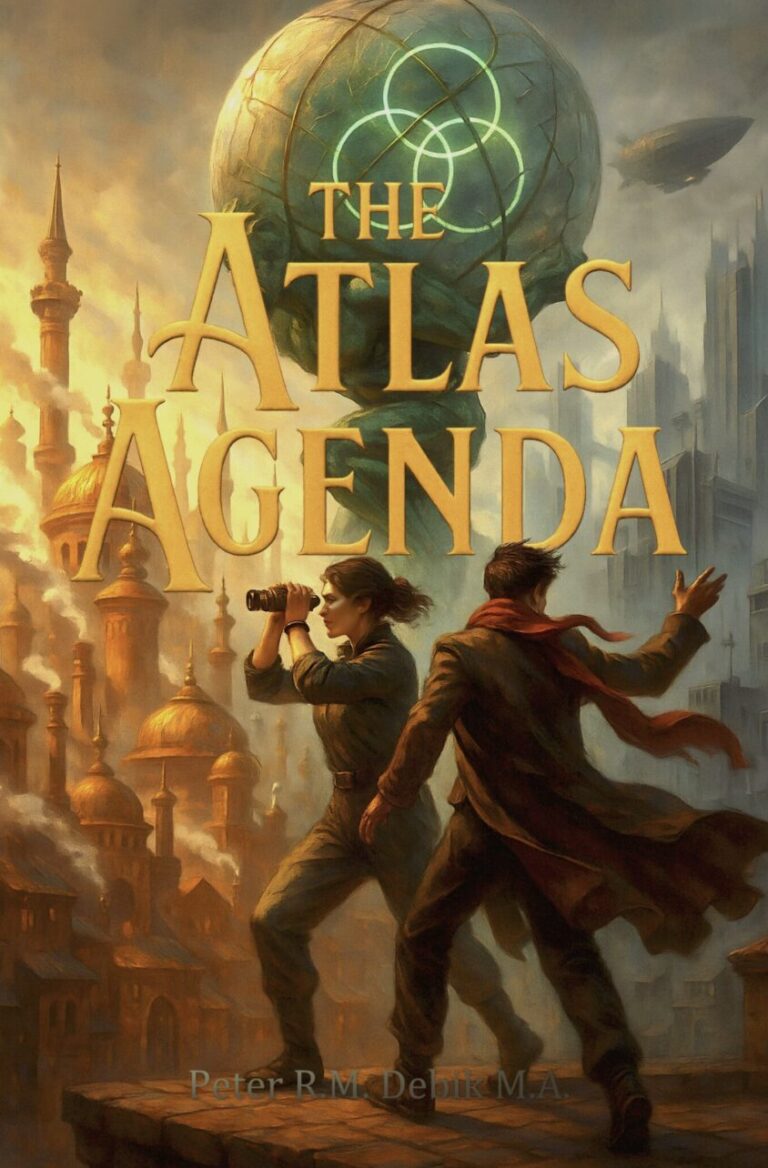
 The Atlas Agenda: Received a 4+ star review, making it an IndieReader Approved title.

Following find an interview with author Peter Debik.
1. What is the name of the book and when was it published? “The Atlas Agenda”, published April 23, 2025.
2. What’s the book’s first line? “What happens when the last person forgets?”
3. What’s the book about? Give us the “pitch”. The Atlas Agenda hurls you headfirst into a ruthless steampunk dystopia on the brink of collapse. It’s a stark exploration of memory, truth, and the bureaucratic forces that erase them. Set in a world unsettlingly close to our own, it follows a lone dissenter in an authoritarian regime where comfort has replaced freedom, and convenience has buried complexity. Determined to expose the lie sustaining this false peace, the protagonist faces a harrowing question: Is it worth breaking collective comfort to reclaim the truth, even if doing so risks shattering the manufactured happiness of others?
4. What inspired you to write the book? A particular person? An event? Even before taking office, Donald Trump and the proponents of Project 2025 made clear their intention to reshape the United States into an authoritarian, fascist, and racist state—dismantling the separation of powers in the process. Similar tendencies can be observed in Germany with the rise of the AfD (Alternative for Germany) party. But such plans only gain traction because large segments of the population are willing to embrace authoritarianism out of apathy or convenience, choosing to ignore both historical precedent and present-day realities. Many not only accepted Project 2025 as beneficial, but also failed to examine its implications—uncritically repeating Republican slogans and subscribing to conspiracy theories instead of engaging with verified facts and evidence-based discourse.
This raises a troubling question: which is more dangerous—the seizure of power by an elite driven solely by self-interest, or the willful ignorance of a population so complacent and misinformed that it falls for false promises of a utopian future?
In Germany, right-wing nationalists also exhibit a deep reluctance to confront the horrors of the Nazi past. Rather than engaging in critical reflection, they seek to erase history and once again stir up hatred against foreigners. The German AfD finds ideological support from right-wing nationalists abroad, including influential figures in the United States like Elon Musk.
“Nipping it in the bud” was reason enough for me to weave a warning for the 21st century into a compelling narrative. The parallels will be clear to readers who are attentive and open to recognizing uncomfortable truths. For others, it may remain just an engaging story. Until, perhaps, they come to understand its deeper message in hindsight, when they are confronted with the consequences of their own complacency.
5. What’s the main reason someone should really read this book? I want to offer my readers not only the best possible entertainment but also meaningful food for thought. After all, when you choose to spend your time with a story, it should give something back. The Atlas Agenda delivers suspense and intrigue. But above all, it carries a powerful political warning. One reader even described it as “Orwell for the 21st century.”
6. What’s the most distinctive thing about the main character? Who-real or fictional-would you say the character reminds you of? What makes the main character, Al-Khafi, so compelling is the almost godlike, deterministic way in which he pursues his mission to undermine the Atlas Agenda. He is unstoppable, utterly resolute in his purpose. Though he engages in deep, philosophical debates with the second protagonist, Lira, carefully weighing the consequences of his actions, he ultimately never wavers. In a sense, he fulfills his goal.
Even in the epilogue, Al-Khafi resonates with the mythic aura of a titan from Greek mythology, Atlas maybe, driven by an unshakable desire to liberate the world, a mission that seems to have begun long before the story opens and one that continues beyond its final page. Whether Al-Khafi represents God, a god, or a titan remains ambiguous. His name, “Al-Khafi”, one of the 99 names of Allah in Islam, was chosen deliberately. Perhaps he is even a messianic figure, a son of God incarnate, ceaselessly battling for good.
Despite this sense of fate and determinism, the story itself is shaped by chance, marked by unexpected twists, unpredictable developments, and moments of genuine surprise, ensuring it remains thrilling and dynamic throughout. Al-Khafi’s true nature is left open to interpretation, inviting the reader to wrestle with deeper questions of identity, faith, and purpose.