
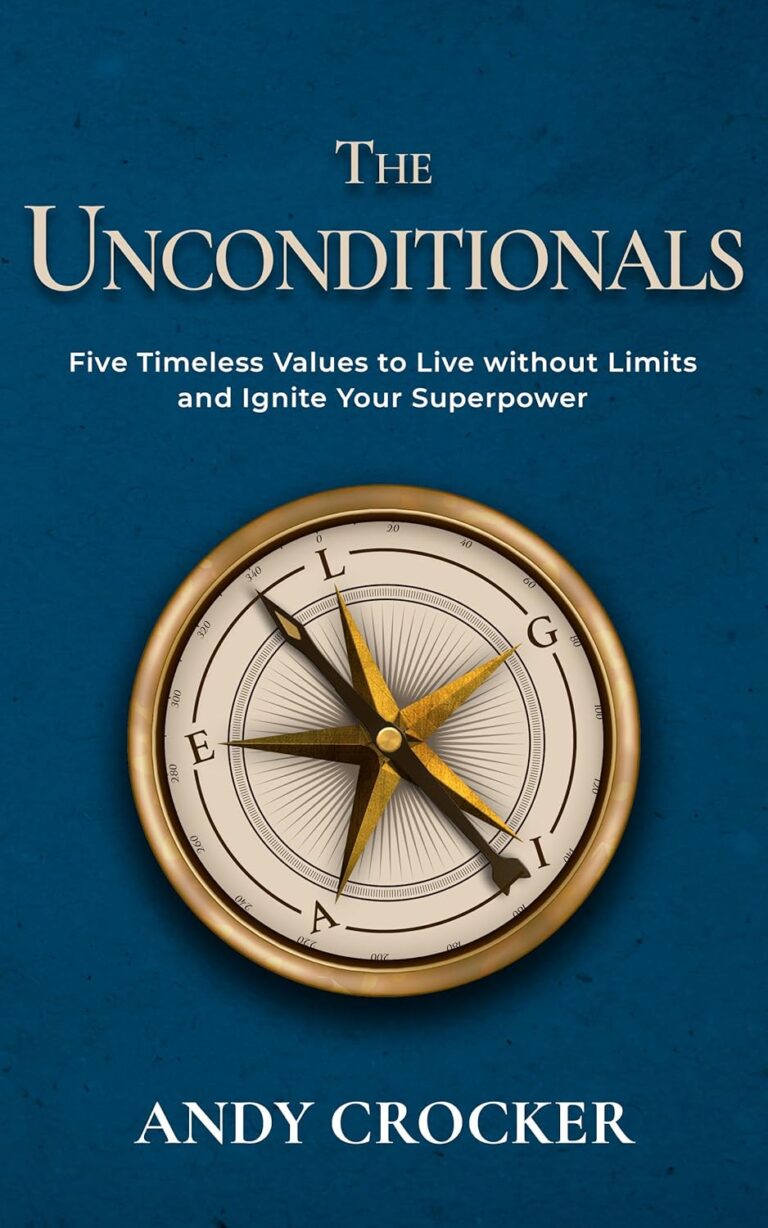
 The Unconditionals: Five Timeless Values to Live Without Limits and Ignite Your Superpower received a 4+ star review, making it an IndieReader Approved title.
Following find an interview with author Andy Crocker.
What is the name of the book and when was it published?
The book is The Unconditionals: Five Timeless Values to Live Without Limits and Ignite Your Superpower, and it was published on May 20, 2025.
What’s the book’s first line?
“I was beaten down by both Elon Musk and Jeff Bezos… and survived.”
What’s the book about? Give us the “pitch.”
The Unconditionals shows how five core values can help you live a more fulfilled and successful life—no matter what’s happening around you.
What inspired you to write the book? A particular person? An event?
Yes—two, actually. Professionally, I had just led a remarkable team in NASA’s Human Landing System competition—against SpaceX and Blue Origin. When we lost, it felt like a once-in-a-lifetime opportunity had slipped through my fingers. Personally, I realized my kids were growing up fast. I hadn’t yet written down the values I wanted to pass on. The result was this book: a blend of reflection and a belief in the power of values in every situation.
What’s the main reason someone should really read this book?
Too many of us live conditionally—we behave based on circumstances, which keeps us from becoming the best we can be. This book teaches how to live unconditionally—to love others and ourselves, be thankful, do what’s right, and grow regardless of what’s happening to us or around us. If you’re aiming for the type of success the world tells us we need—money, popularity, or promotions—this book explains what real success is and how to strive for it.
When did you first decide to become an author?
I’ve written, on and off, throughout my life, and I’ve long thought about publishing books. I actually self-published a children’s book about three years ago, mainly to raise money for a local charity. I didn’t put much marketing effort into it. But I enjoyed the process. This book was quite different, a much more involved process, but I enjoyed it at least as much.
What do you do for work when you’re not writing?
I’m an aerospace executive with over 30 years of experience. I’ve led high-performance teams on complex projects in hypersonics, missile defense, and robotic and human space exploration, including NASA’s Human Landing System program. I was inducted as an Associate Fellow of the American Institute of Aeronautics and Astronautics.
What’s the best and the hardest part of being an indie?
The best part is the freedom to write (and publish) exactly what I want. I can control the message, the look, and how it’s presented to the world. The hardest part is everything else: building a platform, marketing the book, getting it into the hands of readers.
Would you go traditional if a publisher came calling? If so, why?
Yes—if the publisher shared my vision and values. This book isn’t just a product; it’s a mission. If a partnership could help amplify that mission without compromising the message, I’d absolutely consider it.
Is there something in particular that motivates you? (Fame? Fortune?)
What drives me is impact. I wrote this book to make a difference—not headlines. If someone reads The Unconditionals and then strives to live more unconditionally, that’s what matters.
Which writer, living or dead, do you most admire?
I hesitate to pick just one I most admire because I admire so many. I’ll cheat and pick three:
- Abraham Lincoln. He spoke more powerfully and with fewer words than any American leader. His writing wasn’t just eloquent; it was principled, precise, and morally grounded.
- Teddy Roosevelt. He lived fully—intellectually, physically, and morally—and wrote with urgency and integrity. He had a rare combination of action and articulation.
- Winston Churchill. He was a writer of extraordinary range and beauty. His command of the language enabled him to lead in the darkest of times to rouse nations and stir souls.
Which book do you wish you could have written?
The 7 Habits of Highly Effective People by Stephen R. Covey. It’s a rare book that’s both actionable and timeless. Covey didn’t just offer habits—he offered a new lens for how to live and lead with character.