
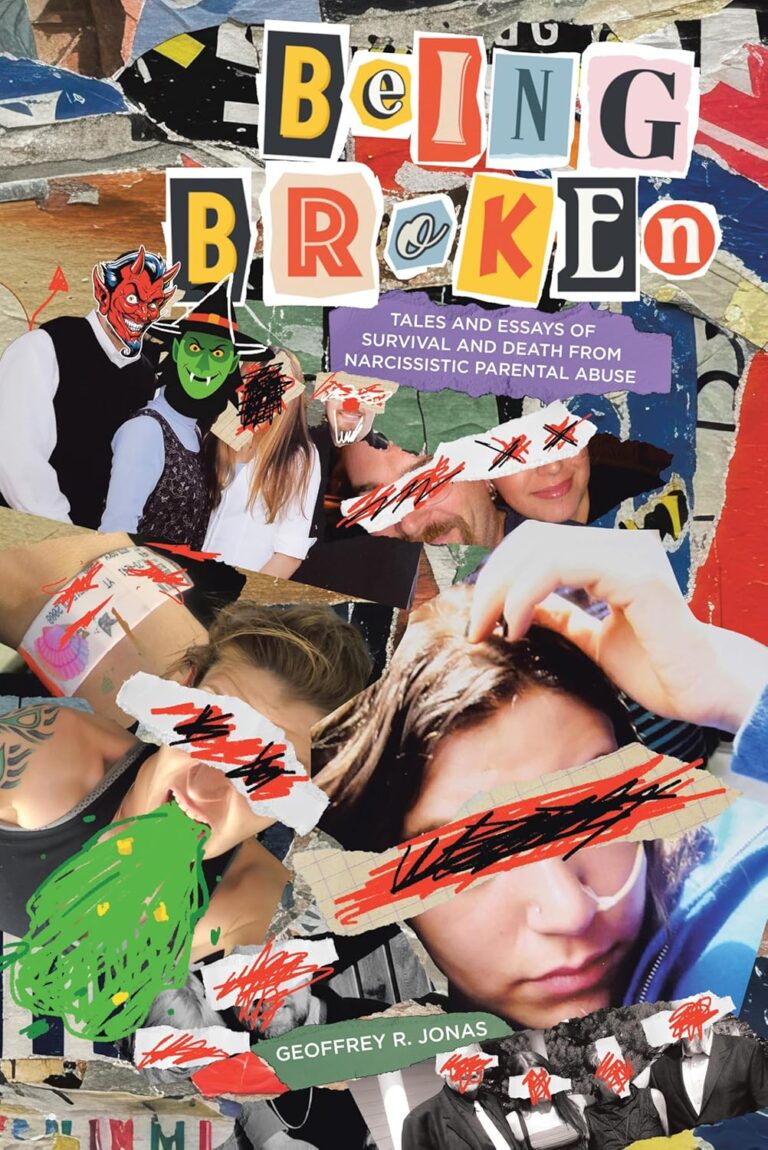
 Being Broken: Tales and Essays of Survival and Death from Narcissistic Parental Abuse received a 4+ star review, making it an IndieReader Approved title.
Following find an interview with author Geoffrey R. Jonas.
What is the name of the book and when was it published?
The book is called Being Broken: Tales and Essays of Survival and Death from Narcissistic Parental Abuse.
The title has a double meaning. First, to represent the process of how one becomes broken through abuse and trauma. Second, to describe living with Complex Post Traumatic Stress Disorder (CPTSD), as it feels to me. There’s a process to being broken by our parents, and there’s living with the consequences of the feeling of being broken.
What’s the book’s first line?
My sister died on January 6th, 2022, of fentanyl poisoning.
What’s the book about? Give us the “pitch”.
A young woman dies alone in a hotel room, her fentanyl-poisoned cocaine still on the desk. She had been missing for nearly 2 weeks and in the care of social services. They had been trying to find a place for her to live with her 3-year-old son who she had left with her parents. Six months later, her father fights for his life in Intensive Care for 4 weeks, but succumbs to his illness because of a lifelong excessive use of alcohol and tobacco. A month after his death, her mother is assessed by doctors to be unable to care for herself because of her Alzheimer’s and mental health issues brought on by benzodiazepine and alcohol addiction.
The son, the brother, the stepson, is the only one left to pick up the pieces of a family left in ruins. In an attempt to understand what happened to his family, the son begins a journey of the self and finds out the truth of his family. After going over letters, notes, emails, videos, and text messages, he uncovers a disturbing picture of the abuse his sister suffered at the hands of their parents. He also begins to better understand his own struggles with mental health and substance addiction because of the trauma and abuse he also suffered from their parents. Children in abusive families do not know they are being abused, until they do, and for some it is too late.
Follow the son as he looks back and through his family history to discover the generational abuse that trickled down through the years to land on him and his sister. Learn about how parents who suffer from Narcissistic Personality Disorder emotionally abuse and manipulate their children and how that affects them. See how the abuse and trauma becomes mental illness in those abused and how they fall into vicious traps of addiction, eating disorders, self-harm, and Complex Post Traumatic Stress Disorder. Witness the transformational change of the son as he works on his recovery of his lost inner child and tries to become the man he was meant to be.
What inspired you to write the book? A particular person? An event?
Simply put, the death of my sister. After her death, I began to research how such a thing could happen. I had already been studying Substance Use Disorder (SUD) and trauma for many years; however, this was the first time I started looking directly into my family. The writing began as essays, discussing the abuse and trauma and how it relates to SUD. Once I started connecting the dots between trauma and SUD, I wanted to incorporate real-life examples of our experiences to better communicate that relation.
What’s the main reason someone should really read this book?
I think people who are interested in learning more about NPD, narcissistic parental abuse, and trauma and SUD would be interested in this book. People who feel that there are improvements that can be made in recovery treatment programs for SUD and CPTSD will find key, and alternative, options in this book.
I also believe that the information in my book is helpful in recognizing NPD abuse, the symptoms of CPTSD, and the science of addiction to allow people to protect themselves from the harms of these types of abuse and the resulting disorders that may result.
I wrote this book for people suffering from similar types of abuse, as well as SUD. Many people in abusive relationships, especially caregiver relationships, are not even aware that they are experiencing abuse. I wanted to portray that they are not alone with what they are going through and that there is hope for recovery.
As for SUD, challenging the status quo views on addiction may allow people to see that there are alternative treatment options out there and that it is not something that you have to live with forever. SUD can be overcome and we can live a life free of the cycle of substance use.
When did you first decide to become an author?
As mentioned above, it really started with the essays. As a man of science and evidence, I needed to understand what happened. I had been writing essays and posting them on my LinkedIn page about my journey with SUD and it evolved into understanding trauma and child abuse.
Writing this was difficult, though. Writing about your own trauma, and that of my sister, could be very overwhelming. I would tackle a difficult topic, which may only be a couple of paragraphs, and I would have to stop for the rest of the day, or a couple, before I could get back to the keyboard.
Is this the first book you’ve written?
Yes, it is. However, I feel it is only the beginning of my writing journey. I’ve caught the ‘bug’ and am encouraged that I can write successfully.
What do you do for work when you’re not writing?
I was CEO for a couple of successful companies, as well as a ‘Safe Cannabis Use Consultant’ with over 30 certifications for cannabis use, from growing it to neurological effects. However, after my family started dying, I have lost the drive to sit in an office all day. I’m now mostly retired, but still do consultations when requested. I now enjoy gardening, painting, woodworking, and taking care of my family and home.
How much time do you generally spend on your writing?
That depends on how motivated I am. Sometimes it is all day, sometimes it is days or weeks in between sessions. This book was hard to write, so sometimes I had to take time to recover after writing about very difficult events in my life. Also, summer is pretty short where I live in northern Canada, so writing is more of a winter activity since I want to take advantage of the summer months.
What’s the best and the hardest part of being an indie?
The best: having full control over the manuscript and being able to decide where it would be distributed. Also, just getting it published quickly. Querying and trying to find an agent was tedious and time consuming.
The hardest: the cost. I have had to spend a lot of money on publishing, marketing, reviews, and award submissions.
What’s a great piece of advice that you can share with fellow indie authors?
Follow your heart and say what you want to say. We are often too concerned with how others will receive what we are trying to convey. We can’t please everyone. There will always be people who don’t like what we have to say. Don’t mind them. Know and trust yourself.
Also, just write. Put your head down and do it. If you’re struggling, take a break. It’s not going anywhere, and it is not a sprint, but a marathon. Keep at it.
Would you go traditional if a publisher came calling? If so, why?
That would depend on what they were offering. I think the most eye-opening surprise when I first looked into being published was how much work a publisher was expecting me to do with marketing and supporting the book. The onus is now on authors to market our own work. Some expected large, established social media platforms and commitments to doing most of the marketing work. This pushed me to self-publish. If I had to do all that work myself anyway, I wanted the control of it.
However, it is a personal belief that the publisher should be the one that is required to push the book and market it. Why should I be giving a sizeable chunk of my profit to a publisher if they will not put in the work to get it out to the public?
Is there something in particular that motivates you (fame? fortune?)
For this book, my motivation was to share my sister’s story and show others experiencing the same things that they are not alone. This was never about fame and fortune. I didn’t even expect to sell as many books as I have (and that is not many so far), nor get the positive reviews that I have gotten.
I also wanted to explore my belief that we need to change the collective mind of how we approach SUD. We need to look at SUD as not a cause, not a disease, but as a symptom, a behavioural disorder that can be unlearned. A vast majority of people with SUD have suffered some kind of trauma in their lives and they are using street drugs as a form of medication to manage their untreated mental illness. Addiction is not about ‘partying’ or ‘having fun’, it is about trying not to feel bad, to feel normal. However, left untreated, or mistreated like my sister, the addiction spirals out of control and the result of my sister’s case was her death.
We have to change the public view of people with addiction to not see them as criminals and degenerates, but individuals that are suffering from horrific traumas and need our help, not condemnation.
Which writer, living or dead, do you most admire?
I would have to say Stephen King. He was originally cast as a pulp, campy horror writer and has instead has become one of the most prolific and greatest writers in history.
Which book do you wish you could have written?
The Darkness That Comes Before and any of the other books in the Prince of Nothing series by R. Scott Bakker. His writing is incredible. The character debates on religion, government, society, magic, and more, absolutely blew me away. Just an amazing series of books.