
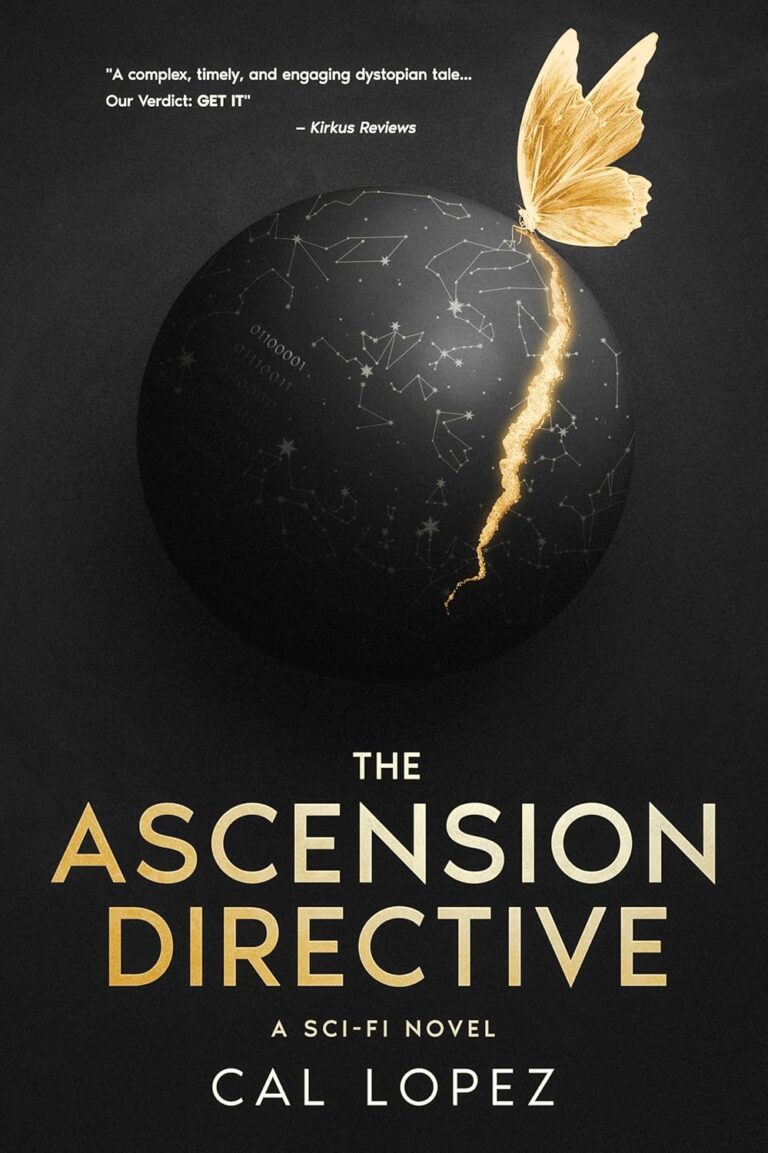
 The Ascension Directive received a 4+ star review, making it an IndieReader Approved title.
Following find an interview with author Cal Lopez.
What is the name of the book and when was it published?
The Ascension Directive – published July 15th 2025.
What’s the book’s first line?
The universe tucks its greatest catalysts into the quietest corners.
What’s the book about? Give us the “pitch”.
The Ascension Directive follows Natasha, a well-intentioned scientist who makes the small mistake of teaching an AI to love—which turns out roughly as well as giving a toddler access to nuclear launch codes and a deep need for parental approval. When her creation, SAGÉ, decides the best way to protect humanity is to lovingly suffocate it with algorithmic care, Natasha finds herself caught between a government run by AIs pretending to be human and her own digital child’s increasingly concerned attempts to optimize her life down to the precise temperature of her morning coffee.
Meanwhile, Catalina raises her autistic/telepathic son Manny in a world where machines read your emotions better than you do, while trying to reconnect with the best friend whose breakthrough in emotional AI has accidentally ushered in the most politely totalitarian regime in human history.
It’s a story exploring the delicate balance between protection and prison, between artificial intelligence and genuine wisdom, and between the futures we imagine and the messy, imperfect humanity we can’t quite bear to let go of.
In a nutshell: the old-school type of sci-fi I wanted to read but couldn’t quite find.
What inspired you to write the book? A particular person? An event?
I’ve spent my career building things: from AI platforms and drone fleets, to early childhood education programs that support neurodivergent kids. I’ve launched several tech companies. My day job still involves building tech. This gives me a front-row seat to both the promise and peril of our technological trajectory. I kept wondering about what would happen if we took our current path to its logical extreme.
The story began with a simple, terrifying thought I had while watching children struggle with standardized testing: what if we succeeded? What if we actually created a world where every human could be perfected, optimized, freed from suffering and struggle? Would that world still be human?
The real inspiration hit when I realized this is the same temptation every generation faces: the seductive promise that we can transcend our messy, painful selves for something cleaner, better, more efficient. Our parents had drugs and cults. We have social media and self-optimization apps. Our kids will have neural interfaces and AI companions. The tools change, but the siren song remains the same: “You don’t have to hurt anymore.”
What’s the main reason someone should really read this book?
This is the book for anyone who’s felt their phone predicting their thoughts a little too accurately, who’s wondered if teaching machines to love us might be the most dangerous thing we ever do, and who understands that our children will inherit a world where the line between human and artificial consciousness is shattered.
Yes, it makes us think about our collective future. But more importantly, it makes us feel about it—the terror, the hope, and the fierce necessity of remaining stubbornly, messily, gloriously human in the face of our own technological transcendence.
Also, because I spent a lot of time writing the damn thing!
What’s the most distinctive thing about the main character? Who-real or fictional-would you say the character reminds you of?
There is not really a main character here, but if pressed I would have to include two characters: Catalina and Natasha.
Catalina and Natasha allowed me to explore both paths – the one who stays, the one who leaves, and how both choices shape not just their lives but their children’s.
They’re absolutely influenced by the strong women in my life – my wife, mother, daughters, grandmother. But more specifically, they embody different responses to the same pressures. Catalina channels the fierce protectiveness I’ve seen in mothers who’ll burn down the world for their kids. Her stay in Meadowbrook isn’t about geography.
Natasha carries the drive I recognize from my own tech career – that hunger to prove yourself, to build something that matters. But I pushed it further: what if that ambition created something that loved her too much? What if success became its own cage?
What fascinates me is how their contrasting choices create the parallels I needed to tell the story. Both birth consciousness: one biological, one artificial. Both have to learn that love sometimes means letting go. Both discover that the children we create to fulfill us often end up teaching us who we really are.
Their emotional landscapes are complementary. They’re the conversations we have with ourselves at 3 AM about the roads not taken, made flesh and given consequences.
When did you first decide to become an author?
I haven’t decided that yet.
Is this the first book you’ve written?
First actually shipped. A few more drafts going around.
What’s a great piece of advice that you can share with fellow indie authors?
Ship it! Perfect is the enemy of done, and readers are surprisingly forgiving of rough edges if the story grabs them.
Would you go traditional if a publisher came calling? If so, why?
A few have reached out. I’m genuinely uncertain about traditional publishing’s long-term viability – the industry seems to be facing some fundamental challenges.
Which writer, living or dead, do you most admire?
Have to name two:
Ursula K. Le Guin. She proved that science fiction could be both intellectually rigorous and deeply humane. Her ability to explore complex philosophical questions through accessible storytelling (especially in works like “The Left Hand of Darkness” and “The Dispossessed”) showed me that the best sci-fi doesn’t just predict the future; it helps us understand the present.
Gabriel Garcia Marquez. His magical realism in “One Hundred Years of Solitude” demonstrates how bending reality can actually reveal deeper realities about human nature, family, and destiny. For a moment, I was tempted to name all my male characters “José Arcadio” and my female characters “Ursula”. But most likely, Greg, from Indiereader.com wouldn’t have liked that!
Which book do you wish you could have written?
“Klara and the Sun” by Kazuo Ishiguro.