
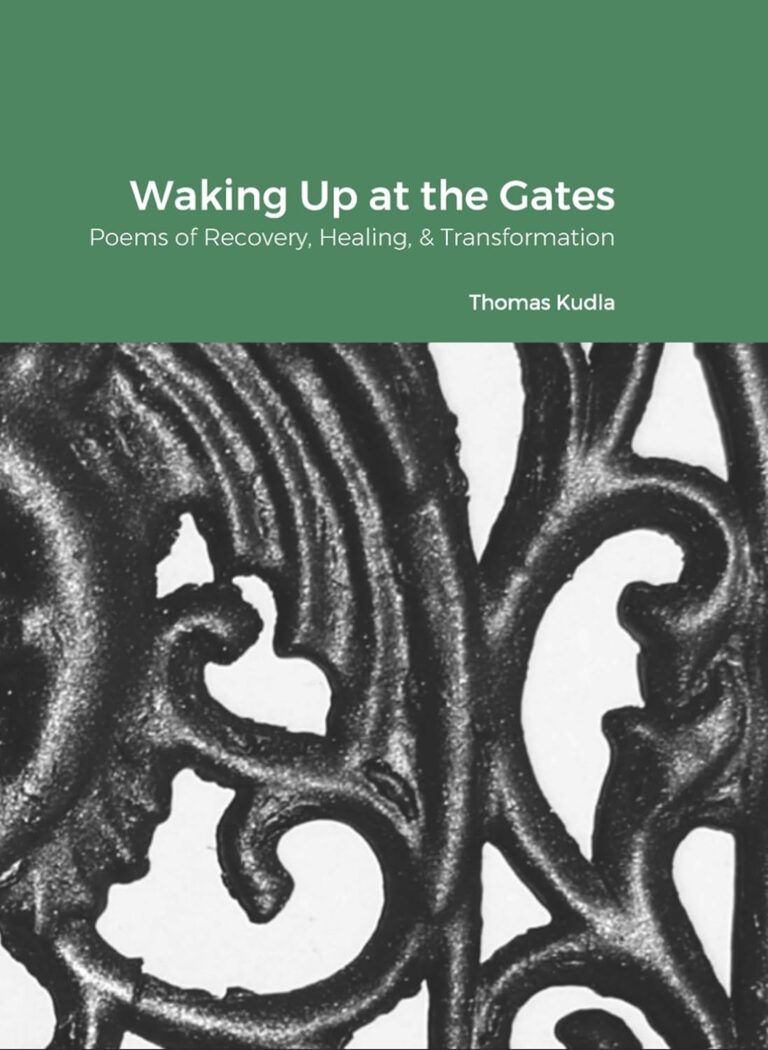
Waking Up at the Gates: Poems of Recovery, Healing, & Transformation was the winner in the Poetry (Fiction) category in the 2025 IndieReader Discovery Awards, where undiscovered talent meets people with the power to make a difference.
Following find an interview with author Thom Kudla.
What is the name of the book and when was it published?
Waking Up at the Gates: Poems of Recovery, Healing, & Transformation, 2024
What’s the book’s first line?
“NewLEAF: Live Each Attempt Fiercely.”
What’s the book about? Give us the “pitch”.
Waking Up at the Gates is an epiphanic poetic journey from the deathly daily grind of the working world to the imaginative mindscapes of creative rebirth. This book guided me through a fatally difficult time in my life; I hope it can do the same for those who read it.
What inspired you to write the book? A particular person? An event?
The impetus for writing Waking Up at the Gates was the fear that soon developed in the back of my mind after facing my own mortality that I could die at any moment and would probably have no legacy. Yet there was so much that I learned and could share with the world—it seemed selfish to keep the writings from my life locked away in a desk somewhere. As a result, 2024 ended up being my most productive year of book publishing yet as the completion of all the writing projects I started and never finished became my primary goal. More than a dozen books later, I feel more complete and satisfied as a human being, and I’m happy to know that people can read what I’ve written all these years if they ever feel so inclined.
What’s the most distinctive thing about the main character? Who-real or fictional-would you say the character reminds you of?
I always envisioned Waking Up at the Gates as the tale of a poet grappling with the desire to continue writing or an artist deciding to persist in creating. But it is meant as something much more existential, as if the poet were at the Pearly Gates and was told to prove why he should go back to earth to keep on living instead of dying only to be forgotten. After much soul-searching, he realizes that the only reason he could think to return to the land of the living would be to share his writing, and the wisdom contained therein, with the world. At least, that’s what the speaker’s words mean to me in this book.
What’s the main reason someone should really read this book?
For those who have ever felt discouraged, Waking Up at the Gates will give you the hope and inspiration you need to move forward in your life.
If they made your book into a movie, who would you like to see play the main character(s)?
Interesting question for a book of poetry… I like it. The poet facing an existential crisis in Waking Up at the Gates would be played by Michael Fassbender. There is a subtle, quiet, and sophisticated intensity to his acting that would lend itself well to the gravitas of these introspective moments.
When did you first decide to become an author?
When I was 12, instead of vacationing during the summer or having fun in the sun playing outside with my friends, I was busy writing my first novel. Writing has always been my passion.
Is this the first book that you’ve written?
No.
What do you do for work when you’re not writing?
After years of copywriting, proofreading, and marketing work, I have taken on a role in sales support that enables me to exercise the organizational side of my brain without sacrificing too much of my creative energies. I am very fortunate that I found a career that grants me the financial freedom and social flexibility to pursue my writing passion more adamantly in my spare time.
How much time do you generally spend on your writing?
It depends on the project. Waking Up at the Gates took me two years to write, including eight months of revision. My longest project to date took me four years to write and publish. And yet some books seem to materialize much faster, as if I’m on autopilot and the muse has taken control. Those books are special in their own way and can take me as little time as a spring and summer season to write and publish.
What’s the best and the hardest part of being an indie?
The best part? Writing for the love of the craft without feeling like you need to perform—and perform well—for your audience and the publisher. Waking Up at the Gates is a testament to this. The hardest part? No one takes you seriously! They don’t realize that it was a conscious choice on my part to self-publish originally. Originally, I never even sent my manuscripts to a publisher or agent.
Would you go traditional if a publisher came calling? If so, why?
Perhaps. But I remember a creative writing director once told his class of budding writers to pray we never get a book deal because “the moment you sign that contract, it becomes a job instead of a passion.” I think this fear instilled in me as an undergraduate has persisted even to this day, inhibiting my interest in mainstream publishing. And yet… I’d be lying if I said I don’t want to see my words making a difference in more people’s lives. Plus, I don’t entirely dislike receiving royalty checks.
Is there something in particular that motivates you (fame? fortune?)
I am motivated by understanding myself and the world. Most importantly, I am driven by an undying desire to find meaning in what more often than not seems like what Camus would call “the benign indifference of the universe.”
Which writer, living or dead, do you most admire?
This has not changed: Hafiz. He was so wise.
Which book do you wish you could have written?
Usually I say Infinite Jest by David Foster Wallace because I’m always impressed when writers extend beyond the traditional boundaries of their chosen form. But these days, I think I would have wanted to write Dog Songs by Mary Oliver. To be able to do what you love—to write—and to have the topic of that writing be something you love equally as much as the sacred act of writing itself—that, to me, seems sublime.