
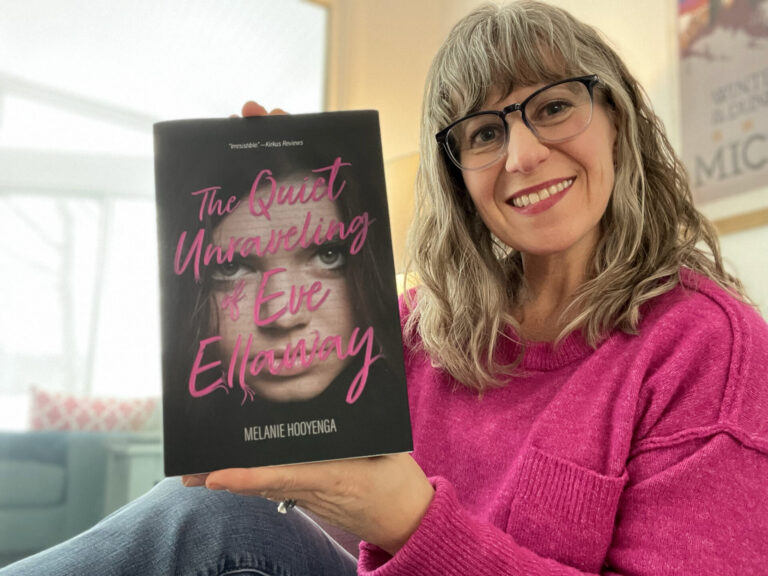
The Quiet Unraveling of Eve Ellaway was the winner in the Young Adult (Fiction) category in the 2025 IndieReader Discovery Awards, where undiscovered talent meets people with the power to make a difference.
Following find an interview with author Melanie Hooyenga.
“Thank you so much for this incredible award! Eve’s story came to me several years before I wrote it, and I waited a few more years before publishing, so receiving this recognition means a lot to me. As an indie author, my biggest challenge isn’t coming up with ideas or writing my books — it’s reaching readers — and I’m excited to see how this award helps me do just that. Thank you.”
What is the name of the book and when was it published?
The Quiet Unraveling of Eve Ellaway, February 25, 2025
What’s the book’s first line?
To wish away everything you know—everyone you know—for a chance at something better is a dangerous daydream.
What’s the book about? Give us the “pitch”.
Short pitch:
All Eve Ellaway wants is to escape to college, start a life of her own, and finally sever the connection to her twin sister Gen who disappeared when they were babies. Because while the rest of the world moved on from the kidnapping, Gen’s still very much alive at home. Every night, Eve pretends to be Gen to protect her mother’s delicate grasp on reality — dividing her life, her stories, and her dreams so there’s enough for two sisters — but is she sacrificing the last threads of her identity and any hope for a normal future? As the lies propping up Eve’s life start to crumble, she no longer knows what she wants. But Gen does, and she’s ready to take it.
Long pitch:
All Eve Ellaway wants is to escape to college, start a life of her own, and finally sever the connection to her twin sister Gen who disappeared when they were babies. Because while the rest of the world moved on from the kidnapping, Gen’s still very much alive at home.
Most families would grieve their missing child. Some families might create a shrine for their lost daughter. But the Ellaways are not most families.
Every night, Eve pretends to be Gen to protect her mother’s delicate grasp on reality — dividing her life, her stories, and her dreams so there’s enough for two sisters. Eve’s forced to maintain her father’s lie to ease his guilt over Gen’s disappearance, but is she sacrificing the last threads of her identity and any hope for a normal future?
As the lies propping up Eve’s life start to crumble, she no longer knows what she wants. But Gen does, and she’s ready to take it.
What inspired you to write the book? A particular person? An event?
The idea for this book is one of the few I’ve had as a result of intentional brainstorming. I had just finished reading a book about twins and was drawn to writing a story about twins, but, I argued with myself, I don’t have a twin. No problem, I’d make one of the twins disappear.
I’m passionate about mental health — destigmatizing it, making sure people get the help they need, and openly talking about my own struggles — and it plays a major role in the story. This was the first time I wrote a character who is a writer, and I was able to share some of my teenage dreams through her. I also wanted to write a book with an unreliable narrator, and had a lot of fun creating a character who keeps the reader guessing.
What’s the most distinctive thing about the main character? Who-real or fictional-would you say the character reminds you of?
The most distinctive thing about Eve is that she not only pretends to be her sister Gen, she talks to Gen like you’d expect twin sisters to talk: they bicker, they conspire against their parents, and they rely on each other more than anyone else. In the Ellaway household, Gen never disappeared, and Eve’s become a master at dividing the events of her life to share with her mom during their “special time.”
As for a real or fictional person she reminds me of, I really don’t know. All my characters have elements of me in them, but Eve is the first character I’ve made a writer, and it was fun to share inside glimpses at how our minds work.
What’s the main reason someone should really read this book?
Anyone looking for a unique twist on the missing sibling trope with more than one gasp-inducing twist should read Eve’s story. I set out to write an unreliable narrator, and as much as readers want to scream at her to make better choices, they can’t help but keep reading to see what happens next.
When did you first decide to become an author?
I’ve been a writer since I could form sentences. I spent junior high and high school writing poems, songs, and short stories for my friends, but stopped writing fiction when I went to college. During my twenties I got as far as outlining an idea, but didn’t actually sit down and write a book until I was living in Mexico in my thirties. I didn’t have a work visa so used my time studying the publishing industry and writing my first manuscript, and that’s when I met many of my closest writing friends. While I didn’t publish my first book until I returned to the US, that time is when I first considered myself an author.
Is this the first book that you’ve written?
The Quiet Unraveling of Eve Ellaway is my tenth published novel, but the first psychological suspense that I’ve written. I have three trilogies — YA contemporary time travel , YA sports romance, and YA adventure romance — as well as three unpublished novels and at least a dozen more story ideas.
What do you do for work when you’re not writing?
For the past ten years, I’ve worked in marketing at nonprofit organizations. I spent six years as the Director of Marketing & Communications at the community foundation in my town, and I’ve worked remotely as a Brand Content Manager, which shifted to Social Media & Web Strategy Manager, at Penn State World Campus for almost four years. I’ve also volunteered for a number of nonprofits in my community, most recently for our Pride organization, where I designed the t-shirts for our festival!
How much time do you generally spend on your writing?
Not nearly enough! I dedicate an hour each morning to writing and try to be vigilant about not letting other to-dos creep into that time. Other marketing responsibilities happen during the evening 3-4 nights per week.
What’s the best and the hardest part of being an indie?
The best part of being an indie author is having complete control over my book. I can change my book price on a whim, I know where my sales stand on any given day, and I have the freedom to write what I want and still be able to publish.
But that freedom and flexibility doesn’t guarantee sales. Getting into bookstores is difficult, and while there are more avenues to distribution than there used to be, word of mouth is still the best way to sell books.
I often tell people that if you’ve ever heard of me or my books, it’s because of something I did myself. I don’t have a team of people handling things for me. My background is in graphic design and I currently work in marketing, so I design my own covers, format my books, handle my marketing, post to social, and schedule events! I do outsource editing because I firmly believe every book improves with an impartial set of eyes.
If all of that sounds exhausting, that’s because it is! And it doesn’t include actually writing. I have a day job, lots of hobbies (including triathlons and mountain biking), and I volunteer in my community, so I have to budget my time very carefully.
Would you go traditional if a publisher came calling? If so, why?
I signed with an agent in the fall of 2024, so yes, I would publish traditionally if a publisher made an offer. My dream is to be hybrid — publishing both indie and traditional — and I hope my next book makes that dream a reality.
Is there something in particular that motivates you (fame? fortune?)
I love hearing from readers. A lot of authors avoid reviews and prefer not to know what readers say about their work, but since I was a child I’ve watched people’s faces when I tell a story because those reactions nourish me. These days, getting texts or messages from people while they’re reading keep me going!
As for a goal that motivates me, I would absolutely love to have one (or more) of my books made into a TV series or movie. The books in my sports romance series are written in a way that would translate really well to a ten-episode Netflix series, as would my time-traveling character Biz.